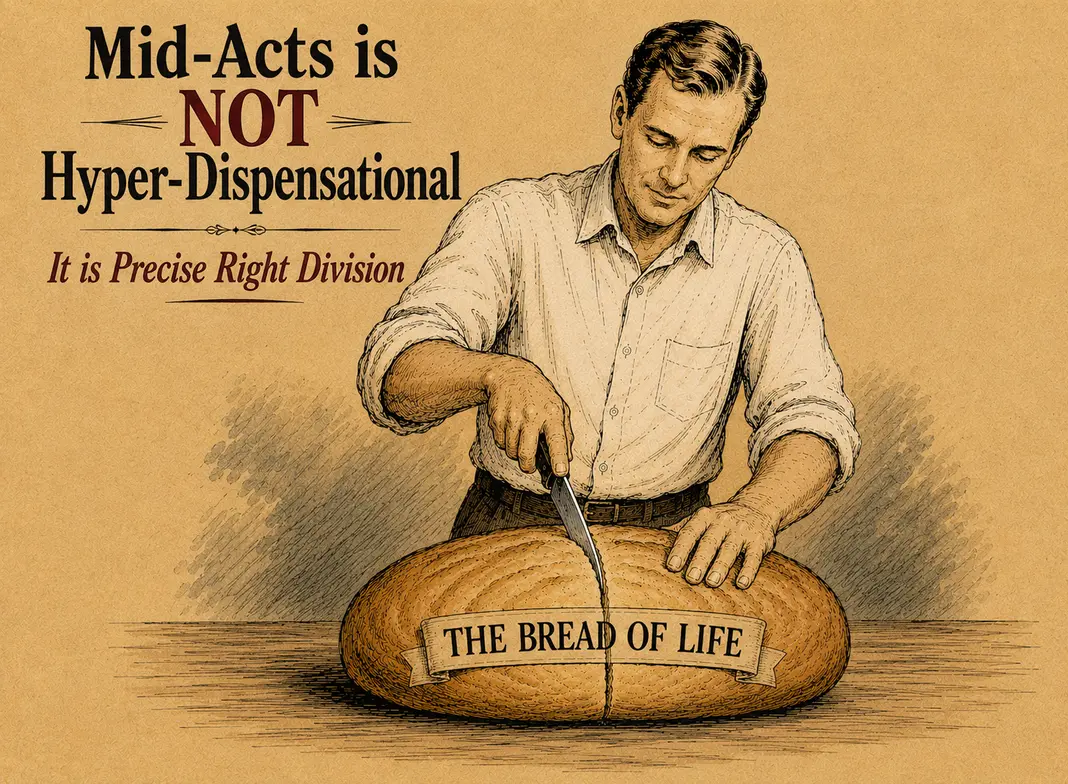
Peter S. Ruckman's booklet "Hyper-Dispensationalism" (Bible Baptist Bookstore, 1985) is a transcribed tape recording directed against what he calls "ultra-dispensationalism" — the position that rightly divides the apostle Paul's unique commission and the mystery of the Body of Christ from the earlier kingdom program given to Israel through the twelve apostles. His primary targets are Ethelbert Bullinger, J. C. O'Hare, Cornelius Stam, and others who took seriously the instruction of 2 Timothy 2:15: "Study to shew thyself approved unto God, a workman that needeth not to be ashamed, rightly dividing the word of truth."
What follows is a systematic response to the arguments Ruckman advances. The purpose is not to answer personal insults — Ruckman calls those who hold this position "bloodsuckers and leeches," "hypocrites," and worse — but to address his scriptural case directly and show that it does not hold up under examination. The reader is encouraged to open the KJV and check every reference.
The Name-Calling Is Not Argument
Before engaging the substance, one observation must be made. A significant portion of Ruckman's booklet consists not of biblical argument but of rhetorical attack. He compares Mid-Acts dispensationalists to Campbellites, Jehovah's Witnesses, and Seventh Day Adventists. He says they "never recover" once exposed to the teaching, that "a toad frog has more sense," and that their ministry is devoted purely to destroying Baptist churches.
None of this is argument. A position is not refuted by comparing it to heresy; it is refuted by Scripture. When a man spends more words on insults than on texts, the careful reader asks why. The answer, as we will see, is that Ruckman's actual scriptural case is considerably weaker than his confidence suggests.
The Source Considered
Before engaging Ruckman's arguments, it is worth knowing something about the man making them — not to dismiss him, but to calibrate the weight his confident pronouncements deserve.
Ruckman was a fierce and effective defender of the Authorized King James Bible. In an era when the modern-versions flood was washing away confidence in a settled, preserved text, Ruckman stood his ground with energy and conviction. Whatever his faults, that contribution was real, and those who value the KJV owe him acknowledgment on that point. A man can be right on an important issue and wrong on others, and Ruckman is a good example of exactly that.
The same combative certainty with which he defended the KJV he also brought to matters that Scripture does not plainly address — and here the pattern becomes instructive. In "Black Is Beautiful" (1995), Ruckman devotes substantial space to the claim that UFO occupants are literal alien beings, operating with government knowledge and cover-up, and concludes that anyone who disagrees is "mentally sick" (p. 340). The assertion is sweeping, the confidence absolute, and the evidence a combination of selected texts and conspiratorial inference. This is not an isolated specimen. In "The Book of Genesis" he argues that the forbidden fruit was literally a grape (p. 87) — a confident, specific claim for which Scripture provides no warrant. In "The Mark of the Beast" he declares that the Antichrist will stand ten feet tall, and presents this "without any guesswork" (p. 106). In "The Sure Word of Prophecy" he maintains that a purpose of the millennium is the population of other planets — stated, again, with a certainty that goes well beyond anything the text establishes.
Ruckman himself, in an unguarded moment, identified precisely this habit in others. He wrote that "all heretics like to state dogmatically what an obscure thing is... so people will stand in wide-eyed amazement" ("The Book of Matthew," pp. 542–543). The observation is shrewd. It is also self-implicating, describing with precision the method Ruckman employed across decades of teaching and writing.
We do not say dogmatically that every such claim is impossible. Scripture describes remarkable phenomena that are not fully explained, and humility before the text is appropriate. But there is a difference between acknowledging what Scripture leaves open and asserting as certainty what Scripture does not address. These are speculations dressed as confirmed revelation, delivered with the same authoritative register Ruckman uses when he declares the Acts 9 position a "heresy" comparable to the Jehovah's Witnesses. The man who freely goes beyond Scripture in one direction, presenting conjecture as settled doctrine, is not well-positioned to condemn those who do nothing more than take the apostle Paul's own words about his own gospel at face value.
This context does not answer Ruckman's arguments — the arguments must be answered on their merits, and they will be. But it is a necessary frame. When a teacher's confident assertions range from the genuinely insightful to the frankly fanciful, readers are right to weigh his pronouncements carefully rather than receive them as settled orthodoxy.
The Argument from Disagreement Proves Too Much
Ruckman's most repeated challenge is this: Mid-Acts teachers cannot agree on when the present dispensation began. Bullinger places it after Acts 28, O'Hare at Acts 18, Stam and Baker at Acts 9. Ruckman takes this disagreement as proof that the whole position is confused and unreliable.
This is what logicians call the argument from confusion — it does not engage the texts, it simply points to disagreement among advocates. But consider: by this same standard, the entire Baptist tradition stands condemned. Baptists disagree among themselves on a remarkable number of foundational issues. Some are Calvinist; others are Arminian. Some hold pre-tribulation rapture; others mid-trib or post-trib. Some are premillennial; others amillennial or postmillennial. Some practice close communion; others open. Some hold to elder rule; others to pure congregationalism. Some are cessationist regarding spiritual gifts; others are not. Some hold the church began at Pentecost; others at Matthew 16. There are Baptists who sprinkle — which would scandalize Ruckman, since the very name "Baptist" derives from the immersion debate he considers so vital.
Disagreement among advocates of a position does not disprove the position. It means that some advocates are more consistent than others. The Acts 9 position — that the Body of Christ as the mystery entity of Ephesians 2–3 began with Paul's calling as apostle to the Gentiles — is the most consistent answer, and it is the one Ruckman never directly refutes. He conflates it with positions he has already attacked (Acts 28) and then declares victory.
The "In Christ Before Me" Challenge — John 15 Answers It
Ruckman's most pointed exegetical challenge against the Acts 9 position is Romans 16:7: "Salute Andronicus and Junia, my kinsmen, and my fellowprisoners, who are of note among the apostles, who also were in Christ before me." If people were "in Christ" before Paul's conversion in Acts 9, Ruckman argues, then the Body of Christ predates Paul, and Acts 9 cannot be the starting point.
This argument only works if "in Christ" has one meaning throughout Scripture — membership in the mystery Body of Ephesians 2–3. But the Lord Jesus Christ himself shows otherwise, the night before the crucifixion, long before the mystery was revealed.
In John 15 the Lord described his relationship with his disciples in these words: "I am the vine, ye are the branches: He that abideth in me, and I in him, the same bringeth forth much fruit: for without me ye can do nothing" (John 15:5). Notice what this relationship looks like: branches in a vine, able to bear fruit, but also subject to being removed — "Every branch in me that beareth not fruit he taketh away" (v. 2), "If a man abide not in me, he is cast forth as a branch, and is withered" (v. 6). This is Israel's kingdom/prophetic relationship with their Messiah — a conditional, covenant standing addressed to Jewish disciples who were part of God's earthly programme for the nation.
This is emphatically not the relationship Paul describes for the Body of Christ. In Ephesians 5:30 Paul says believers are "members of his body, of his flesh, and of his bones" — not branches that may be cut off, but body members permanently joined. The Body believer is "sealed with that holy Spirit of promise" (Ephesians 1:13), "sealed unto the day of redemption" (Ephesians 4:30). You cannot cut off a limb from a body the way you can cut off a branch from a vine. The vine and the body describe two different relationships with Christ, rooted in two different programmes of God.
This distinction answers Romans 16:7 directly. Andronicus and Junia were "in Christ before" Paul — meaning they were in that prophetic, kingdom relationship with Israel's Messiah before the mystery Body was ever revealed. The prophets themselves spoke of Israel being justified in the LORD (Isaiah 45:25). To be in that in-Christ standing under Israel's programme is not the same as membership in the mystery — "which in other ages was not made known unto the sons of men, as it is now revealed unto his holy apostles and prophets by the Spirit" (Ephesians 3:5). What was not made known in other ages could not have been operative in other ages.
Ruckman dismisses the distinction between "in Christ" and "in Christ's Body" as "a very unique position." What is unique is his refusal to allow that the same Lord can stand in different relationships with different people under different administrations — something the whole of Scripture demonstrates from beginning to end.
Ruckman's Own Dispensationalism Has Fewer Proofs
Ruckman attacks the "Dispensation of Grace" in Ephesians 3:2 by arguing that "dispensation" there simply means God dispensed grace personally to Paul — it is not a named period of time. He then appeals to Noah finding grace (Genesis 6:8) as if this settles the matter: grace existed in all ages, so there is no distinct dispensation of grace.
This is selective reasoning. Ruckman himself operates with multiple dispensations throughout his ministry. He recognizes, at minimum, the dispensations of innocence, conscience, human government, promise, law, grace, and the kingdom — the classic seven of Scofield. Where does Scripture use the word "dispensation of human government" or "dispensation of promise"? These labels are inferences from the scriptural narrative, exactly as the present administration is inferred. Yet Ruckman applies these distinctions freely when teaching and never feels the need to produce a verse that reads "this is the dispensation of law."
Paul, however, does something none of the other divisions do: he explicitly names the present administration. He calls it the "dispensation of the grace of God which is given me to you-ward" (Ephesians 3:2), the "dispensation of the fulness of times" (Ephesians 1:10), and he describes its content as a mystery "which in other ages was not made known unto the sons of men, as it is now revealed unto his holy apostles and prophets by the Spirit" (Ephesians 3:5). Paul has more explicit scriptural support for a distinct present administration than Ruckman has for several of the dispensations in his own system. To demand from Mid-Acts a "one verse" proof for the dispensation of grace while freely using dispensational labels that carry no such explicit verse is inconsistent at best.
Ruckman's own reading of Ephesians 3:2 also fails the context test. He says the "dispensation" is simply God dispensing grace to Paul. But the passage continues: "How that by revelation he made known unto me the mystery... Which in other ages was not made known unto the sons of men, as it is now revealed... That the Gentiles should be fellowheirs, and of the same body, and partakers of his promise in Christ by the gospel" (Ephesians 3:3–6). The content of this dispensation — Gentile co-heirship, one Body, equal standing — is clearly a corporate reality, not merely a personal grace given to Paul. The grace was given to Paul so that he could bring this mystery to others. That is an administrative change on a scale that defines a new era of God's dealings, whatever one chooses to call it.
"By the Cross" Is Not "At the Cross"
Ruckman makes much of Ephesians 2:16: "And that he might reconcile both unto God in one body by the cross, having slain the enmity thereby." He argues that since the Body was reconciled "by the cross," the Body therefore came into existence at the crucifixion — long before Paul.
But by the cross identifies the means and instrument of the reconciliation, not the moment at which the Body became a living, populated entity. Scripture says we are justified by faith (Romans 5:1). The basis for our justification was accomplished at the cross, yet our individual justification occurs when we believe. No one argues that all men were individually justified at the moment Christ died, simply because the atonement was the instrument of their eventual justification.
The cross abolished the enmity — the law of commandments — and made possible the one new man. That is past tense and gloriously true. But the Body of Christ as a present reality, with actual living members placed into it by the Spirit through the proclamation of the gospel, required that the mystery be revealed and the gospel be preached. The foundation of a building and the building itself are not the same thing. Ruckman himself admits this when he concedes that Gentiles did not actually enter the Body until Acts 8, 13, 14, 15, and 16. If the Body was fully formed and populated at the cross, why were there no Gentile members until years later? His own concession destroys his argument.
Matthew 28 — Ruckman Ignores the Text He Cites
Ruckman insists that Matthew 28:19–20 cannot be limited to the Tribulation and must apply to the present church age. "Go ye therefore, and teach all nations, baptizing them in the name of the Father, and of the Son, and of the Holy Ghost: Teaching them to observe all things whatsoever I have commanded you."
Let us take that literally. Teaching them to observe all things whatsoever I have commanded you. What had the Lord commanded? Read Matthew 5: "Think not that I am come to destroy the law or the prophets: I am not come to destroy, but to fulfil. For verily I say unto you, Till heaven and earth pass, one jot or one tittle shall in no wise pass from the law, till all be fulfilled. Whosoever therefore shall break one of these least commandments, and shall teach men so, he shall be called the least in the kingdom of heaven: but whosoever shall do and teach them, the same shall be called great in the kingdom of heaven" (Matthew 5:17–19).
The Lord commanded the observance of the Law — down to the least commandment. Matthew 28:20 requires that this be taught to the nations. If Ruckman believes Matthew 28 is the operating commission for the present age, he must also teach Law observance down to the least commandment — or he is not obeying the commission he is defending. He does not do this. No Baptist does. They cannot, because Paul explicitly says that "Christ is the end of the law for righteousness to every one that believeth" (Romans 10:4), and "ye are not under the law, but under grace" (Romans 6:14).
The plain reading of Matthew 28:20 shows that this commission belonged to the eleven Jewish apostles, whose message was rooted in everything the Lord taught during his earthly ministry to Israel. Paul received his commission separately, directly from the risen and glorified Lord, not from the eleven, and explicitly says it came "not of men, neither by man, but by Jesus Christ" (Galatians 1:1). The two commissions are distinct. Matthew 28 cannot be the church's operating commission without demanding Law observance — which even Ruckman would reject.
At this point an advocate of Ruckman's position may protest: progressive revelation through Paul removes the Law requirement, because Christ fulfilled every jot and tittle (Matthew 5:17–18). We are not under the law but under grace (Romans 6:14). Therefore Matthew 28:20 must be read in light of Paul's fuller revelation.
This objection, however, concedes everything. The moment one appeals to Paul's revelation to correct or qualify what Matthew 28:20 requires, one has already admitted that Paul's epistles are the governing authority for the present age — not Matthew 28. That is precisely the Mid-Acts position. You cannot invoke Paul to limit Matthew 28 and then simultaneously invoke Matthew 28 as your commission. One or the other governs; they cannot both govern at once without contradiction.
Furthermore, the record of Scripture shows that the Jewish disciples operating under the kingdom commission did not read Matthew 28 through Paul's lens. Approximately twenty-five years after Pentecost, James and the elders of the Jerusalem assembly told Paul: "Thou seest, brother, how many thousands of Jews there are which believe; and they are all zealous of the law" (Acts 21:20). Thousands of Jewish believers, a generation after the resurrection, were still keeping the Law — because the commission under which they operated required it. The eleven disciples to whom Matthew 28 was given were not confused about what "teaching them to observe all things" meant. They taught Law observance. The Matthew 28 commission produced Law-keeping churches. Paul's commission produced something entirely different.
Paul's Baptizing Was Apostolic Confirmation, Not Church Ordinance
Ruckman's most persistent argument is that Paul baptized converts (Acts 9:18; 16:33; 18:8; 1 Corinthians 1:14–16) and therefore water baptism is for the present age. He appeals to 1 Corinthians 11:1 — "Be ye followers of me, even as I also am of Christ" — and says we must follow Paul's baptism practice.
But Ruckman never seriously engages the question of why Paul baptized during the Acts period, nor why he says plainly in 1 Corinthians 1:17: "For Christ sent me not to baptize, but to preach the gospel." This is Paul's own statement of his primary calling. He is not distancing himself from a practice he repents of; he is clarifying where the weight of his commission lay. The fact that he did baptize some people, and was himself baptized at conversion (Acts 9:18), is perfectly consistent with the transitional period of the Book of Acts, during which the full implications of the mystery were still being unfolded.
Consider the context of that baptism. At Paul's conversion, the Lord sends Ananias to him with specific instructions. Ananias baptizes Paul in connection with his being filled with the Holy Ghost and his commissioning as an apostle. This took place in the context of an apostolic ministry that came with specific identifying signs. The Lord himself had defined those signs in Mark 16:17–18: "And these signs shall follow them that believe; In my name shall they cast out devils; they shall speak with new tongues; They shall take up serpents; and if they drink any deadly thing, it shall not hurt them; they shall lay hands on the sick, and they shall recover."
Paul exercised these very signs during his Acts ministry. They are what Paul calls the "signs of an apostle" in 2 Corinthians 12:12: "Truly the signs of an apostle were wrought among you in all patience, in signs, and wonders, and mighty deeds." Water baptism in Paul's early ministry was part of the apostolic signs-ministry — a transitional confirmation of his apostolic authority to a Jewish nation that "requireth a sign" (1 Corinthians 1:22). Water baptism was not wrong in that context; it was appropriate to the transition. Just as Paul circumcised Timothy in Acts 16 to reach the Jews, yet later declared that "circumcision is nothing, and uncircumcision is nothing" (1 Corinthians 7:19), his early use of water baptism was suited to the apostolic transition period.
Ruckman points to the silence of Paul's epistles — Paul never confessed water baptism as a sin, therefore it remains valid. But this argument destroys itself. Paul also never confessed the circumcision of Timothy as a sin. No one argues that circumcision is therefore a standing command for the present age. The absence of a confession is not proof of a continuing command. Paul's epistles also never command any church to baptize believers in water. There is no equivalent of the Lord's Supper instruction in 1 Corinthians 11 for water baptism. The silence Ruckman uses to defend the practice cuts equally against it.
Ruckman himself would not tell believers today to handle serpents, though Mark 16 lists that sign alongside baptism. He distinguishes the transitional signs from present practice — as he must. He simply refuses to apply the same principle consistently when it reaches water baptism.
"One Baptism" — Ruckman Concedes the Point
In Ephesians 4:4–5, Paul writes of "one Lord, one faith, one baptism." Ruckman himself acknowledges that this "one baptism" refers to the baptism of the Holy Spirit — the saving act of the Spirit placing a believer into the Body of Christ (1 Corinthians 12:13). He argues that Stam and others take this out of context to eliminate water baptism.
But notice what Ruckman has conceded: the one operative baptism for the Body of Christ is Spirit baptism. His remaining argument is that water baptism continues alongside Spirit baptism as a picture or figure of the real thing. He argues that water baptism is the outward symbol of the one true inward baptism of the Spirit. But this concession is fatal to his own case. If water baptism is only a picture of the real baptism, it is not itself the substance. It carries no saving weight, no indispensable doctrinal function. By Ruckman's own admission, a believer who is Spirit-baptized into the Body of Christ has received the one baptism that matters. The picture adds nothing to the reality. Yet Ruckman spends his entire booklet insisting that refusing the picture makes one a heretic comparable to the Jehovah's Witnesses. The disproportion is remarkable.
The problem is compounded when we ask where Paul commands his churches to administer this picture. The answer is nowhere. This requires a positive Pauline command establishing water baptism as an ongoing ordinance — and no such command exists in the epistles. "One baptism" is not a numerical coincidence; it is a declaration of what the present age is defined by. The same epistle that says "one baptism" also says "one body" — there are not two bodies, a Jewish one and a Gentile one. The unity of the one body is expressed in the one Spirit baptism that forms it (1 Corinthians 12:13).
There is a final irony here that Ruckman himself supplies. Near the close of his booklet he writes: "We Bible-believing Baptists don't make too much of an issue out of it because we believe that a man is saved by grace through faith and that baptism is only a figure of salvation." This is offered as a contrast to those obsessive Mid-Acts people who cannot stop talking about the subject. But Ruckman has just devoted twenty-two pages — his entire booklet — to making water baptism the central issue, the defining test of orthodoxy, and the mark of heresy in those who handle it differently. The claim that Baptists don't make too much of an issue of water baptism is difficult to sustain when the denomination's very name is rooted in the practice. The title "Baptist" is not derived from a doctrine of grace, nor from a position on Scripture, nor from an ecclesiology — it is derived from the ordinance of water baptism. It is the defining identity of the tradition. A man whose denominational name is "Baptist" who insists he doesn't make too much of water baptism, while spending a booklet condemning those who make nothing of it, has said more than he intended.
Peter and Paul — Same Saving Truth, Different Programmes
Ruckman argues that if Peter and Paul preached different gospels, Peter was cursed under Galatians 1:8–9. Since both preached salvation by grace (Acts 15:11), they preached the same gospel, and there is no valid distinction between their ministries.
This misreads both Galatians 1 and the clear distinction Paul makes in Galatians 2. Paul says in Galatians 2:7–8: "But contrariwise, when they saw that the gospel of the uncircumcision was committed unto me, as the gospel of the circumcision was unto Peter; (For he that wrought effectually in Peter to the apostleship of the circumcision, the same was mighty in me toward the Gentiles.)" Two gospels, two apostleships, two spheres. This is not Paul's opinion; it is what the Spirit of God records in Scripture.
The Galatians 1:8–9 curse is not about two different administrative programmes; it is about distorting the content of justification by faith. Peter was not cursed because he operated in a different sphere. He was rebuked to his face (Galatians 2:11) because his behaviour in withdrawing from the Gentiles contradicted the truth of Paul's gospel — the equal standing of Jew and Gentile in the one Body. That rebuke actually confirms the distinction: Peter's sphere was the circumcision, and when he acted as though that distinction still separated believers at the table, Paul corrected him on the basis of the mystery.
The difference runs deeper than sphere of ministry. It reaches the tense and content of the message itself.
Peter's gospel was a message of future salvation to the remnant of Israel: "And it shall come to pass, that whosoever shall call on the name of the Lord shall be saved" (Acts 2:21, from Joel 2:32). "Repent ye therefore, and be converted, that your sins may be blotted out, when the times of refreshing shall come from the presence of the Lord" (Acts 3:19). The salvation Peter holds out to Israel is contingent on national repentance and is consummated at the Lord's return — shall be saved, shall come. It is kingdom language addressed to a covenant nation, promising what the prophets promised: restoration, the times of refreshing, the return of the Lord to reign.
Paul's gospel is a message of present salvation to a different audience entirely: "For by grace are ye saved through faith" (Ephesians 2:8). "Now is the accepted time; behold, now is the day of salvation" (2 Corinthians 6:2). The believing sinner is saved — present tense, immediately, completely, apart from national repentance or future kingdom conditions.
And who is Paul's audience? Not the covenant nation standing in the place of privilege. Paul writes to those "who in time past were Gentiles in the flesh" (Ephesians 2:11), "aliens from the commonwealth of Israel, and strangers from the covenants of promise, having no hope, and without God in the world" (v. 12). His audience also includes those Jews who, far from being the believing remnant Peter addressed, have been judicially blinded: "blindness in part is happened to Israel, until the fulness of the Gentiles be come in" (Romans 11:25). These blinded, set-aside Israelites — counted, in Paul's gospel, on the same footing as the Gentiles (Romans 3:9, 22–23) — are not Peter's audience. Peter was preaching to an Israel still in the place of covenant relationship, calling the remnant to repentance. Paul was preaching to the uncircumcision and to a blinded, set-aside Israel, offering present justification to both on equal terms.
Peter did not preach to Paul's audience. He could not have — his commission was to the circumcision. To flatten this distinction and read Peter's water baptism commands into Paul's letters is not harmonizing Scripture. It is confusing two distinct administrations that God himself kept separate.
What Ruckman Never Addresses
In all his twenty-two pages, Ruckman never seriously engages the following:
Galatians 1:11–12: "But I certify you, brethren, that the gospel which was preached of me is not after man. For I neither received it of man, neither was I taught it, but by the revelation of Jesus Christ." Paul's gospel came by direct revelation — it was not passed down from the twelve. It was something new.
Romans 16:25: "Now to him that is of power to stablish you according to my gospel, and the preaching of Jesus Christ, according to the revelation of the mystery, which was kept secret since the world began." The mystery was kept secret since the world began. It was not present at Pentecost. It was not present in Matthew 28. It is Paul's, by revelation.
Ephesians 3:9: "And to make all men see what is the fellowship of the mystery, which from the beginning of the world hath been hid in God." Hidden from the beginning. Not partially revealed, not hinted at, but hid in God until it pleased him to reveal it through Paul.
These verses are the foundation of the Mid-Acts position, and Ruckman ignores them entirely.
Conclusion: The Bread Is Intact
Ruckman's cover illustration shows a man hacking the "bread of life" to pieces — implying that Mid-Acts dispensationalists damage Scripture by over-dividing it. The irony is that the charge belongs elsewhere. It is the failure to rightly divide that has produced the confusion Ruckman himself displays: taking commissions meant for the twelve and applying them universally, reading baptism instructions from Peter's Pentecost sermon into Paul's letters, and dismissing as heresy a careful reading of Paul's own words about his own gospel and his own unique commission.
"Study to shew thyself approved unto God, a workman that needeth not to be ashamed, rightly dividing the word of truth" (2 Timothy 2:15). This command assumes that the word of truth has divisions that must be rightly handled. The apostle Paul, writing under inspiration, tells us there is a mystery kept secret since the world began, revealed through him, constituting an administration distinct from all previous ages. To receive his words at face value is not heresy. It is obedience.
© 2026 Edward R. Cross



Comments
No comments yet. Be the first to share your thoughts.
Leave a comment