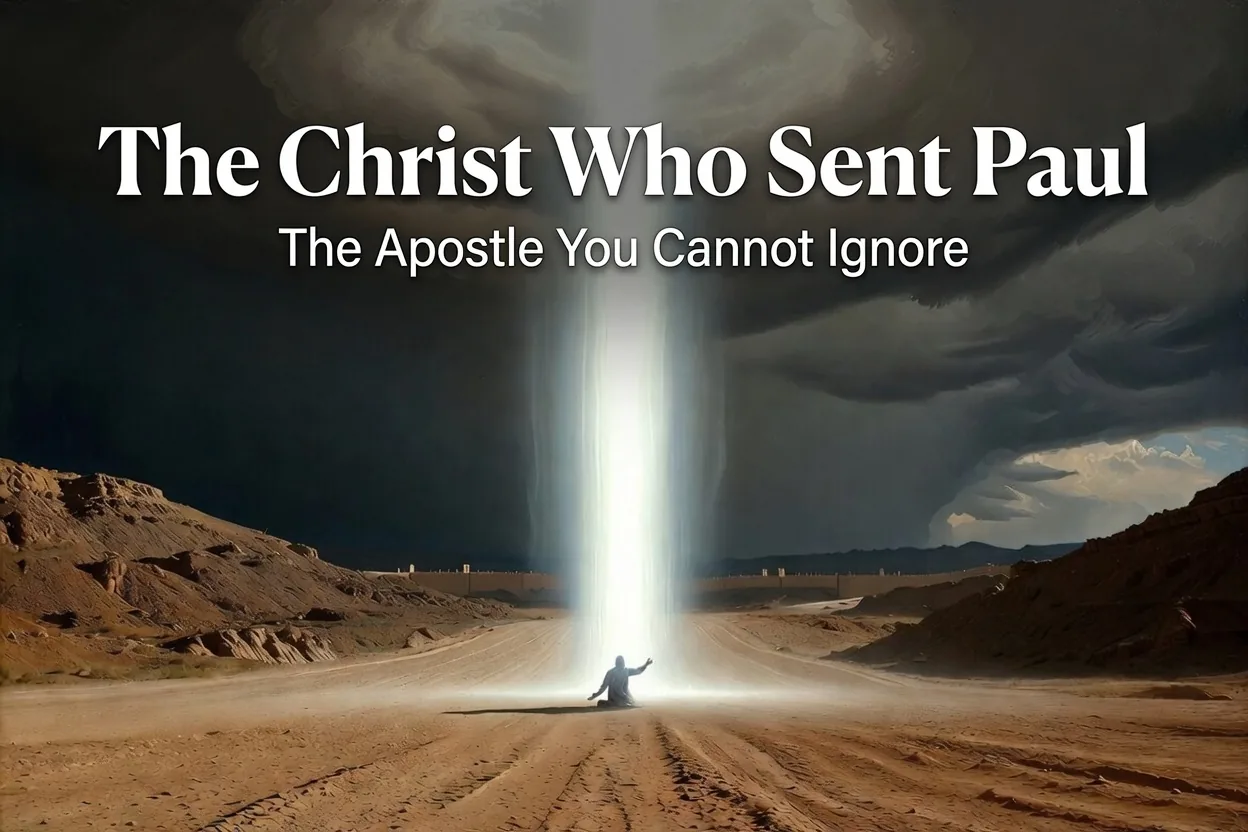
There is a question that cuts to the heart of how a believer approaches the whole Bible, and most people never think to ask it: Who is your apostle? Not in a tribal or sectarian sense, but in the most literal, biblical sense of the word — who was sent by the Lord Jesus Christ to minister to you, to deliver God's word for you, and to lay out the doctrine you are to live by?
If you are a Gentile believer living in the dispensation of the grace of God, the answer is unambiguous. It is the Apostle Paul. Christ sent him. God commanded it. The Holy Spirit sealed it. And yet a startling number of Bible-professing Christians give Paul's letters a secondary place — propped up by Peter's Pentecost sermon, governed by Matthew's kingdom instructions, and corrected by James's epistle to the twelve tribes. They say they follow Jesus, but they follow a Jesus they have constructed by blending programs that God kept carefully distinct. The result is confusion — doctrinal, practical, and spiritual.
This article makes a direct claim: Following Paul is following Christ. And not following Paul is not an expression of superior devotion to Jesus — it is disobedience to the risen Christ who appointed Paul for you.
That is not an insult to the other apostles, nor an elevation of Paul above his Lord. It is a reckoning with what the Bible actually says about how Christ operates in the present dispensation. Let the Scripture make the case.
Why Paul? The Question Behind the Question
Before we can answer why following Paul is following Christ, we have to answer a prior question: why did the risen Christ commission a new apostle at all? The Twelve had already been chosen, trained, and sent. Pentecost had already come. The Spirit had already fallen. And they already had their commission:
"Go ye therefore, and teach all nations, baptizing them in the name of the Father, and of the Son, and of the Holy Ghost: Teaching them to observe all things whatsoever I have commanded you:" (Matthew 28:19-20)
And not only all nations — Mark records it in the broadest terms possible:
"Go ye into all the world, and preach the gospel to every creature." (Mark 16:15)
Every creature. The scope of their commission could not have been wider. It was not limited to Israel. It was not limited to any geography. All nations, all the world, every creature. So why raise up a thirteenth man? If the Gentile world simply needed more workers to carry out the same program, the logical solution was obvious — bring Paul to the Twelve, train him under their authority, and send him as an extension of their existing ministry. That is exactly what they had done when they needed to replace Judas. They chose Matthias according to a specific qualification:
"Wherefore of these men which have companied with us all the time that the Lord Jesus went in and out among us, Beginning from the baptism of John, unto that same day that he was taken up from us, must one be ordained to be a witness with us of his resurrection." (Acts 1:21-22)
The requirement was clear: he had to have been present from the beginning, to have walked with the Lord in the flesh, to have witnessed the ministry firsthand. Matthias qualified. Paul qualified for none of it. He had not companied with them. He had not been present from the baptism of John. He had spent those years "breathing out threatenings and slaughter against the disciples of the Lord" (Acts 9:1), hauling men and women out of their homes and into prison (Acts 8:3), voting for their deaths, punishing them in the synagogues, and — by his own admission — "being exceedingly mad against them even unto strange cities" (Acts 26:10-11). He was, in his own words, "a blasphemer, a persecutor, and injurious" (1 Timothy 1:13). This was the man God chose. When he first came to Jerusalem after his conversion, the disciples were afraid of him and did not believe he was a disciple at all (Acts 9:26). He was the last man anyone would have chosen.
And yet God chose him. Deliberately. Conspicuously. And God did not send him to the Twelve for training or to have his message vetted and updated. Paul is explicit about this:
"But I certify you, brethren, that the gospel which was preached of me is not after man. For I neither received it of man, neither was I taught it, but by the revelation of Jesus Christ." (Galatians 1:11-12)
He did not go to Jerusalem to compare notes with Peter. He did not submit his doctrine to the council of the apostles for approval. Three years passed before he even went to see Peter, and when he eventually met with the pillars of the Jerusalem church, he came with a message already formed — one that added nothing to him from them, and to which they added nothing:
"But of these who seemed to be somewhat, (whatsoever they were, it maketh no matter to me: God accepteth no man's person:) for they who seemed to be somewhat in conference added nothing to me:" (Galatians 2:6)
Furthermore, God did not simply update the Twelve's message to include the Gentiles. He gave an entirely different message to an entirely different man — and that man's authority was so suspect, so unverifiable by the ordinary credentials of the apostolic circle, that it had to be confirmed by signs and wonders:
"Truly the signs of an apostle were wrought among you in all patience, in signs, and wonders, and mighty deeds." (2 Corinthians 12:12)
Consider the weight of that. Why would God need to confirm Paul's apostleship through miraculous signs if Paul were simply a co-worker sent to assist the Twelve with their existing commission? The Twelve's authority was established on the basis of their years with Christ, their eyewitness of the resurrection, and their role in Israel's prophetic program. Paul had none of that pedigree. His authority rested entirely on the direct commission of the risen Christ — and God confirmed it supernaturally because there was no other way to establish it. The very need for that confirmation tells you something: Paul was not doing what the Twelve were doing. He was not carrying their message further. He was carrying something they had never been given.
The answer is found in the nature of what Paul was given. It was not simply a wider mission field. It was an entirely different message, for an entirely different purpose, according to an entirely different program — one that God had kept hidden from the beginning of the world.
"Now to him that is of power to stablish you according to my gospel, and the preaching of Jesus Christ, according to the revelation of the mystery, which was kept secret since the world began," (Romans 16:25)
This mystery — the Body of Christ, Jews and Gentiles as one new man, seated in heavenly places, under grace and not law — was hidden in God. It was not in the Old Testament prophets. It was not in John the Baptist's preaching. It was not in the Sermon on the Mount. It was not at Pentecost. It was hidden — and it was revealed, for the first time, to the Apostle Paul.
"And to make all men see what is the fellowship of the mystery, which from the beginning of the world hath been hid in God, who created all things by Jesus Christ:" (Ephesians 3:9)
"Even the mystery which hath been hid from ages and from generations, but now is made manifest to his saints:" (Colossians 1:26)
Because the mystery was hidden from ages and from generations, it was hidden from all previous men of God, including the twelve apostles. That is why a new apostle was required — not to replace the Twelve, but to fulfill the word of God for a new program that none of them had been given.
"Whereof I am made a minister, according to the dispensation of God which is given to me for you, to fulfil the word of God;" (Colossians 1:25)
This is the answer to the why. And it is also the answer to why you cannot substitute any other apostle for Paul and expect to have the doctrine suited to today. The message of the mystery was not distributed among twelve men — it was given to one, and you follow that one or you go without it.
Christ Appointed Him — The Damascus Road Was No Accident
The risen Lord Jesus Christ appeared to Paul personally. This was not a vision, not a dream, not a feeling, and not the mediation of another apostle. It was a direct, face-to-face, blinding appearance of the glorified Christ.
"And I said, Who art thou, Lord? And he said, I am Jesus whom thou persecutest. But rise, and stand upon thy feet: for I have appeared unto thee for this purpose, to make thee a minister and a witness both of these things which thou hast seen, and of those things in the which I will appear unto thee; Delivering thee from the people, and from the Gentiles, unto whom now I send thee," (Acts 26:15-17)
The word "send" there is the same family of words behind apostle — one sent with a commission. Jesus personally dispatched Paul to the Gentiles. This was not self-promotion on Paul's part, not an expansion of the existing mission, and not a human ordination. The Lord of glory appeared and said, I send thee.
This is why Paul describes his apostleship not as a career path or a calling discerned through prayer, but as a direct command:
"Paul, an apostle of Jesus Christ by the commandment of God our Saviour, and Lord Jesus Christ, which is our hope;" (1 Timothy 1:1)
By commandment. The word carries legal, binding authority. When someone obeys a commandment, they are not expressing personal preference. When someone disobeys a commandment, they are not simply making a different choice — they are in defiance of the one who issued the command. If Christ commanded that Paul be your apostle, then setting Paul aside is not spiritual humility. It is rebellion against the Lord who issued the command.
The point is plain: unless you are a first-century Jewish believer waiting on Israel's kingdom, Paul is your apostle. Every genuine expression of the gospel of grace in this age traces back to the ministry Christ gave to Paul.
Paul Received the Mystery Gospel — "My Gospel"
One of the most revealing features of Paul's writing is his repeated use of the phrase my gospel. The phrase appears three times in Scripture. Not once does Jesus in the Gospels refer to the gospel He preached as my gospel. He uses the phrase "the gospel" or "the gospel of the kingdom," but never my gospel. Only Paul uses the possessive. And Paul uses it deliberately.
"Now to him that is of power to stablish you according to my gospel, and the preaching of Jesus Christ, according to the revelation of the mystery, which was kept secret since the world began," (Romans 16:25)
This is not Paul claiming ownership in a proprietary sense. It is Paul acknowledging that the gospel he preached — the gospel of the grace of God, the mystery of Christ — was given to him alone, by direct revelation, in a way that distinguished it from every other gospel previously preached. He presses this point with extraordinary force:
"But I certify you, brethren, that the gospel which was preached of me is not after man. For I neither received it of man, neither was I taught it, but by the revelation of Jesus Christ." (Galatians 1:11-12)
Not after man. Not from Peter. Not from James. Not passed down from the earthly ministry of Christ. By the revelation of Jesus Christ — meaning the risen, glorified, post-ascension Christ who appeared to Paul and unlocked what had never before been made known. To bypass Paul's gospel is not to get closer to Christ. It is to reach past the very message Christ sent to you.
Paul Is the Apostle of the Gentiles — That Means You
Paul is explicit about his specific jurisdiction. This is not a matter of interpretation.
"For I speak to you Gentiles, inasmuch as I am the apostle of the Gentiles, I magnify mine office:" (Romans 11:13)
He magnifies his office. Not out of pride, but because the office matters. An ambassador who is dismissed, ignored, or overruled cannot fulfill his mission. Paul understood that his unique apostleship to the Gentiles was the means by which Christ would reach the nations in this present age. To sideline Paul is to sideline the very mechanism Christ put in place.
But the title apostle of the Gentiles does not tell the complete story of Paul's commission. When the risen Christ first described it on the Damascus road, He named three groups:
"Delivering thee from the people, and from the Gentiles, unto whom now I send thee," (Acts 26:17)
And again, at his conversion, the Lord declared through Ananias:
"He is a chosen vessel unto me, to bear my name before the Gentiles, and kings, and the children of Israel:" (Acts 9:15)
The children of Israel are in that commission. But which Israelites? Not the believing remnant — those were already Peter's people. At that very moment, Peter and the Jerusalem apostles were shepherding the remnant according to the election of grace: the Jews who had believed at Pentecost and through the early Acts ministry, those whom God had preserved out of a nation that, as a whole, had rejected its Messiah.
"Even so then at this present time also there is a remnant according to the election of grace." (Romans 11:5)
"What then? Israel hath not obtained that which he seeketh for; but the election hath obtained it, and the rest were blinded." (Romans 11:7)
The election had obtained it — and Peter was their apostle. The rest were blinded. And here is what makes this even more precise: Paul himself had already established in Romans 2 that an unbelieving, law-breaking Jew stood before God in no different condition than a Gentile:
"For circumcision verily profiteth, if thou keep the law: but if thou be a breaker of the law, thy circumcision is made uncircumcision." (Romans 2:25)
"For he is not a Jew, which is one outwardly; neither is that circumcision, which is outward in the flesh: But he is a Jew, which is one inwardly; and circumcision is that of the heart, in the spirit, and not in the letter; whose praise is not of men, but of God." (Romans 2:28-29)
And what was the precise breach of law that stripped their circumcision of its value? The law itself had always demanded more than the cutting of flesh. Moses commanded it plainly:
"Circumcise therefore the foreskin of your heart, and be no more stiffnecked." (Deuteronomy 10:16)
Jeremiah pressed it on the men of Judah at the door of judgment:
"Circumcise yourselves to the LORD, and take away the foreskins of your heart, ye men of Judah and inhabitants of Jerusalem: lest my fury come forth like fire, and burn that none can quench it, because of the evil of your doings." (Jeremiah 4:4)
Heart circumcision was never optional — it was the intent of the law from the beginning. An Israelite who bore the outward mark but left his heart uncircumcised had broken the very law he boasted in. By rejecting their Messiah, the unbelieving Jews revealed exactly that — uncircumcised hearts, stiffnecked before God, fulfilling Moses' warning and Jeremiah's indictment. Their outward circumcision, performed in the flesh but never matched in the heart, was already accounted as nothing.
The blinded, unbelieving Israelite — the one whose circumcision had been made uncircumcision because he was a breaker of the law — was counted among the uncircumcised. He was, in God's reckoning, in the same category as the Gentile nations. When Paul was sent to the uncircumcision, he was therefore sent to both Gentiles and to that blinded portion of Israel whose outward circumcision counted for nothing. They were all uncircumcision in God's sight. Paul's commission encompassed them all.
It is to this blinded Israel — the hardened, the unbelieving, those upon whom God had poured the spirit of slumber, now reckoned with the uncircumcised nations — that Paul also had a charge. He carried Christ's name to them not to build on the foundation Peter had already laid among the remnant, but to reach those that remnant never reached, with a message the remnant had never heard.
Paul was governed by this principle absolutely:
"Yea, so have I strived to preach the gospel, not where Christ was already named, lest I should build upon another man's foundation: But as it is written, To whom he was not spoken of, they shall see: and they that have not heard shall understand." (Romans 15:20-21)
He did not go where Christ had already been named through Peter. He did not expand the remnant ministry, polish it, or carry it to a wider Jewish audience. Peter's foundation was Peter's. Paul's commission took him to those who had not heard — Gentiles, yes, but also those Israelites outside the election who had been blinded, the very ones Paul longed to provoke to jealousy through his ministry among the nations:
"For I speak to you Gentiles, inasmuch as I am the apostle of the Gentiles, I magnify mine office: If by any means I may provoke to jealousy them which are my flesh, and might save some of them." (Romans 11:13-14)
This is why it is a mistake to frame Paul's ministry as simply a Gentile extension of what Peter began. The two ministries operated in separate jurisdictions with separate messages and separate purposes. Peter had the circumcision, the remnant, the prophetic program, and the promises made to the fathers. Paul had the uncircumcision, the blinded of Israel, the hidden mystery, and a gospel that had never before been spoken. One built on prophecy; the other on revelation. They were not two lanes of the same road.
The other apostles recognized this. Peter, James, and John formally conceded the mission to the uncircumcised to Paul:
"And when James, Cephas, and John, who seemed to be pillars, perceived the grace that was given unto me, they gave to me and Barnabas the right hands of fellowship; that we should go unto the heathen, and they unto the circumcision." (Galatians 2:9)
The right hand of fellowship was not a polite handshake — it was a formal acknowledgment of divided jurisdiction. The pillars of the Jerusalem church did not claim authority over Paul's ministry. They recognized that Christ had given him something distinct and separate. Peter went further still, deferring to Paul's writings as Scripture with the authority of the other holy scriptures:
"And account that the longsuffering of our Lord is salvation; even as our beloved brother Paul also according to the wisdom given unto him hath written unto you; As also in all his epistles, speaking in them of these things; in which are some things hard to be understood, which they that are unlearned and unstable wrest, as they do also the other scriptures, unto their own destruction." (2 Peter 3:15-16)
Peter calls Paul's letters scripture. He notes they are hard to understand — and that wresting them to destruction is the mark of the unlearned and unstable. If Peter, who walked with Jesus in the flesh, treated Paul's epistles as the word of God on the same level as the other scriptures, on what basis does any believer today treat them as optional or secondary?
Paul Is Our Pattern — The First Believer of This Age
Perhaps the most striking statement about Paul's role is found in 1 Timothy, where the risen Christ Himself explains why Paul was saved the way he was:
"Howbeit for this cause I obtained mercy, that in me first Jesus Christ might shew forth all longsuffering, for a pattern to them which should hereafter believe on him to life everlasting." (1 Timothy 1:16)
A pattern. Christ saved Paul the way He did — apart from law, apart from works, by pure grace through faith, without water baptism, without a kingdom sign, outside of Israel's covenantal framework — on purpose. Paul was saved as a demonstration of how every subsequent believer would be saved in this dispensation. The word hereafter is the key: after Paul, this is the pattern. Not Peter's Pentecost message. Not the way the disciples were called at the Sea of Galilee. The Damascus Road pattern — grace, faith, the gospel of the death, burial, and resurrection of Christ. And to grasp just how radical that pattern is, consider what Paul had done before that road.
Paul had blasphemed. He had compelled believers to blaspheme (Acts 26:11). He had consented to the death of Stephen, a man full of the Holy Ghost (Acts 7:55-8:1). He had dragged men and women who bore the name of Christ into prison and into death. In the preaching of the Lord's earthly ministry, that put him in the most dangerous of categories:
"Wherefore I say unto you, All manner of sin and blasphemy shall be forgiven unto men: but the blasphemy against the Holy Ghost shall not be forgiven unto men. And whosoever speaketh a word against the Son of man, it shall be forgiven him: but whosoever speaketh against the Holy Ghost, it shall not be forgiven him, neither in this world, neither in the world to come." (Matthew 12:31-32)
Under the gospel of the kingdom, blasphemy against the Holy Ghost was the unpardonable sin — not forgiven in this world, not in the world to come. By every measure of the kingdom program then in operation, Paul was a man without hope. His sins did not place him near the edge of what could be forgiven. They placed him beyond it.
And yet Paul tells us exactly why he obtained mercy:
"Who was before a blasphemer, and a persecutor, and injurious: but I obtained mercy, because I did it ignorantly in unbelief." (1 Timothy 1:13)
Ignorantly in unbelief. He was not sinning against full light. He genuinely believed he was serving God by destroying the church. He had not received the revelation that Jesus was the Christ and that the Holy Ghost was confirming it. He acted in the darkness of unbelief, not in the defiant, eyes-open rejection that the kingdom warning addressed. And on that basis — pure mercy, extended to a man who deserved none of it — Christ saved him.
This is precisely why God chose Paul as the pattern. Not despite his history, but because of it. If the chief of sinners, the blasphemer, the persecutor, the man who by the kingdom gospel's own standard stood beyond the reach of forgiveness, could be saved by grace through faith in a moment — then the grace of God in this dispensation truly knows no floor. There is no sin too great, no past too dark, no record too far gone. The very case that looked most impossible became the demonstration of what grace can do.
"Moreover, brethren, I declare unto you the gospel which I preached unto you, which also ye have received, and wherein ye stand; By which also ye are saved, if ye keep in memory what I preached unto you, unless ye have believed in vain. For I delivered unto you first of all that which I also received, how that Christ died for our sins according to the scriptures; And that he was buried, and that he rose again the third day according to the scriptures:" (1 Corinthians 15:1-4)
This is the gospel by which you are saved. This is Paul's gospel. There is no other pattern for salvation today, and Paul is the model for it. To dismiss Paul as one voice among many is to dismiss the very pattern Christ designed.
Christ Speaking Through Paul — Not Paul's Own Words
The most common objection to the Pauline priority is the fear of elevating a man. "I follow Jesus, not Paul." It sounds spiritual. It sounds loyal. It is, in fact, a misunderstanding of what Paul claims for himself — and what Christ claims through him.
Paul did not write his letters as expressions of his own theological opinions. He was clear, and he repeated the claim more than once, that what he wrote were the commandments of the Lord:
"If any man think himself to be a prophet, or spiritual, let him acknowledge that the things that I write unto you are the commandments of the Lord." (1 Corinthians 14:37)
Not suggestions. Not insights. Not helpful advice from a seasoned missionary. Commandments of the Lord. The Greek-aware reader might jump to the original language here, but the English is plain enough. When Paul wrote to the Corinthians, he was transmitting commands from the risen Christ to the church.
"For ye know what commandments we gave you by the Lord Jesus." (1 Thessalonians 4:2)
By the Lord Jesus. Paul explicitly attributes the source of his instructions to the Lord. This is not borrowed authority — Paul is the mouthpiece of Christ's ongoing voice to the Body of Christ. The risen Lord did not cease to speak when He ascended. He continued to speak — through Paul.
"Since ye seek a proof of Christ speaking in me, which to you-ward is not weak, but is mighty in you." (2 Corinthians 13:3)
Christ speaking in Paul. Not around Paul. Not behind Paul. In him. Paul is not the source — he is the vessel. To reject Paul is not to get past the vessel and find the real Christ. It is to reject the Christ who chose to speak through that vessel.
When Paul's converts in Thessalonica received his preaching, he gave thanks precisely because they understood this:
"For this cause also thank we God without ceasing, because, when ye received the word of God which ye heard of us, ye received it not as the word of men, but as it is in truth, the word of God, which effectually worketh also in you that believe." (1 Thessalonians 2:13)
The word of God. Not Paul's word. Not good religious teaching. The word of God. A believer who says "I follow Jesus, not Paul" is, without realizing it, claiming to follow Christ while setting aside the very words Christ sent to them.
The Lord's Own Promise: Receiving Paul Is Receiving Christ
Jesus made this principle explicit in His own teaching. Before Paul was ever converted, Jesus laid down the rule:
"Verily, verily, I say unto you, He that receiveth whomsoever I send receiveth me; and he that receiveth me receiveth him that sent me." (John 13:20)
This verse is spoken at the Last Supper, and the context is the chain of authority running from the Father through the Son to those the Son sends. Jesus had just told the disciples that the servant is not greater than his lord, nor he that is sent greater than he that sent him (John 13:16). The point is about representation and recognition. To receive Christ — in this context — is to acknowledge who He is: that He came from the Father, that He speaks for the Father, that His words carry the authority of the One who sent Him. It is not a phrase for a salvation decision. It is a declaration about how divine authority travels. You receive Christ by recognizing where He comes from and submitting to what He says. And precisely because receiving Christ means recognizing His divine origin and authority, receiving the one Christ sends carries the same weight — because that sent one arrives with Christ's commission, Christ's message, and Christ's authority behind him.
This has nothing to do with the modern evangelical phrase of "receiving Christ" as a formula for salvation — asking Jesus into your heart. That vocabulary belongs to a different conversation entirely. Here, receiveth is the language of acknowledgment, recognition, and submission to divinely delegated authority.
The principle cuts both ways. Receive the one Christ sends — acknowledge his commission, submit to his message — and you receive Christ. Refuse the one Christ sends, and you refuse Christ. There is no middle position — no way to honor the sender while rejecting the one He sent. Christ sent Paul. To receive Paul's apostleship and doctrine is to receive Christ. To dismiss Paul is to dismiss the Christ who dispatched him.
Paul applied this same principle to those who would despise him:
"He therefore that despiseth, despiseth not man, but God, who hath also given unto us his holy Spirit." (1 Thessalonians 4:8)
This is not Paul defending his ego. It is Paul warning that the stakes in rejecting his message are not merely theological. They are spiritual at the deepest level. To despise the apostle Christ sent is to despise God.
Jesus' Earthly Ministry Was Not For You
A critical piece of rightly dividing the Scripture is understanding to whom Jesus ministered during His earthly life. This is not a complicated conclusion — Jesus states it plainly:
"I am not sent but unto the lost sheep of the house of Israel." (Matthew 15:24)
"Now I say that Jesus Christ was a minister of the circumcision for the truth of God, to confirm the promises made unto the fathers:" (Romans 15:8)
Jesus, in His earthly ministry, was a minister of the circumcision — that is, He ministered to Israel in fulfillment of the Abrahamic and Davidic covenants. His instructions to the Twelve were bounded by the same scope:
"These twelve Jesus sent forth, and commanded them, saying, Go not into the way of the Gentiles, and into any city of the Samaritans enter ye not: But go rather to the lost sheep of the house of Israel. And as ye go, preach, saying, The kingdom of heaven is at hand." (Matthew 10:5-7)
The kingdom of heaven is at hand. This was Israel's message, for Israel's program. It was not the gospel of grace. It was the gospel of the kingdom — and the Twelve were explicitly forbidden from taking it to the Gentiles.
Paul recognized this shift with precision. The believer today does not know Christ according to the flesh — that is, according to His earthly life under law, ministering to Israel:
"Wherefore henceforth know we no man after the flesh: yea, though we have known Christ after the flesh, yet now henceforth know we him no more." (2 Corinthians 5:16)
Now henceforth. There is a line. After that line, we know Christ through the revelation He gave to Paul — the mystery, the Body of Christ, the dispensation of grace. The believer in this age is not addressed in the Sermon on the Mount as doctrine for daily life. He is addressed in Romans through Philemon.
This is not a diminishment of the four Gospels. All Scripture is profitable. But not all Scripture is addressed to you as your doctrine, your rule, your pattern. The Gospels are part of your Bible — but Paul is your apostle.
The Contrasts Are Not Contradictions — They Are Dispensational Distinctions
One of the most confusing things that happens when right division is not applied is that the Bible appears to contradict itself. Does God forgive conditionally or unconditionally? Is the believer under law or not? Is the kingdom earthly or heavenly? Is water baptism required or not? The answers differ depending on what part of Scripture you are reading — and that is not a problem to be solved by forcing harmony. It is a dispensational reality to be understood by right division.
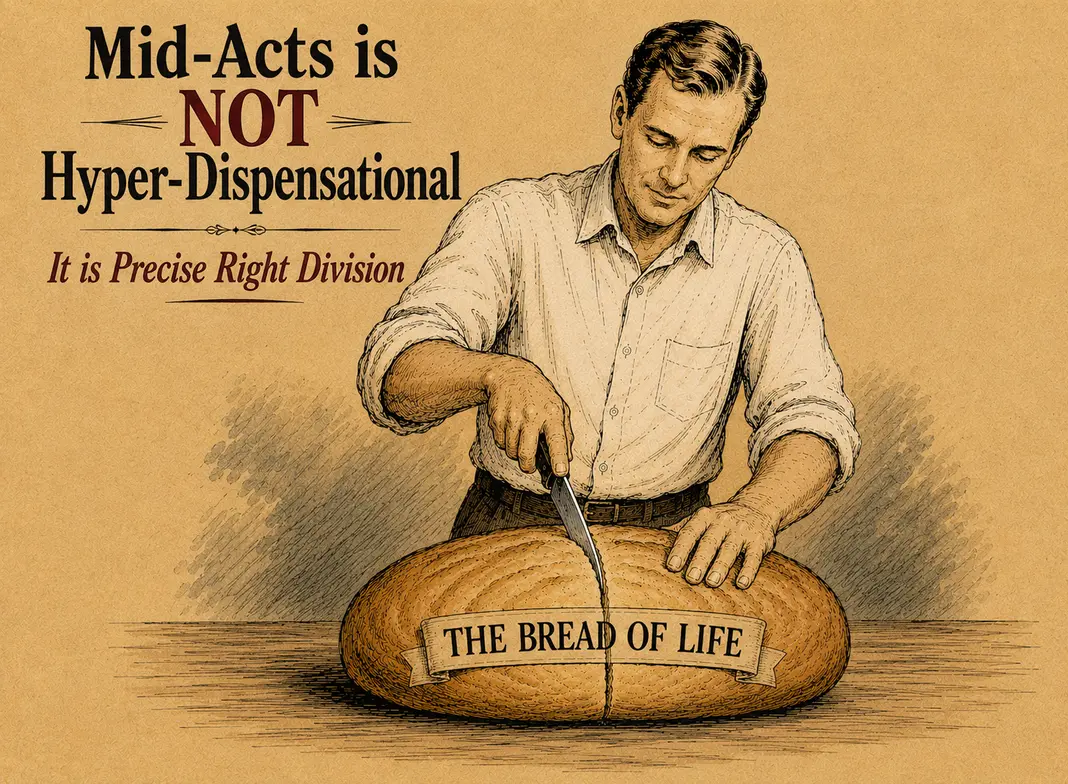
Paul says it this way: "Study to shew thyself approved unto God, a workman that needeth not to be ashamed, rightly dividing the word of truth." (2 Timothy 2:15) The word rightly dividing means to cut straight, to make a clean, accurate division. A workman who does not divide rightly is not simply behind in his studies — he is ashamed, producing a confused message because he has applied the wrong instructions to the wrong people.
And it is worth pausing to ask: where does this command come from? Search the Old Testament — Moses never told Israel to rightly divide the word of truth. The prophets never issued it. John the Baptist never preached it. Jesus never gave it to the Twelve during His earthly ministry. Peter never commanded it at Pentecost. James never wrote it to the twelve tribes. It is found nowhere in all of Scripture except here, in Paul's letter to Timothy.
That is not incidental. The very existence of the command proves that something had entered the word of God that required division. You do not tell a workman to rightly divide unless there is something to divide — two programs, two purposes, two sets of instructions that must be kept distinct or the whole work collapses into confusion. Before Paul, the word of God contained prophecy — "spoken since the world began" (Acts 3:21). With Paul, something entirely new entered: the mystery — "kept secret since the world began" (Romans 16:25). Now the word of God contained both, and a workman handling it would have to know which was which, to whom each belonged, and how to apply each correctly. Hence the command: rightly divide.
The command itself is therefore a Pauline marker. It acknowledges that the canon Paul wrote into is more complex than anything that came before — not because the earlier Scripture is flawed, but because the full word of God now encompasses two distinct divine programs running through the same book. No one before Paul needed to issue this command because no one before Paul had introduced the material that made division necessary. The very fact that Paul gives it — and gives it only to his own student, preparing him to handle Paul's doctrine rightly — is itself evidence that Paul's writings belong to a category all their own.
Here are four key contrasts that demonstrate why following the earthly Jesus instead of the risen Christ through Paul produces error:
Forgiveness. In Christ's earthly ministry, forgiveness was conditional on the forgiveness you extend to others: "But if ye forgive not men their trespasses, neither will your Father forgive your trespasses." (Matthew 6:15). Through Paul, forgiveness is an accomplished fact, received by grace: "In whom we have redemption through his blood, the forgiveness of sins, according to the riches of his grace;" (Ephesians 1:7). "And you, being dead in your sins and the uncircumcision of your flesh, hath he quickened together with him, having forgiven you all trespasses;" (Colossians 2:13). Note the word all. All trespasses — past, present, and future. This is not Matthew 6. This is grace.
Law. In His earthly ministry, Jesus upheld the law in its fullness: "Think not that I am come to destroy the law, or the prophets: I am not come to destroy, but to fulfil. For verily I say unto you, Till heaven and earth pass, one jot or one tittle shall in no wise pass from the law, till all be fulfilled." (Matthew 5:17-18). This is not error — Jesus was made under the law (Galatians 4:4) to fulfill it for Israel.
A common but mistaken conclusion drawn from this is that the cross settled the matter for everyone — that Christ fulfilled the law, and therefore it passed away at Calvary, leaving no one under its obligations. But that reading cannot survive what Christ said to His apostles after the cross. The risen Lord's commission to the Twelve was not to declare the law abolished. It was this:
"Teaching them to observe all things whatsoever I have commanded you:" (Matthew 28:20)
All things. This was spoken post-resurrection, after the cross, after the fulfillment Christ accomplished. And what had He commanded them? He had told them that whoever broke one of the least of the law's commandments and taught men to do so would be called the least in the kingdom of heaven — and whoever did and taught them would be called great:
"Whosoever therefore shall break one of these least commandments, and shall teach men so, he shall be called the least in the kingdom of heaven: but whosoever shall do and teach them, the same shall be called great in the kingdom of heaven." (Matthew 5:19)
The least commandments — still binding, still to be taught and observed, and the standard of greatness in the kingdom tied directly to doing so. The Twelve were commissioned after the cross to teach the nations to observe all of this. The cross did not remove law from Israel's program. It confirmed the covenant and sealed what the prophets had spoken. Thousands of Jewish believers in Acts remained zealous of the law (Acts 21:20), and rightly so — they were still operating within Israel's covenantal framework under the ministry of the circumcision apostles.
The reason the Body of Christ is not under law has nothing to do with the cross wiping law away for all people everywhere. It is because the mystery program — the one revealed to Paul — never included law to begin with. It was hidden before law, before prophecy, before the covenants made with Israel. The Body of Christ does not graduate out of law; it was never placed under it. That is the Pauline distinction:
"For sin shall not have dominion over you: for ye are not under the law, but under grace." (Romans 6:14). "But if ye be led of the Spirit, ye are not under the law." (Galatians 5:18). These are not contradictions with what Jesus told the Twelve. They are two different programs — one for Israel under covenant, one for the Body of Christ under grace.
The Kingdom. Jesus announced an at-hand kingdom to Israel — an earthly, literal, Davidic kingdom: "From that time Jesus began to preach, and to say, Repent: for the kingdom of heaven is at hand." (Matthew 4:17). "Thy kingdom come. Thy will be done in earth, as it is in heaven." (Matthew 6:10). Through Paul, the believer already possesses a heavenly kingdom: "Who hath delivered us from the power of darkness, and hath translated us into the kingdom of his dear Son:" (Colossians 1:13). "Blessed be the God and Father of our Lord Jesus Christ, who hath blessed us with all spiritual blessings in heavenly places in Christ:" (Ephesians 1:3). The location of our blessings is in heavenly places, not on an earthly throne in Jerusalem. A believer who mixes these programs will perpetually misunderstand both his current standing and his future hope.
Signs and Wonders. To Israel, Christ gave signs as credentials of the kingdom: "And these signs shall follow them that believe; In my name shall they cast out devils; they shall speak with new tongues; They shall take up serpents; and if they drink any deadly thing, it shall not hurt them; they shall lay hands on the sick, and they shall recover." (Mark 16:17-18). Signs were the divine authentication of the kingdom message to a nation that required them — "For the Jews require a sign" (1 Corinthians 1:22).
But signs were not exclusive to Israel's apostles during the Acts period. God also used signs and wonders to confirm Paul's apostleship, precisely because his commission and message were so unlike anything that had come before. Paul himself appealed to this confirmation when his authority was challenged:
"Truly the signs of an apostle were wrought among you in all patience, in signs, and wonders, and mighty deeds." (2 Corinthians 12:12)
And Luke records it during Paul's Acts ministry:
"Long time therefore abode they speaking boldly in the Lord, which gave testimony unto the word of his grace, and granted signs and wonders to be done by their hands." (Acts 14:3)
God bore witness to the word of his grace — Paul's distinct message — through the same miraculous means He had used for Israel's program. During the transitional Acts period, when the mystery was first being proclaimed and Paul's apostleship was still being established, signs served as divine credentials bridging the old and the new. Paul himself acknowledged the scope of it: "Through mighty signs and wonders, by the power of the Spirit of God... I have fully preached the gospel of Christ." (Romans 15:19).
The transition away from signs, however, is traceable within Paul's own letters. In his earlier epistles he heals freely and works miracles openly. But by his later prison epistles and the pastoral letters, the picture has changed markedly. Epaphroditus was sick nigh unto death and Paul could not simply heal him (Philippians 2:27). Trophimus was left sick at Miletum (2 Timothy 4:20). Timothy was told to take wine for his stomach and his often infirmities — not healed by an apostle's touch (1 Timothy 5:23). The sign gifts were winding down even within Paul's own ministry, and Paul himself wrote their obituary:
"Whether there be prophecies, they shall fail; whether there be tongues, they shall cease; whether there be knowledge, it shall vanish away." (1 Corinthians 13:8)
Signs were transitional — used by God to confirm both the kingdom message to Israel and Paul's new apostleship during Acts, and then withdrawn as the mystery program was fully established and the complete word of God was in hand. A believer today who expects sign gifts as evidence of genuine faith is not only operating under a program that has been superseded — he is ignoring the evidence within Paul's own ministry that those gifts were already ceasing before the Acts period closed.
Baptism. Water baptism did not originate with the church — it was rooted in Israel's prophetic program from the beginning. The Jewish nation was deeply familiar with ritual washings and ceremonial cleansings woven throughout the law, what the writer of Hebrews called "divers washings, and carnal ordinances, imposed on them until the time of reformation" (Hebrews 9:10). When John the Baptist came baptizing with water, he was doing so for a specific national purpose: "that he should be made manifest to Israel" (John 1:31). It was Israel's purification rite, pointing to the national cleansing God had promised through Ezekiel: "Then will I sprinkle clean water upon you, and ye shall be clean" (Ezekiel 36:25). Peter carried it forward at Pentecost under the same kingdom program:
"Repent, and be baptized every one of you in the name of Jesus Christ for the remission of sins, and ye shall receive the gift of the Holy Ghost." (Acts 2:38)
This was the kingdom readiness message for Israel — not the mystery gospel. Water baptism belonged to that prophetic program, tied to the offer of the earthly kingdom to the nation.
Paul himself was water baptized. When Ananias came to him in Damascus after the Damascus road encounter, the instruction was immediate: "And now why tarriest thou? arise, and be baptized, and wash away thy sins, calling on the name of the Lord." (Acts 22:16). He was saved in the transitional Acts period, when that ordinance was still in operation, and he received it because that was what was then in practice. And during that same transitional period, when Paul went to Corinth, he baptized some there — Crispus, Gaius, and the household of Stephanas (1 Corinthians 1:14-16).
Why did he do it? During the transitional Acts period, water baptism was connected to the signs of an apostle being used to confirm the word — signs the Jews required and that God was still providing as Israel was being provoked to jealousy through Paul's Gentile ministry (Romans 11:11, 14). The same pattern seen in Acts 14:3 — God giving testimony to "the word of his grace" through signs and wonders by Paul's hands — was the context in which water was still being used. But it was never the center of what Christ had sent Paul to do. Writing from Ephesus to the Corinthians, Paul makes this plain:
"For Christ sent me not to baptize, but to preach the gospel:" (1 Corinthians 1:17)
He even thanks God he baptized almost none of them — because people were already beginning to glory in who had baptized them rather than in the cross (1 Corinthians 1:14-15). Men were already dividing themselves by the name of who had baptized them, and Paul refused to let his own name become a banner over anyone — "lest any should say that I had baptized in mine own name" (1 Corinthians 1:15).
As Israel fell nationally into blindness at Acts 28 and the transitional period closed, the confirming signs faded along with any remaining role for water. The trajectory is unmistakable in Paul's own letters: by the time of the prison epistles and the pastoral letters, no one is being baptized in water, and people are being left sick rather than healed. The ordinance that had served its confirming purpose during the transition simply disappears.
What remains is the one baptism Paul defines for this dispensation — not a ritual performed by human hands, but a sovereign act of God:
"For by one Spirit are we all baptized into one body, whether we be Jews or Gentiles, whether we be bond or free; and have been all made to drink into one Spirit." (1 Corinthians 12:13)
This baptism places the believer into Christ's death and resurrection — a spiritual union no water can accomplish:
"Know ye not, that so many of us as were baptized into Jesus Christ were baptized into his death?" (Romans 6:3)
"Buried with him in baptism, wherein also ye are risen with him through the faith of the operation of God, who hath raised him from the dead." (Colossians 2:12)
Note: "the operation of God." No ceremony, no minister, no water — God Himself performs this baptism the moment the gospel is believed. Paul's summary for the Body of Christ is therefore singular and final: "One Lord, one faith, one baptism" (Ephesians 4:5). One. And because God has already performed that baptism, there is no second one to add.
These are not minor theological adjustments. They are structural differences in what God requires, what God promises, and how God deals with man. Mixing them does not produce a richer Christianity — it produces a confused one.
The Logical Cost of Not Following Paul
It is worth pausing to state clearly what a believer loses when they neglect Paul as their apostle. Without Paul as the pattern, the cross is diminished as the sole basis for salvation. The power of Christ's resurrection is exchanged for human willpower trying to keep commands never given to the Body of Christ. The spiritual riches that are already yours in Christ go unknown and unclaimed. God's will for this present age remains a mystery — not because it was not revealed, but because the one to whom it was revealed has been set aside. And the Body of Christ is weakened, placed back under law, confused with Israel, and left in a conditional standing that grace abolished.
These are not theoretical losses. They are the lived spiritual reality of millions of professing Christians who are working hard, doing religious things, trying to keep commandments given to Israel, and never resting in the finished work of Christ, because they have never let Paul show them their position in Christ Jesus.
Without Paul, you do not know about your being a member of the Body of Christ. You do not know about being already "translated" into the kingdom of His dear Son (Colossians 1:13). You do not know about being "seated together in heavenly places in Christ Jesus" (Ephesians 2:6). You do not know about being "accepted in the beloved" (Ephesians 1:6) or "complete in him" (Colossians 2:10) or possessing "all spiritual blessings in heavenly places" (Ephesians 1:3). None of these truths appear in the Gospels. None of them come through Peter. They are Paul's — given to him by Christ for the Body.
To ignore Paul is not a more Christ-centered Christianity. It is a Christianity that is ignorant of what Christ is doing right now.
Answering the Objections
"Isn't this Paul-worship?"
No. The charge of Paul-worship misunderstands what following Paul actually means. Paul himself repeatedly directs his readers past himself to Christ. "For other foundation can no man lay than that is laid, which is Jesus Christ." (1 Corinthians 3:11). Paul preaches Christ according to the revelation of the mystery, not himself. Following Paul does not terminate on Paul — it passes through Paul to the risen Christ whose commandments Paul delivers. To glorify Christ in this dispensation is to take seriously the office of the apostle Christ appointed to speak for Him.
The irony is that those who say "I follow Jesus, not Paul" often end up following Peter, or James, or John the Baptist — men who were never sent to them — thinking they are being more faithful to Christ. But following men who were not sent to you is not loyalty to Christ. It is confusion.
"But all Scripture is profitable."
True — and Paul said so: "All scripture is given by inspiration of God, and is profitable for doctrine, for reproof, for correction, for instruction in righteousness:" (2 Timothy 3:16). But profitable is not the same as directly applicable. The law of Moses is profitable — Paul uses it to show the character of God, the sinfulness of man, and the pattern of prophecy. But the believer today is not required to keep the dietary laws or bring an offering to the temple. All Scripture is profitable; not all Scripture is your instruction.
And the verse immediately before this, in the same epistle, gives you the method for handling all Scripture correctly: "Study to shew thyself approved unto God, a workman that needeth not to be ashamed, rightly dividing the word of truth." (2 Timothy 2:15). All Scripture is profitable — and all Scripture must be rightly divided. These two truths belong together.
"Jesus is the focus, not Paul."
True, and Paul agrees. But here is the point: you cannot focus on Jesus while ignoring what Jesus is saying. Jesus speaks today through the words He gave to Paul. To say "I follow Jesus" while setting aside 1 Corinthians through Philemon is to follow a Jesus of your own construction — one built from his earthly ministry to Israel, stripped of the mystery He revealed after His ascension. That is not greater devotion to Christ. It is, as Paul himself would say, direct rebellion against the commandments of the Lord.
"Be ye followers of me, even as I also am of Christ." (1 Corinthians 11:1). Follow Paul — as he follows Christ. Paul does not ask you to follow him apart from Christ. He asks you to follow him to Christ, and to follow him because he is following Christ and relaying Christ's instructions. You cannot get to Christ's current word by going around Paul. Paul is the road.
"But Jesus said ___ — why not follow that?"
Because Jesus said it to Israel, under law, for a different program, and before the revelation of the mystery. Jesus was made under the law to redeem them that were under the law (Galatians 4:4). He ministered to the circumcision to confirm the promises made to the fathers (Romans 15:8). When He said keep the commandments, He was speaking to those under the Mosaic covenant. When He said sell all that thou hast, He was preparing kingdom disciples for the coming earthly reign. When He said take no thought for the morrow, He was speaking to those who would be supernaturally provided for as they proclaimed the kingdom.
"Now to him that is of power to stablish you according to my gospel, and the preaching of Jesus Christ, according to the revelation of the mystery, which was kept secret since the world began," (Romans 16:25).
The key word is stablish. What establishes you — gives you a secure footing — is Paul's gospel according to the revelation of the mystery. Not the Sermon on the Mount as personal doctrine. Not the Olivet Discourse as your end-times map. Paul's gospel. The mystery. Right division is not diminishing Jesus. It is honoring the new revelation given by the risen and ascended Christ.
Standing Fast in Paul's Traditions
Paul does not merely request that his readers follow his teaching. He commands it in the strongest possible language, and he frames it explicitly as the commandment of the risen Lord:
"Therefore, brethren, stand fast, and hold the traditions which ye have been taught, whether by word, or our epistle." (2 Thessalonians 2:15)
"Holding fast the faithful word as he hath been taught, that he may be able by sound doctrine both to exhort and to convince the gainsayers." (Titus 1:9)
"And the things that thou hast heard of me among many witnesses, the same commit thou to faithful men, who shall be able to teach others also." (2 Timothy 2:2)
This is a chain of transmission — Paul to Timothy to faithful men to others. The substance passing through that chain is Paul's doctrine, his pattern, the mystery of Christ. Paul understood that if his ministry was silenced or set aside, the Body of Christ would be left without its divine instruction manual. He passed the commission on, and it was to be held fast, not revised, not supplemented with conflicting programs, not diluted with kingdom teaching.
The Colossians were instructed: "As ye have therefore received Christ Jesus the Lord, so walk ye in him: Rooted and built up in him, and stablished in the faith, as ye have been taught, abounding therein with thanksgiving." (Colossians 2:6-7). As "ye have been taught" — and who taught them? Paul. The walk that flows from salvation is not an improvised attempt to keep the Sermon on the Mount. It is the walk Paul taught — grace, faith, love, rooted and built up in who they already are in Christ Jesus.
The Offering of the Gentiles — Paul's Unique Commission
One of the most visually striking descriptions of Paul's ministry is found in Romans:
"Nevertheless, brethren, I have written the more boldly unto you in some sort, as putting you in mind, because of the grace that is given to me of God, That I should be the minister of Jesus Christ to the Gentiles, ministering the gospel of God, that the offering up of the Gentiles might be acceptable, being sanctified by the Holy Ghost." (Romans 15:15-16)
Paul describes himself as a minister of Jesus Christ to the Gentiles — the genitive is deliberate. He is not ministering about Christ in a general sense. He is ministering as Christ's representative, and the offering he brings to God is the Gentile believers sanctified by the Holy Ghost through his gospel. If Paul is offering them up, then they did not exist as the Body of Christ before Paul. The Body began with Paul. And if what Paul offers is acceptable, it is because it is Christ who stands behind every word of the mystery gospel.
The Thessalonians received this gospel and Paul gives thanks:
"But we are bound to give thanks alway to God for you, brethren beloved of the Lord, because God hath from the beginning chosen you to salvation through sanctification of the Spirit and belief of the truth: Whereunto he called you by our gospel, to the obtaining of the glory of our Lord Jesus Christ. Therefore, brethren, stand fast, and hold the traditions which ye have been taught, whether by word, or our epistle." (2 Thessalonians 2:13-15)
Called by our gospel — Paul's gospel. That gospel is the mechanism of their calling. Stand fast. Hold the traditions. This is Christ's word for today, passed through the one Christ appointed to deliver it.
The Heart of the Matter: Christ's Voice Today
The conclusion is not a close call. The evidence is cumulative, consistent, and unambiguous. Christ, after His ascension, appeared to Paul. He commissioned him. He gave him a message no one else had received. He appointed him specifically to the Gentiles — and to all those outside the then-believing Jewish remnant, including the blinded of Israel whose unbelief had placed them among the uncircumcision. He made his pattern the pattern for all subsequent believers. He spoke through him as through His own mouth. He made Paul's words His commandments. He warned that to despise Paul was to despise not a man, but God.
"Paul is Christ's voice today." That is not an overstatement. It is the only conclusion the Bible permits. And if Paul is Christ's voice today, then to follow Paul is to obey Christ. And to neglect Paul — to push his letters to the margins in favor of Matthew's kingdom gospel or Peter's Pentecost instructions — is to be in practical disobedience to the risen Christ.
This is not Paul-worship. The Lord is not the message — He is the Source, and Paul is the means. But dismissing the means does not bring you closer to the Source. It leaves you without the message.
The call, then, is plain: "Be ye followers of me, even as I also am of Christ." (1 Corinthians 11:1). Follow Paul. Study Romans through Philemon as your core doctrine. Hold fast the form of sound words — "Hold fast the form of sound words, which thou hast heard of me, in faith and love which is in Christ Jesus." (2 Timothy 1:13). Be rooted and built up in who you already are in Christ. And understand that in doing so, you are not elevating a man. You are submitting to the risen Lord who said, "I send thee," and who said through His apostle, "be ye followers of me."
To follow Paul is to follow Christ. And the only obedience that counts in this dispensation is the obedience the risen Christ, through Paul, has defined.
© 2026 Edward R. Cross






Comments
No comments yet. Be the first to share your thoughts.
Leave a comment