
"Fear not, little flock; for it is your Father's good pleasure to give you the kingdom." — Luke 12:32 KJV
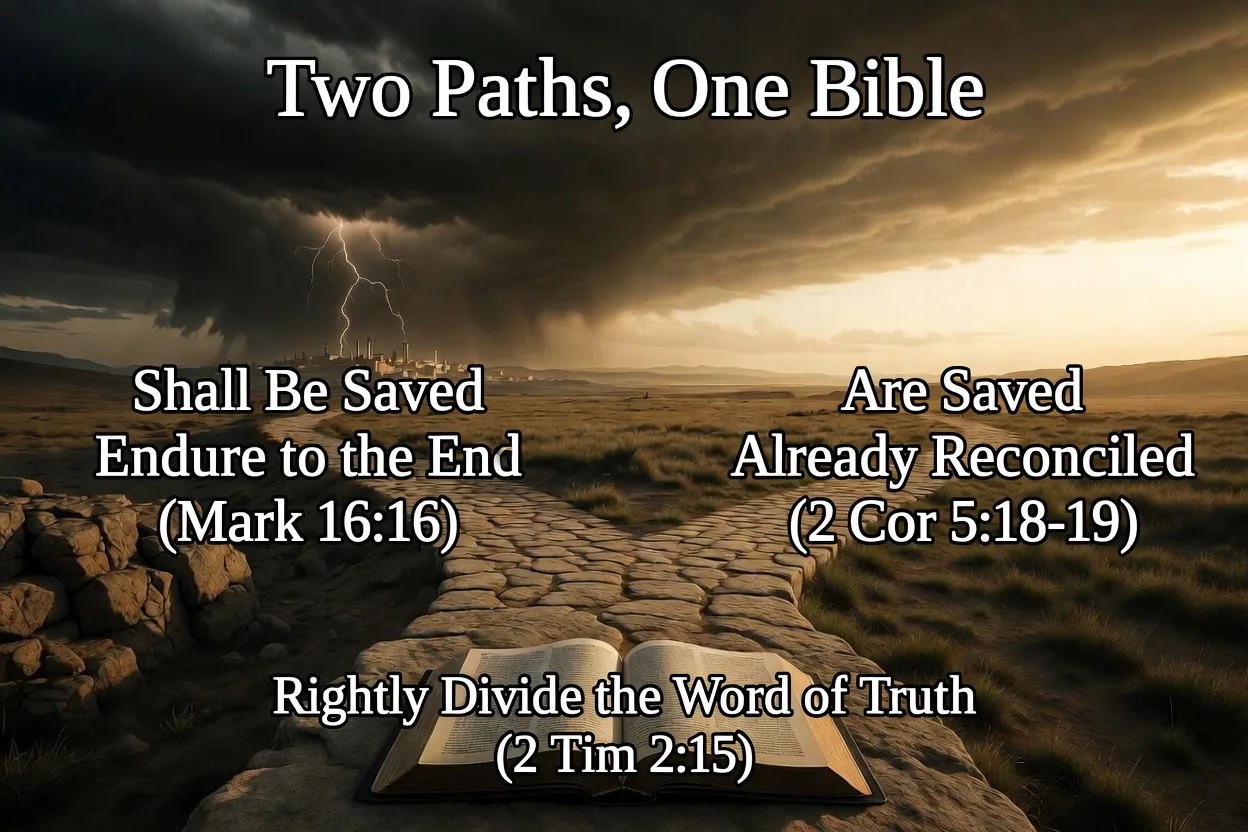
There are two salvations in your Bible. Not two ways to get to the same place, but two distinct programs with two distinct destinations, two distinct sets of conditions, and two distinct tenses. The one most Christians have heard about is the salvation Paul preaches — present possession, sealed by the Spirit, rooted in the finished work of the cross. The other one gets mentioned only when someone needs to explain away a hard verse. It gets treated like a footnote, a problem to be dissolved, a passage to be qualified.
That is a mistake. Israel's kingdom salvation is not a problem to be dissolved. It is a full program, grounded in covenant, driven by prophecy, and heading toward a real fulfillment when the King returns. Understanding it on its own terms does not confuse the grace gospel. It protects it. When you know what kingdom salvation actually is — what it requires, what it promises, who it is for, and how it works — you stop borrowing pieces of it for Paul's letters, and you stop flattening Paul's letters back into it. The line between the two programs gets clearer, not harder.
This article treats kingdom salvation as a subject in its own right.
What Israel Was Waiting For
To understand kingdom salvation, you have to start where Israel started: the promise. God made covenant with Abraham, then with the nation at Sinai, then with David. He promised a land, a throne, a seed, and a kingdom. The prophets filled in the details across centuries — a coming King from David's line, a renewed nation, enemies defeated, the nations blessed through Israel, the Law written on hearts instead of stone, sins forgiven nationally, the Spirit poured out, the dead raised. All of that is woven together in Israel's prophetic program.
Jeremiah saw a day when God would say of Israel: "And their Redeemer is strong; the LORD of hosts is his name: he shall throughly plead their cause, that he may give rest to the land, and disquiet the inhabitants of Babylon." (Jeremiah 50:34 KJV). Ezekiel saw national resurrection — dry bones coming together, breath entering them, the whole house of Israel standing again. (Ezekiel 37:1-14 KJV). Zechariah saw Israel looking on the One they pierced, mourning as for a firstborn son, a fountain opened for sin and uncleanness. (Zechariah 12:10, 13:1 KJV). Jeremiah named the covenant that would make it all permanent: "Behold, the days come, saith the LORD, that I will make a new covenant with the house of Israel, and with the house of Judah." (Jeremiah 31:31 KJV)
Kingdom salvation is not a generic category. It is the fulfillment of all of that. It is what happens when the King arrives and God's covenants with Israel reach their appointed end. It is national in scope, prophetic in origin, and tied from beginning to end to the presence and return of Israel's Messiah.
This is the salvation being offered when Jesus walked the earth and said, "Repent: for the kingdom of heaven is at hand." (Matthew 4:17 KJV) The kingdom — and everything Israel was promised — was being put within reach. And the conditions for receiving it were tied directly to that kingdom program.
The Conditions Were Never a Single Checkbox
One of the most common errors in reading the Gospels is assuming kingdom salvation functions like Paul's gospel with extra steps. It does not. The conditions are not arbitrary additions to a single act of belief. They are a coherent package that belongs to a covenant program operating within a prophetic timeline.
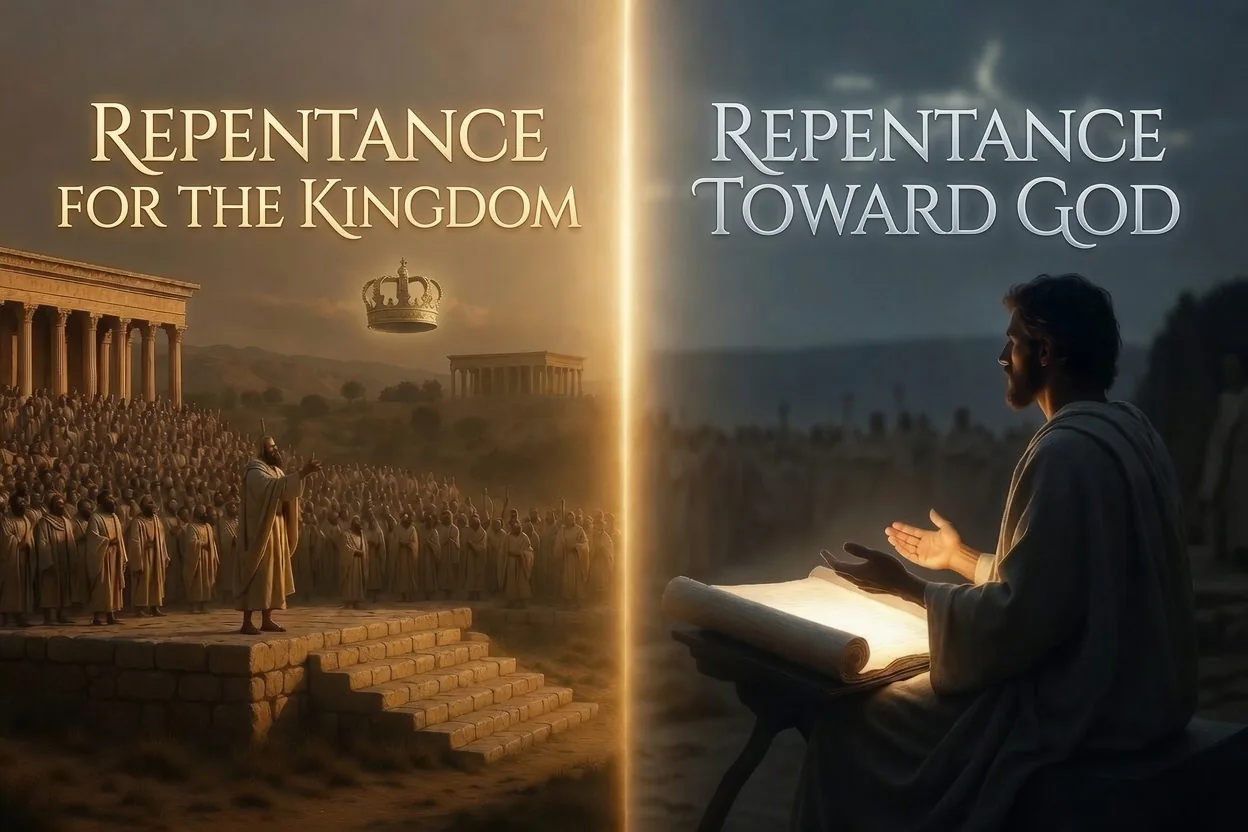
The Lord preached repentance from the start. "Repent: for the kingdom of heaven is at hand." (Matthew 4:17 KJV) Repentance under the kingdom program meant a turning of the nation — a national acknowledgment that Israel had rejected its prophets, broken the covenant, and needed to return to God. John the Baptist set the table for it. "Bring forth therefore fruits meet for repentance." (Matthew 3:8 KJV) This is not merely emotional sorrow. It is a genuine turning that produces visible evidence.
To repentance the Lord added belief in His name — not belief in the cross, which had not yet been revealed, but belief that Jesus of Nazareth was the Christ, the Son of the living God, the King promised to Israel. "He that believeth on him is not condemned: but he that believeth not is condemned already, because he hath not believed in the name of the only begotten Son of God." (John 3:18 KJV) The issue driving the kingdom program was the national question of who Jesus was. Peter's confession — "Thou art the Christ, the Son of the living God" (Matthew 16:16 KJV) — was the cornerstone of the whole program.
Mark 16:16 brings the conditions together plainly: "He that believeth and is baptized shall be saved; but he that believeth not shall be damned." Belief. And baptism. Not either/or — together, as a package, within the kingdom program. The one who does not believe is already condemned. The baptism belongs to those who believe. These are not separable pieces of the kingdom package; they are the entry point into the covenant people being called to receive their King.
Then there is endurance. "But he that shall endure unto the end, the same shall be saved." (Matthew 24:13 KJV) The end in view is the end of the tribulation — the time of Jacob's trouble — when the pressure against the remnant of Israel will be most severe. Endurance is required because the program is not complete until the King returns. There is no Rapture to extract the remnant before the trial. They must go through it, stay faithful through it, and receive their salvation at the appearing of the King.
Repentance. Belief in Jesus as the Christ. Water baptism. Endurance to the end. Each of those pieces belongs to the same program, and they are not separable from it.
The Remnant Goes Through, Not Around: Matthew 24 and the "One Taken"
That endurance requirement — that the remnant must hold fast to the end — is sometimes undermined by a misreading of Matthew 24 that turns a judgment passage into a rapture passage. The Lord's own illustration corrects it.
In Matthew 24:37-39, the Lord compares the coming of the Son of Man to the days of Noah: "For as in the days that were before the flood they were eating and drinking, marrying and giving in marriage, until the day that Noe entered into the ark, And knew not until the flood came, and took them all away; so shall also the coming of the Son of Man be." (Matthew 24:38-39 KJV) The Lord is precise about what the flood did: it took them all away. The ones taken by the flood were the wicked. Noah and his family were the ones left — preserved through the judgment, not extracted before it.
The Lord then applies the same language directly: "Then shall two be in the field; the one shall be taken, and the other left. Two women shall be grinding at the mill; the one shall be taken, and the other left." (Matthew 24:40-41 KJV) The logic of the illustration demands that the one taken is taken in judgment, just as the flood took the ungodly. The one left is the one preserved — the faithful remnant who endured to the end and is still standing when the Son of Man comes in power.
This is the opposite of how these verses are almost universally preached. In most churches, the "taken" person is the believer caught up to safety and the "left behind" person faces judgment. But that reading reverses the Lord's own illustration. In Noah's account, which the Lord supplies as the interpretive key, being taken means being swept away in judgment. Being left means surviving to enter what comes next.
This matters for the kingdom program's salvation structure because it confirms that the remnant's path runs through the tribulation, not around it. There is no pre-tribulation extraction for the little flock. Matthew 24 never promises one. The endurance requirement is not a formality — it is the real condition for a real remnant facing a real time of trouble. The goal is to be among those left standing when the King arrives, not among those taken away before He gets there.
Matthew 24:31 adds the other half of the picture: "And he shall send his angels with a great sound of a trumpet, and they shall gather together his elect from the four winds, from one end of heaven to the other." This gathering happens after the tribulation, at the coming of the Son of Man in power and glory (verse 30). The elect gathered here are Israel's remnant, collected from wherever they have been scattered, brought together to receive their King and enter the kingdom. This is the prophetic regathering the Old Testament promises — not the Body of Christ's catching away to meet the Lord in the air, which Paul alone reveals as a mystery that had been hidden from ages and generations.
Acts 2:38: Baptism for Remission of Sins Is Kingdom Business
The verse that causes more confusion than almost any other in the whole transitional period is Acts 2:38.
"Then Peter said unto them, Repent, and be baptized every one of you in the name of Jesus Christ for the remission of sins, and ye shall receive the gift of the Holy Ghost." (Acts 2:38 KJV)
People read this verse and hear a baptismal regeneration requirement being laid down as the normative gospel. But the context tells you exactly what is happening. Peter has just indicted the nation of Israel for the murder of their Messiah. The crowd, cut to the heart, cries out: "Men and brethren, what shall we do?" (Acts 2:37 KJV) They are not asking how to receive the mystery gospel. They are asking what to do about what they have just done.
Peter's answer is squarely within the kingdom program. Repent — turn from the nation's rejection of its King. Be baptized in the name of Jesus Christ — identify yourself with Israel's Messiah, publicly, by water baptism, the same baptism of repentance John had been preaching, now with the name of Jesus Christ added to it. This is not a new concept. John the Baptist had preached "the baptism of repentance for the remission of sins" (Mark 1:4 KJV) before the cross was ever in view. Peter's message at Pentecost picks up exactly where John left off, now pointing to Jesus as the fulfillment of everything John announced.
Notice what Peter's message at Pentecost does not include: the cross of Christ as the basis of peace with God. The cross had just happened, but Peter does not preach it as the propitiation for sin. He preaches it as the nation's crime. The cross is the evidence of Israel's guilt. The call to repentance and baptism is the path to being identified with the repentant remnant rather than the rejecting nation. The sins in view are not the sins of all humanity from Adam forward. The forgiveness in view is the covenant forgiveness God offers Israel for their national transgression against their King.
This is why Acts 2:38 is not Paul's gospel. Paul was not sent to baptize. "For Christ sent me not to baptize, but to preach the gospel: not with wisdom of words, lest the cross of Christ should be made of none effect." (1 Corinthians 1:17 KJV) Paul's gospel centers the cross. Peter's message at Pentecost does not. They are doing different things because they are operating in different programs.
The Sermon on the Mount and the Righteousness Required
If Acts 2:38 is the entry point into the believing remnant, the Sermon on the Mount is the operating standard for life within it. And the standard is deliberately elevated beyond anything the Law of Moses required on the surface.
"For I say unto you, That except your righteousness shall exceed the righteousness of the scribes and Pharisees, ye shall in no case enter into the kingdom of heaven." (Matthew 5:20 KJV) That is the Lord's own declaration. Entry into the kingdom requires a righteousness that exceeds external legal performance. The scribes and Pharisees were careful law-keepers by the measure of outward behavior. Their righteousness was not enough. What the Lord requires is something deeper — the inward transformation the New Covenant promises to produce.
The Lord goes on to press the standard inward at every point. Anger is murder at the heart level. Lust is adultery at the heart level. Oaths are unnecessary for the honest man. Love must extend to enemies, not just neighbors. "Be ye therefore perfect, even as your Father which is in heaven is perfect." (Matthew 5:48 KJV)
This is not a checklist for earning heaven through moral performance. It is the description of what the New Covenant will produce in the remnant when God writes His law in their hearts. The Lord is showing Israel what the kingdom life looks like — the life that flows from a genuinely transformed people under a covenant that does the transforming work internally.
And the Lord is equally plain about what the failure of that transformation means for the kingdom program. "Not every one that saith unto me, Lord, Lord, shall enter into the kingdom of heaven; but he that doeth the will of my Father which is in heaven." (Matthew 7:21 KJV) The issue is not profession — it is the doing of the Father's will. Those who produce the fruit are known by it. Those who do not are not recognized by the King regardless of what they have called Him. The kingdom entry is conditioned on the reality of inward transformation expressing itself in outward life.
None of this is the Body of Christ's operating standard. Paul never tells members of the Body of Christ that their entry into heaven requires a righteousness exceeding the Pharisees, or that they will be evaluated by their works at the door of the kingdom. Paul tells the Body of Christ they are already complete in Him. (Colossians 2:10 KJV) The contrast is not incidental — it reflects a different program with a different kind of standing.
The New Covenant Was Made With Israel
People assume the New Covenant is for the Body of Christ because the phrase "New Testament" appears at the top of every Bible from Matthew forward. That assumption needs to be corrected. The New Covenant is not made with the Body of Christ. It is made with Israel.
Jeremiah is unmistakable: "Behold, the days come, saith the LORD, that I will make a new covenant with the house of Israel, and with the house of Judah." (Jeremiah 31:31 KJV) Not with Gentiles. Not with a spiritual Israel. With the house of Israel and the house of Judah — the two literal divided kingdoms of the nation, to be restored together under God's covenant at the end.
Hebrews quotes Jeremiah directly and applies it to the little flock: "For this is the covenant that I will make with the house of Israel after those days, saith the Lord; I will put my laws into their mind, and write them in their hearts: and I will be to them a God, and they shall be to me a people." (Hebrews 8:10 KJV) The writer of Hebrews is addressing the believing Jewish remnant — the little flock — and telling them the New Covenant is being put in force for them. The blood of the covenant has been shed. The promises of the covenant are on the way to fulfillment.
What the New Covenant promises is exactly what the Sermon on the Mount requires. God will put His laws in their minds and write them in their hearts. He will be their God and they shall be His people. "And they shall not teach every man his neighbour, and every man his brother, saying, Know the Lord: for all shall know me, from the least to the greatest. For I will be merciful to their unquity, and their sins and their iniquities will I remember no more." (Hebrews 8:11-12 KJV) National knowledge of God. National mercy. National forgiveness. This is the covenant fulfillment that Israel's kingdom salvation is driving toward.
The Body of Christ does not operate under the New Covenant. Paul never places the Body of Christ under it. Paul's signature statement is not New Covenant language — it is mystery language: "by grace are ye saved through faith." (Ephesians 2:8 KJV) The Body of Christ is a new creature, not a renewed covenant nation. Those are different things entirely.
The Holy Spirit in the Kingdom Program
The Holy Spirit is present in the kingdom program, but His role there is not identical to His role in Paul's letters. In Paul's letters, every believer is sealed with the Spirit the moment they believe. "In whom ye also trusted, after that ye heard the word of truth, the gospel of your salvation: in whom also after that ye believed, ye were sealed with that holy Spirit of promise." (Ephesians 1:13 KJV) That sealing is permanent, unconditional, and is given equally to all members of the Body of Christ without exception the moment they trust Paul's gospel.
The Holy Spirit in the kingdom program operates differently. Ezekiel prophesied it: "A new heart also will I give you, and a new spirit will I put within you: and I will take away the stony heart out of your flesh, and I will give you an heart of flesh. And I will put my spirit within you, and cause you to walk in my statutes, and ye shall keep my judgments, and do them." (Ezekiel 36:26-27 KJV) The Spirit's work in the kingdom is the engine of New Covenant transformation — causing the people to walk in God's statutes, producing the obedience the covenant requires.
At Pentecost, Peter announces that the promised Spirit has arrived. Acts 2:38 connects receiving the gift of the Holy Ghost to repentance and baptism in the name of Jesus Christ. The Spirit is given as part of the kingdom package — tied to covenant entry, to the identification of the remnant, to the empowering of the people to do what the New Covenant promised they would do.
This is why the Lord said to Nicodemus: "Verily, verily, I say unto thee, Except a man be born of water and of the Spirit, he cannot enter into the kingdom of God." (John 3:5 KJV) Water and Spirit — both elements of the kingdom program's entry requirements. The water connects to the baptism of repentance. The Spirit connects to the internal transformation the New Covenant promised. Without both, entry into the kingdom is impossible. That is a kingdom statement for a kingdom context.
The distinction matters because the Holy Spirit in Paul's letters is a sealing guarantee from the moment of faith. The Holy Spirit in the kingdom program is the New Covenant's provision for ongoing transformation and kingdom entry. They are not operating identically, and they are not addressing the same program.
Salvation Language Across the Remnant Epistles
The Remnant epistles — James, 1 and 2 Peter, the Johannine letters, Jude — are not general letters to all Christians everywhere. They are addressed to the believing Jewish remnant in the kingdom program, and their salvation language reflects that program consistently. Reading them with that in mind turns what seem like doctrinal problems into a coherent picture.
James is the most direct challenge to anyone trying to read kingdom salvation as simple belief alone. James does not soften the point: "What doth it profit, my brethren, though a man say he hath faith, and have not works? can faith save him?" (James 2:14 KJV) And again: "Even so faith, if it hath not works, is dead, being alone." (James 2:17 KJV) James is not contradicting Paul. He is describing the operating standard of the kingdom program, where faith without the fruit of transformed life does not constitute the covenant faithfulness the kingdom requires. The faith James commends is the faith of Abraham, who offered up his son — a faith that acts. Kingdom program faith is demonstrated, not merely professed.
James also ties the outcome of that faithful endurance to a specific promise: "Blessed is the man that endureth temptation: for when he is tried, he shall receive the crown of life, which the Lord hath promised to them that love him." (James 1:12 KJV) The crown of life is a future reward — received when the trial is completed, not possessed at the moment of initial belief. And at the other end, James frames the rescue of a straying brother in salvation terms: "he which converteth the sinner from the error of his way shall save a soul from death, and shall hide a multitude of sins." (James 5:20 KJV) Saving a soul from death within the kingdom program is a real outcome that real faithfulness produces and real apostasy forfeits.
1 Peter carries the same future-oriented posture throughout. Peter does not merely say that salvation is coming — he says it in terms that make the present uncertain unless the remnant stays the course. "And if ye call on the Father, who without respect of persons judgeth according to every man's work, pass the time of your sojourning here in fear." (1 Peter 1:17 KJV) The Father judges according to works. The remnant sojourns here in fear. That is not the language of a person resting in a sealed, unconditional standing. It is the language of a person living inside a covenant program where works and faithfulness matter to the outcome.
Peter makes the stakes explicit in 1 Peter 4: "For the time is come that judgment must begin at the house of God: and if it first begin at us, what shall the end be of them that obey not the gospel of God? And if the righteous scarcely be saved, where shall the ungodly and the sinner appear?" (1 Peter 4:17-18 KJV) The righteous — the faithful remnant — are scarcely saved. Not easily. Not automatically. The program puts real pressure on the people of God, and Peter's language reflects it without apology. This is not a picture of settled assurance. It is a picture of a remnant being brought through fire, and barely through at that.
2 Peter introduces the most sobering note of all in the Remnant epistles outside of Hebrews 6. Peter urges the little flock to give all diligence to add virtue, knowledge, temperance, patience, godliness, and brotherly kindness to their faith — and then says: "Wherefore the rather, brethren, give diligence to make your calling and election sure: for if ye do these things, ye shall never fall: For so an entrance shall be ministered unto you abundantly into the everlasting kingdom of our Lord and Saviour Jesus Christ." (2 Peter 1:10-11 KJV) Make your calling and election sure. The entrance into the everlasting kingdom is what is in view — and it is ministered to those who give diligence to the things listed. This is not Paul telling the Body of Christ their salvation is already secure. This is Peter telling the little flock how to make sure of the entrance they have been promised.
The contrast Peter draws in chapter two is even starker. Describing those who have known the Lord and then departed: "For it had been better for them not to have known the way of righteousness, than, after they have known it, to turn from the holy commandment delivered unto them. But it is happened unto them according to the true proverb, The dog is turned to his own vomit again; and the sow that was washed to her wallowing in the mire." (2 Peter 2:21-22 KJV) These are people who knew the way of righteousness. They were washed. They turned back. And Peter says it would have been better for them never to have known it. That is not hypothetical language. Consider what that statement would even mean if applied to the Body of Christ. Paul tells us the moment a person believes his gospel they are sealed with the Holy Spirit of promise, completely forgiven, justified, and beyond condemnation. If that is the standing in view, then turning away from it changes nothing about it — the seal holds regardless. So in what sense would it be better for such a person to have never known? Better compared to what? If the salvation is unconditional and permanent, knowing it and then walking away from it costs the person nothing they actually possessed. The warning has no teeth. It makes no sense. The only framework in which "it would have been better not to have known" carries genuine weight is one where knowing and then departing forfeits something real — where the path that was open is now closed, and the person who turned back is worse off than if they had never set foot on it at all. That is the kingdom program. That is covenant severity operating on people whose promised salvation is still ahead of them, and whose apostasy removes them from the company of those who will receive it. It is the voice of the kingdom program dealing with real apostasy in real people who were real participants in the little flock.
The epistles of John press the commandment-keeping requirement from a different angle. John does not frame obedience as one component among several — he makes it the test of whether a person actually knows God at all. "And hereby we do know that we know him, if we keep his commandments. He that saith, I know him, and keepeth not his commandments, is a liar, and the truth is not in him." (1 John 2:3-4 KJV) In the kingdom program, profession without obedience is not merely weak — it is a lie. This is the same ground the Lord covered in the Sermon on the Mount when He said not everyone who says Lord, Lord will enter the kingdom. John is applying that same standard in epistolary form.
John also ties the hope of the program directly to the purifying effect it should produce right now: "Beloved, now are we the sons of God, and it doth not yet appear what we shall be: but we know that, when he shall appear, we shall be like him; for we shall see him as he is. And every man that hath this hope in him purifieth himself, even as he is pure." (1 John 3:2-3 KJV) The hope is future — when he shall appear. The response to that hope is present purification. Kingdom-program believers live toward a future event, and that future event shapes their present conduct. The hope is not yet realized; therefore they purify themselves while they wait.
Even the opening declaration — "now are we the sons of God" — carries the conditional character of the kingdom program when read alongside Hebrews. John says they are sons of God now, but it does not yet appear what they shall be. Hebrews describes that same sonship in terms that make the condition explicit: "But Christ as a son over his own house; whose house are we, if we hold fast the confidence and the rejoicing of the hope firm unto the end." (Hebrews 3:6 KJV) Whose house are we — if we hold fast. The membership in the household is real, but it is held within a program that requires holding fast to the end. That is not the language of unconditional adoption. Paul's language of sonship carries no such condition. "For ye have not received the spirit of bondage again to fear; but ye have received the Spirit of adoption, whereby we cry, Abba, Father." (Romans 8:15 KJV) The Spirit of adoption is received. It is not conditioned on holding fast to the end. The Body of Christ's sonship is a settled present possession. The little flock's sonship is real and present, but it is held within a covenant framework where the full inheritance is still ahead and the endurance requirement is still in force. John and Hebrews are writing to the same people about the same program, and together they show that "now are we the sons of God" does not mean what it would mean coming from Paul's pen.
This passage is one of the most routinely misapplied texts in the post-resurrection Scriptures. It is a staple of sermons preached to congregations of people who are told they belong to the Body of Christ, and the application runs like this: since you are going to be like Christ when He appears, you ought to purify yourself now in light of that coming glory. The passage sounds universally applicable, and the sentiment sounds right, so few people stop to ask whether John is actually addressing them.
But the misapplication runs deeper than just the audience. It distorts the entire basis of the Body of Christ's motivation for holy living. Paul never motivates the Body of Christ by pointing to a future appearance and saying "therefore purify yourself." Paul motivates from present position, not future expectation. "I beseech you therefore, brethren, by the mercies of God, that ye present your bodies a living sacrifice." (Romans 12:1 KJV) The mercies already received are the ground. "If ye then be risen with Christ, seek those things which are above." (Colossians 3:1 KJV) The present reality of being risen with Christ is the ground. "Likewise reckon ye also yourselves to be dead indeed unto sin, but alive unto God through Jesus Christ our Lord." (Romans 6:11 KJV) What you already are is the ground. Paul's pattern is consistently: here is what God has already done and what you already are — now live accordingly.
John's pattern is the reverse: here is what you will be when He appears — now purify yourself in light of that. That is kingdom-program logic, not mystery-program logic. The little flock lives toward a future event that has not yet arrived. Their full transformation, their full likeness to Christ, their full kingdom inheritance — it is all still ahead of them. The purification that flows from that hope is covenant faithfulness in motion, a remnant pressing toward what has been promised. When 1 John 3:2-3 is preached to the Body of Christ as if the appearing in view is the Rapture and the purification is just good Christian practice, it quietly imports the kingdom program's future-oriented posture into a program where the believer is already complete, already seated in heavenly places, already possessing everything needed for life and godliness. It tells people to purify themselves toward something they already have — and in doing so, subtly suggests that they do not quite have it yet.
And John frames the whole of kingdom faithfulness under the same overcomer language that runs through Revelation: "For whatsoever is born of God overcometh the world: and this is the victory that overcometh the world, even our faith. Who is he that overcometh the world, but he that believeth that Jesus is the Son of God?" (1 John 5:4-5 KJV) Overcoming is the mark. Faith in Jesus as the Son of God is the engine of that overcoming. This is consistent with the kingdom program's central confession — that Jesus is the Christ, the Son of the living God — as the issue around which the whole program turns.
2 John adds a warning that reinforces the conditional character of the program's reward: "Look to yourselves, that we lose not those things which we have wrought, but that we receive a full reward." (2 John 8 KJV) The full reward is something that can be lost. Looking to yourself — watchfulness, faithfulness, continued adherence to the doctrine of Christ — is what secures it. That is not Pauline language. Paul tells the Body of Christ their inheritance is sealed. John tells the little flock to look to themselves lest they lose what they have worked for.
Jude strikes the same chord in a brief letter saturated with urgency: "Keep yourselves in the love of God, looking for the mercy of our Lord Jesus Christ unto eternal life." (Jude 21 KJV) The eternal life is something they are looking for — not yet possessed in the present-tense Pauline sense, but anticipated at the coming of the Lord. Jude urges the remnant to keep themselves, to contend for the faith, to pull some from the fire. The program demands active faithfulness because the destination has not yet arrived.
Revelation brings the commandment-keeping requirement into sharpest focus of all, and it does so repeatedly and without qualification. The book of Revelation is tribulation-period kingdom-program Scripture from beginning to end — John writing to the seven churches of Asia about things that must shortly come to pass, centered on Israel's time of trouble and the return of their King. And the defining mark of the faithful remnant in that book is not faith alone, but faith expressed in covenant faithfulness.
Revelation 12:17 identifies the remnant that the dragon goes to make war with: "And the dragon was wroth with the woman, and went to make war with the remnant of her seed, which keep the commandments of God, and have the testimony of Jesus Christ." Two marks: keeping the commandments of God, and holding the testimony of Jesus Christ. Together. Not one or the other.
Revelation 14:12 returns to the same combination at the height of the tribulation's pressure: "Here is the patience of the saints: here are they that keep the commandments of God, and the faith of Jesus." Patience — endurance — again. Keeping the commandments of God. The faith of Jesus. This is the identity of the tribulation remnant at the point of maximum pressure, and commandment-keeping is central to it.
And at the very end of the book, the condition for entering the city is stated plainly: "Blessed are they that do his commandments, that they may have right to the tree of life, and may enter in through the gates into the city." (Revelation 22:14 KJV) The right to the tree of life and entrance into the city — the consummation of kingdom salvation — belongs to those who do His commandments. Not those who simply believed a proposition at some point in the past. Those who do.
The letters to the seven churches in Revelation 2-3 run on the same track. Every promise in those letters is addressed to the overcomer — "to him that overcometh." The promises are real and glorious: the tree of life, the hidden manna, the morning star, the white garments, a place in the New Jerusalem. But they are all conditioned on overcoming. The churches are warned, commended, corrected, and threatened with consequences for failure that no Pauline letter ever raises for the Body of Christ. The lamp stand removed. The name blotted from the book of life. Spewed out of the mouth. These are kingdom-program warnings for kingdom-program people living inside a kingdom-program accountability structure.
None of this language appears in Paul's letters to the Body of Christ. Paul never tells the Body of Christ to make their calling and election sure. Paul never warns that the righteous barely make it. Paul never describes apostasy as being worse than never having known the truth. Paul never conditions eternal life on keeping the commandments. Paul tells the Body of Christ they are sealed, complete, and beyond condemnation. The contrast is not a contradiction — it is two programs speaking in two entirely different voices because they are dealing with two entirely different standings before God.
What is remarkable — and troubling — is how systematically the church has been trained to not believe what these passages plainly say. Rather than rightly dividing them as kingdom-program Scripture addressed to a specific people in a specific prophetic context, the traditional approach has been to explain them away, soften them, or reinterpret them until they can be made to fit Paul's letters. The result is theological gymnastics on an enormous scale.
James 2 on faith and works was so uncomfortable for the Reformation that Martin Luther famously dismissed it as "an epistle of straw" because it appeared to contradict Paul. The standard evangelical resolution is to say works are merely the evidence of genuine faith — a fruit that proves what is already possessed. That reading is not wrong as far as it goes, but it dodges the real issue. James is not giving a test for detecting genuine Pauline salvation. He is describing the operating standard of the kingdom covenant, where faith without works is not merely undetectable — it is dead. The passage means exactly what it says. It just does not mean it for the Body of Christ.
Hebrews 6 gets handled in one of two ways. Calvinists typically argue that the people described were never truly saved to begin with — they had intellectual exposure to the truth, not real faith — making "once enlightened" and "partakers of the Holy Ghost" mean something considerably less than they appear to mean. Arminians read the passage as proof that genuine salvation can be lost. Both camps are importing a Pauline-program question — can a member of the Body of Christ lose their standing? — into a text that is not addressing that question at all. The passage is addressing Jewish remnant believers in the kingdom program who are in danger of abandoning their confession of Jesus as the Messiah. The warning is real, the program is real, and neither the Calvinist nor the Arminian framework can account for it on its own terms.
The "scarcely saved" language in 1 Peter 4:18 is routinely softened to mean the Christian life is simply difficult, or that even the godly barely avoid certain kinds of loss. Rarely is it allowed to mean what a plain reading suggests — that within the kingdom program, the remnant's passage to their promised salvation is genuinely demanding and not guaranteed to everyone who makes a beginning. Similarly, 2 Peter 2:20-22 on the dog returning to his vomit provokes one of the most well-worn theological debates in the church, with Calvinists arguing these people were never saved and Arminians arguing they were and then lost it. Both sides are so committed to resolving the tension within Pauline categories that neither one simply asks: is this addressed to the Body of Christ at all?
The Revelation overcomer passages are perhaps the most flagrant example. The conditional promises of Revelation 2-3 — "to him that overcometh" — are almost universally applied to the Body of Christ as motivational language about rewards for spiritual maturity, with the more uncomfortable warnings (lamps removed, names blotted from the book of life) quietly set aside or spiritualized. The possibility that these letters are addressed to a kingdom-program remnant, that the conditions are real kingdom-program conditions, and that the Body of Christ has no place in these chapters at all — that reading is simply not on the table in traditional churches because the right division necessary to reach it has never been taught.
The consistent pattern across all of these passages is the same: rather than let the text say what it says to whom it says it, the tradition reaches for a harmonizing maneuver that makes the passage compatible with Pauline doctrine. Sometimes that maneuver is exegetical (redefining terms), sometimes theological (Calvinist or Arminian framework), and sometimes simply homiletical (applying it to the Body of Christ as a devotional principle while quietly ignoring the parts that don't fit). In every case, the result is that the passage is not allowed to mean what it means. The kingdom program's salvation language is either explained away or flattened back into Paul — and neither move is rightly dividing the word of truth.
Hebrews 6: When Falling Away Is Real
Hebrews 6:4-6 has troubled more Christians than perhaps any other passage in the post-resurrection Scriptures.
"For it is impossible for those who were once enlightened, and have tasted of the heavenly gift, and were made partakers of the Holy Ghost, And have tasted the good word of God, and the powers of the world to come, If they shall fall away, to renew them again unto repentance; seeing they crucify to themselves the Son of God afresh, and put him to an open shame." (Hebrews 6:4-6 KJV)
The first error people make with this passage is forcing it to address the Body of Christ's standing before God. It does not. Hebrews is written to Jewish believers in the kingdom program — the little flock. The addressees are people who have been "once enlightened," who have "tasted of the heavenly gift," who have been "made partakers of the Holy Ghost," and have "tasted the good word of God, and the powers of the world to come." That is kingdom language from beginning to end. The "powers of the world to come" are the miraculous powers associated with Israel's coming kingdom age — the signs and wonders that attended the early chapters of Acts and will attend the tribulation witness again.
The second error is treating the passage as hypothetical — as though the writer is describing an impossible scenario to make a theological point. The context does not support that reading. The writer is warning a real audience about a real danger within their real program. The warning is covenant severity. God preserves His remnant through real warnings, not just through unconditional comfort. The New Covenant makes the transformation possible; the warnings keep the remnant awake and accountable while the program unfolds.
What does "fall away" look like in the kingdom program? It looks like the departure the writer has already described — the drift from the initial message, the hardening of the heart, the refusal to press on into maturity, and ultimately the apostasy of abandoning Jesus as the Christ and returning to the system that crucified Him. For a Jew under the kingdom program to abandon his identification with Jesus as the Messiah was to place himself back among the nation that had rejected the King. There is no renewal of that repentance available. The opportunity that existed at Pentecost does not simply reset.
This is the same ground the Lord covered when He warned Israel about the blasphemy of the Holy Ghost. "Wherefore I say unto you, All manner of sin and blasphemy shall be forgiven unto men: but the blasphemy against the Holy Ghost shall not be forgiven unto men. And whosoever speaketh a word against the Son of man, it shall be forgiven him: but whosoever speaketh against the Holy Ghost, it shall not be forgiven him, neither in this world, neither in the world to come." (Matthew 12:31-32 KJV) The context is the Pharisees attributing the Spirit's miraculous work — done through Jesus to demonstrate His identity as Israel's Messiah — to the power of Satan. They were not merely disagreeing theologically. They were making a final, deliberate rejection of the Spirit's own testimony about who Jesus was. And the Lord declares that rejection unforgivable — not in this age and not in the age to come.
The connection to Hebrews 6 is direct. The people the writer describes have been partakers of the Holy Ghost and have tasted the powers of the world to come — they have experienced the Spirit's miraculous testimony firsthand, the same category of evidence the Pharisees witnessed and attributed to Beelzebub. If those who received that testimony and then fall away — who effectively side with the nation that crucified the King and put Him to open shame — cannot be renewed again to repentance, it is because they have done in their own persons what the Pharisees did: finally and deliberately rejected the Spirit's witness. The blasphemy of the Holy Ghost and the falling away of Hebrews 6 are not identical events, but they operate on the same principle. Both describe a point of no return within the kingdom program where the Spirit's testimony has been definitively refused, and where no further avenue of repentance remains open.
This is also why the blasphemy of the Holy Ghost has caused such unnecessary terror among members of the Body of Christ who worry they may have committed it. The sin belongs to the kingdom program, where the Spirit was operating in open miraculous power as the witness to Israel's Messiah, and where the final rejection of that witness had kingdom-program consequences. The Body of Christ is not in that program. Paul never warns the Body of Christ about blaspheming the Holy Ghost. He tells them the Spirit has sealed them until the day of redemption. A sealed person cannot commit an unforgivable sin against the One who sealed them — the question does not arise in Paul's program because the standing is entirely different.
John makes explicit what the apostasy of the kingdom program looks like at the confession level. The test of the Spirit throughout John's epistles is the confession that Jesus Christ has come in the flesh. "Hereby know ye the Spirit of God: Every spirit that confesseth that Jesus Christ is come in the flesh is of God: And every spirit that confesseth not that Jesus Christ is come in the flesh is not of God: and this is that spirit of antichrist, whereof ye have heard that it should come; and even now already is it in the world." (1 John 4:2-3 KJV) The kingdom program's central confession is that Jesus of Nazareth is the Christ — the Son of God, come in the flesh, the promised King of Israel. That is the confession Peter made at Caesarea Philippi. That is the confession the little flock is called to maintain. To deny it is to align with the spirit of antichrist.
John is equally direct in his second letter: "For many deceivers are entered into the world, who confess not that Jesus Christ is come in the flesh. This is a deceiver and an antichrist." (2 John 7 KJV) A person who turns back from the confession that Jesus Christ has come in the flesh does not merely become uncertain or spiritually weak — John says they become a deceiver and an antichrist. They are now on the other side of the line entirely. And in 1 John 2, John ties this directly to those who had been among the little flock and departed: "They went out from us, but they were not of us; for if they had been of us, they would no doubt have continued with us: but they went out, that they might be made manifest that they were not all of us." (1 John 2:19 KJV)
This is the falling away of Hebrews 6 described from John's vantage point. The one who was once enlightened, who tasted of the heavenly gift, who was a partaker of the Holy Ghost — and then abandoned the confession of Jesus as the Christ — has not merely drifted into error. They have gone out from the little flock. They have aligned themselves with the antichrist spirit. They have, in their own persons, done what Hebrews 6 calls crucifying the Son of God afresh and putting Him to an open shame. The renunciation of the confession is the apostasy. It is irreversible within the kingdom program for the same reason the blasphemy of the Holy Ghost is irreversible — both are the final rejection of the Spirit's testimony about who Jesus is, and in both cases the Lord says no forgiveness remains.
The Body of Christ has no such warning because the Body of Christ's standing does not rest on continued identification with a kingdom program in progress. Our standing rests on the finished work of Christ, sealed by the Spirit, with nothing added and nothing that can be subtracted. "For I am persuaded, that neither death, nor life, nor angels, nor principalities, nor powers, nor things present, nor things to come, Nor height, nor depth, nor any other creature, shall be able to separate us from the love of God, which is in Christ Jesus our Lord." (Romans 8:38-39 KJV)
Taking Hebrews 6 and applying it to the Body of Christ's standing does not strengthen the doctrine of assurance — it destroys it. The passage does not belong in that conversation. It belongs where the writer put it: in a letter written to the little flock, operating in the kingdom program, being warned with covenant severity to press on.
Peter at Acts 15: "We Shall Be Saved Even As They"
There is a moment in the Jerusalem council that is rarely examined with the care it deserves, and it may be the most precise tense argument in the entire transitional period.
Acts 15 records the dispute over whether Gentile converts needed to be circumcised and keep the Law of Moses. Peter rises and testifies to what God had done through him in reaching Cornelius and the Gentiles. Then he says this:
"But we believe that through the grace of the Lord Jesus Christ we shall be saved, even as they." (Acts 15:11 KJV)
Every word of that sentence carries weight. Peter is speaking for the circumcision — the Jewish remnant believers, the little flock, the very people addressed by Hebrews, James, and the epistles of Peter. He is acknowledging something remarkable: that through the grace of the Lord Jesus Christ, the circumcision shall be saved, just as the Gentile converts are.
Now look carefully at what Peter is not saying.
He is not saying: "we shall be saved, even as they shall be saved." That construction would put both groups in future-tense territory — both the circumcision and the Gentiles still waiting to receive a salvation not yet possessed. But that is not what Peter says. He does not bracket the Gentiles with a second "shall be." He does not collapse Paul's Gentile converts back into the circumcision's future-tense posture.
He is also not saying: "we are saved, even as they are saved." That construction would claim that the circumcision already possesses the same present-tense, settled, sealed salvation that Paul's Gentile converts have. But Peter does not say that either. He does not lift the circumcision into Paul's present-tense possession.
What Peter says is precisely calibrated: we — the circumcision — shall be saved, even as they — the Gentile converts who believe Paul's gospel and already possess it. The Gentiles are the reference point. The circumcision is still moving toward what the Gentiles already have. Peter acknowledges the gap. He does not erase it. He says the same grace of the Lord Jesus Christ that has already brought Paul's Gentiles to "are saved" will in the same way bring the believing remnant of Israel to their promised salvation.
This is Peter, speaking within the transitional period, acknowledging under inspiration that his program has not yet arrived where Paul's program already stands. The circumcision is not yet at "are saved." They are heading toward it, by the same grace, through the same Lord. The tense is not an accident. It is Peter's own testimony about where the little flock stands in the prophetic program.
"All Israel Shall Be Saved": The National Scope
Individual kingdom believers are not the only picture. Underneath and behind the individual story runs the national story, and Paul makes it explicit in Romans 11.
"For I would not, brethren, that ye should be ignorant of this mystery, lest ye should be wise in your own conceits; that blindness in part is happened to Israel, until the fulness of the Gentiles be come in. And so all Israel shall be saved: as it is written, There shall come out of Sion the Deliverer, and shall turn away ungodliness from Jacob: For this is my covenant unto them, when I shall take away their sins." (Romans 11:25-27 KJV)
All Israel shall be saved. Not some. All. National scope. This is not describing individuals believing Paul's gospel one by one. This is the prophetic fulfillment of God's covenant promises to the nation — the moment when the Deliverer comes out of Sion, turns away ungodliness from Jacob, and takes away their sins according to the covenant He made.
This is the culmination of everything the prophets pointed toward. It is the day Zechariah saw when Israel would mourn over the One they pierced and the fountain for sin would be opened. It is the day Ezekiel saw when the dry bones came to life and the Spirit was breathed into the whole house of Israel. It is the day Jeremiah described when God would put His law in their hearts and remember their iniquities no more. Kingdom salvation at its fullest scope is nothing less than the national resurrection of Israel into covenant relationship with their God and their King.
Peter pointed toward this day in Acts 3 when he called Israel to repent so that "the times of refreshing shall come from the presence of the Lord; And he shall send Jesus Christ, which before was preached unto you." (Acts 3:19-20 KJV) The times of refreshing — the kingdom age of restoration — require the return of the King. They have not come. Israel's national sins have not yet been blotted out in the full covenant sense. That event is future. It is certain. It is the destination the whole kingdom program is moving toward.
The Body of Christ does not wait for that day to possess what it needs. We are not waiting for a Deliverer to come out of Sion before our sins are taken away. "In whom we have redemption through his blood, the forgiveness of sins, according to the riches of his grace." (Ephesians 1:7 KJV) Redemption through His blood. Right now. Present possession. Paul's program is already at the destination that Israel's program is still moving toward.
The Kingdom Warnings Are Real Because the Program Is Real
One last clarification is needed. Because kingdom salvation is conditional, tied to endurance, subject to real warnings, and not yet completed, it can sound as though the little flock lives in perpetual uncertainty — never knowing if they will make it to the end. That is not the picture.
God is preserving a remnant. He always has. "Even so then at this present time also there is a remnant according to the election of grace." (Romans 11:5 KJV) The God who covenanted to bring Israel through is the God who provides the Spirit, writes the law in hearts, gives the inward transformation, and keeps the remnant through the very fire that tests them. He does not warn His people and then abandon them. The warnings are one of His tools for preservation. The severity of the warning keeps the remnant awake, watchful, and pressing on. The covenant provision produces the very faithfulness the warnings require.
God is bringing His remnant through. The warnings are real because the program is real. The covenant promises are real because God made them. And the salvation at the end of that road — when the King returns, when the Deliverer comes out of Sion, when the times of refreshing arrive — is as certain as the character of the God who swore it.
Why Both Programs Must Stay in Their Own Place
The practical cost of confusing these two programs is enormous on both sides.
If you take kingdom conditions and apply them to the Body of Christ, you produce a believer who cannot rest. Every hard verse in Hebrews becomes a threat to their standing. Every stumble becomes a question about whether they are still saved. The endurance requirement becomes a millstone. The assurance Paul declares becomes theoretical. The finished work of Christ gets reduced to a head start.
If you strip kingdom conditions out of the kingdom program entirely to make it look more like Paul's gospel, you misrepresent what the Lord and the twelve actually preached, you confuse people about what the tribulation saints face, and you lose the coherent picture of how God deals with Israel through the whole prophetic timeline.
Both programs are God's. Both are true. Both are in your Bible on purpose. The kingdom program is not an embarrassment to be explained away or a preliminary sketch to be absorbed into Paul's letters. It is a distinct work of God for a distinct people moving toward a distinct fulfillment.
The Body of Christ possesses what it has. The little flock is heading toward what it was promised. Neither program is the other. And rightly dividing between them is not optional. It is the only way to give every part of Scripture what it is actually saying.
"Study to shew thyself approved unto God, a workman that needeth not to be ashamed, rightly dividing the word of truth." — 2 Timothy 2:15 KJV
© 2026 Edward R. Cross



Comments
No comments yet. Be the first to share your thoughts.
Leave a comment