There is a question that the Bible answers plainly but that most people never think to ask. It goes something like this: when Jesus told His sheep that He gave them eternal life and that they would never perish, did He mean it? And if He meant it — if those words are true — then what does it mean that the people He spoke them to can still die, must endure to the end to be saved, and will spend the millennial kingdom in natural mortal bodies before finally being glorified?
This is not a contradiction. It is a dispensational reality that the Bible unfolds with remarkable consistency. But you have to be willing to read what is actually there — both the promises and the conditions, the eternal life and the mortal body, the shepherd's care and the Hebrews warnings — without flattening one truth to preserve another.
What follows is an attempt to lay out the full picture: who enters the kingdom, what condition they enter in, what Christ's promise of eternal life means for them, how they are distinguished from the resurrected saints already reigning in glorified bodies, and what becomes of those who die during the thousand-year reign before the eternal state arrives. After establishing the doctrine, we will trace that same truth through the timeline of Revelation, with the prophets standing as witnesses at every turn. And at the end, we will hold all of it against the standing of the Body of Christ — not to belittle the kingdom promises, which are glorious, but to see clearly why Paul calls our calling something apart.
A Necessary Caution: Prophecy, Certainty, and What Paul Reveals
Before tracing what the Scripture says about these future events, an honest word of caution is in order.
We study future prophecy from a different vantage point than we study fulfilled history. The past is certain. We know what Christ accomplished on the cross. We know He rose from the dead. We know Paul received the revelation of the mystery. These are events that have already occurred, and the Scriptures that describe them are interpreted in light of their fulfilment. The future is different. We know what the Scriptures say. But the full meaning of prophetic words has consistently revealed more — and more specific — detail in fulfilment than any student reading them in advance could have precisely mapped.
Daniel understood this better than anyone. The angel told him plainly: "But thou, O Daniel, shut up the words, and seal the book, even to the time of the end" (Daniel 12:4). And again: "Go thy way, Daniel: for the words are closed up and sealed till the time of the end" (Daniel 12:9). There are aspects of Daniel's prophecy — and of the prophetic program generally — that are reserved for the time of their fulfilment. The people living through those events will understand what previous generations could only approximate. This is not a reason to avoid studying prophecy. It is a reason to hold our detailed reconstructions with appropriate humility, and to distinguish carefully between what the text plainly states and what we have inferred from assembling its parts.
A student of prophecy who lived in the century before Christ's first coming had access to every text that described it — Isaiah 53, Psalm 22, Zechariah 9:9, Micah 5:2 — and still could not have predicted precisely how those texts would be fulfilled. Not because the prophecies were unclear, but because fulfilment always brings a precision and depth that advance reading cannot fully anticipate. We should expect no less of the prophecies describing events still future.
These events are also not the primary focus of Paul's revelation of the mystery. Paul's mystery revelation concerns the Body of Christ — what God is doing in the present dispensation of grace. The mystery is "the fellowship of the mystery, which from the beginning of the world hath been hid in God" (Ephesians 3:9). It is the gospel of the grace of God (Acts 20:24), the standing of the believer in Christ (Colossians 2:10), the sealing of the Spirit (Ephesians 1:13), the unsearchable riches of Christ made available to Jew and Gentile alike apart from Israel's covenants. The detailed mechanics of the tribulation, the millennial temple, and the resurrection sequence of Israel's saints belong to the prophetic program — to Moses, the Psalms, the prophets, and the book of Revelation. Paul quotes and alludes to these things, but he does not add new revelation to the prophetic program. He is the apostle of the mystery, not the interpreter of the prophecy.
When Paul does address prophetic events, the context is characteristically corrective — he is not teaching the prophetic program but correcting people who thought prophetic events were already underway. The Thessalonian letters are the clearest example. Paul writes 2 Thessalonians explicitly because the believers there had been shaken, "as that the day of Christ is at hand" (2 Thessalonians 2:2) — someone had persuaded them the day of Christ had already arrived. Paul's response is not a detailed exposition of the prophetic timeline but a pastoral correction: here is what must precede that day, here is why it has not yet come, do not be troubled. The same pattern appears in 2 Timothy 2:18, where Hymenaeus and Philetus had gone astray "saying that the resurrection is past already" — and Paul names this as a dangerous error overthrowing the faith of some. In both cases Paul reaches into prophetic territory to correct a misunderstanding, not to expand the prophetic program. His references to these events are corrective anchors, not prophetic treatises. Reading them as though Paul is making positive contributions to the prophetic timeline misses why he raises them at all.
That said, Paul's revelation does speak — briefly and authoritatively — to certain facts that touch these future events, and we should be clear about what those are.
Paul tells us the Body of Christ will be caught up before the tribulation begins: "the dead in Christ shall rise first: Then we which are alive and remain shall be caught up together with them in the clouds, to meet the Lord in the air" (1 Thessalonians 4:16-17), and that "God hath not appointed us to wrath" (1 Thessalonians 5:9). The Body of Christ is gone before Jacob's trouble begins.
Paul tells us that the saints of the Body will judge the world and angels: "Do ye not know that the saints shall judge the world?...Know ye not that we shall judge angels?" (1 Corinthians 6:2-3). The precise form this takes in eternity is not spelled out, but the fact of it is established.
Paul tells us that creation itself is waiting: "For the earnest expectation of the creature waiteth for the manifestation of the sons of God" (Romans 8:19), and that it will be "delivered from the bondage of corruption into the glorious liberty of the children of God" (Romans 8:21). The transformation of the natural order that the prophets associate with the kingdom is consistent with what Paul describes as creation's coming deliverance.
Paul tells us that God's plan moves toward a final gathering: "That in the dispensation of the fulness of times he might gather together in one all things in Christ, both which are in heaven, and which are in earth; even in him" (Ephesians 1:10). The eternal state, in which all of God's purposes for both programs are consummated, is the horizon toward which everything moves.
Paul tells us our citizenship is heavenly (Philippians 3:20) and that "when Christ, who is our life, shall appear, then shall ye also appear with him in glory" (Colossians 3:4). What the Body of Christ's precise role in eternity looks like alongside the kingdom saints is not laid out in detail. The mystery's focus is our present standing and our heavenly calling — not a mapping of the ages to come.
With these qualifications in place, we can study what the Scriptures say about the kingdom program's future events with both conviction and honesty — conviction because God's word does describe these things plainly, and honesty because we are working from prophetic texts whose ultimate precision awaits their fulfilment.
This article, therefore, is not offered as a definitive doctrinal treatment of Israel's prophetic program in its final details. Prophetic texts whose ultimate precision awaits fulfilment cannot be handled with the same finality as the revelation Paul received, which is already complete and fully disclosed. The aim here is more specific: to trace the consistency of prophetic truth as the Scriptures themselves present it, and to hold that truth plainly distinct from the mystery program committed to Paul. Where the prophets agree, where the Psalms confirm, where the Lord's own teaching aligns with what Daniel and Zechariah foretold — that coherence is worth demonstrating. And where Paul's revelation of the mystery stands apart from all of it — in standing, in program, in hope — that distinction is what gives both their proper weight.
Two Programs, One Bible
Before anything else can be said, the reader must understand that the Bible addresses two distinct groups of people according to two distinct programs, with two distinct gospels, two distinct hopes, and two distinct eternal destinies. The failure to see this has produced centuries of confusion.
Israel's program is prophetic. God made promises to Abraham, renewed them to David, and has never abandoned them. The kingdom announced by John the Baptist, proclaimed by Christ, and preached by the twelve was the fulfilment of those promises — a literal, earthly, theocratic kingdom with Israel at the center, Jerusalem as the capital, and Christ on David's throne. That kingdom was offered to Israel, rejected, and has been deferred. It is coming. Every word of it will be fulfilled.
The deferral has a specific inflection point in the record. When Stephen stood before the Sanhedrin and, full of the Holy Ghost, saw the heavens opened and the Son of man standing on the right hand of God (Acts 7:55-56), and Israel stopped her ears and cast him out, the final national refusal of the testimony was complete. From that point, God raised up a new apostle with a new commission (Acts 9), and Israel's prophetic program was suspended while the mystery program ran its course. The clock stopped. It will restart.
The Body of Christ's program is the mystery. It was "kept secret since the world began" (Romans 16:25), "hid in God" (Ephesians 3:9), and revealed first to the apostle Paul. It is not the fulfillment of Israel's prophecy. It is something else entirely — a heavenly calling, a heavenly citizenship (Philippians 3:20), a heavenly hope.
When we read about kingdom salvation — about who enters the kingdom, who is resurrected at its start, who lives through it in mortal bodies, and what eternal life means under that program — we are reading about Israel's prophetic program. We are not reading about ourselves as the Body of Christ. Keeping that line clear is not optional. It is the only way the Bible's statements about both programs can be taken seriously and literally at the same time.
The Kingdom Arrives at the Second Coming
The kingdom Christ promised Israel will come when He returns. Revelation 19 depicts that return: He comes as King of kings and Lord of lords to judge and make war, and then in Revelation 20 we read that Satan is bound for a thousand years and Christ reigns. Zechariah 14:9 describes it plainly: "And the LORD shall be king over all the earth." Isaiah 2:2-4 describes the nations streaming to Jerusalem, the law going forth from Zion, and an age of universal peace.
At that moment, two very different groups will be positioned to enter and inhabit the kingdom — one group in glorified resurrection bodies, the other in natural mortal ones. Understanding this distinction is foundational to everything else.
The First Resurrection: Glorified Saints Who Reign
Before the mortal remnant enters the kingdom, a resurrection takes place. Revelation 20:4-6 describes it:
"And I saw thrones, and they sat upon them, and judgment was given unto them: and I saw the souls of them that were beheaded for the witness of Jesus, and for the word of God, and which had not worshipped the beast, neither his image, neither had received his mark upon their foreheads, or in their hands; and they lived and reigned with Christ a thousand years. But the rest of the dead lived not again until the thousand years were finished. This is the first resurrection. Blessed and holy is he that hath part in the first resurrection: on such the second death hath no power."
This first resurrection at the opening of the millennium includes the Tribulation martyrs and, according to Daniel 12:2-3, the Old Testament saints as well: "And many of them that sleep in the dust of the earth shall awake, some to everlasting life, and some to shame and everlasting contempt. And they that be wise shall shine as the brightness of the firmament." Daniel sees the resurrection from the dust as a single event — both the glorified and the condemned appearing in the same prophetic vista. This is the same compression that appears throughout OT prophecy, where events separated by significant spans of time are seen together from the prophet's vantage point: Isaiah 61:1-2 moves from the acceptable year of the Lord directly into the day of vengeance in a single sentence, a gap Christ himself split at mid-verse in Luke 4:18-19; Zechariah 9:9-10 passes from the triumphal entry to universal dominion without indicating any interval. Daniel's single horizon does not mean these are simultaneous events — it means he sees their outcome together without the millennium between them in view. In reality, the resurrection he describes is split across two moments separated by a thousand years. "Many...shall awake...to everlasting life"* is the first resurrection at the opening of the millennium — the full company of OT saints raised in glorified bodies to reign with Christ. *"Some to shame and everlasting contempt" is the Great White Throne raising at the millennium's close, described in the same verse because Daniel sees both companies as part of the same resurrection event, though Revelation 20 reveals the thousand years between them. These raised to everlasting life are raised in glorified bodies. They cannot die. The second death — the lake of fire — has no power over them. They reign with Christ through the entire thousand years.
One passage that requires honest engagement here is Matthew 27:52-53: "And the graves were opened; and many bodies of the saints which slept arose, And came out of the graves after his resurrection, and went into the holy city, and appeared unto many." The word many is specific — not all OT saints rose at this moment. A limited, particular company arose, and the text does not identify who they were, what condition their bodies were in, or what became of them afterward.
Some have proposed these were raised in glorified immortal bodies — a firstfruits company alongside Christ. But Paul's own language settles the question. In 1 Corinthians 15:20 Paul writes: "But now is Christ risen from the dead, and become the firstfruits of them that slept." And in verse 23: "Christ the firstfruits; afterward they that are Christ's at his coming." Christ is the firstfruits — singular, alone. Paul places no other glorified resurrection between Christ's rising and the resurrection at His coming. If the Matthew 27 saints rose in glorified immortal bodies, Paul's statement is imprecise: Christ and they are the firstfruits together. But Paul says Christ the firstfruits. The precision of that designation requires that no other person rose to glorified immortality at that moment. The Matthew 27 saints are therefore not in the same category as Christ's resurrection — they are in the category of Lazarus: restored to mortal life, bearing witness to the power of the resurrection, and dying again in due course.
The glorified interpretation also creates immediate practical problems the text never resolves. Glorified bodies cannot die. If these saints were raised immortal, what became of them? Acts 1:9 records Christ's ascension with the disciples watching — no company of resurrected saints ascends with Him. If they did not ascend and cannot die, they would still be present somewhere — yet the text falls entirely silent on any subsequent history. These are conclusions the passage gives no support for. The phrase "appeared unto many" is consistent with the Lazarus reading: a restoration to mortal life, with appearances to those who recognized them bearing testimony to Christ's resurrection. They are genuine miracles — among the most striking the Scriptures record — but the eschatological resurrection they point toward is Revelation 20:4-6: the Tribulation martyrs and OT saints raised in glorified bodies at the opening of the millennium. That harvest comes later, with Christ alone as its firstfruits.
This is the company Paul describes in 1 Corinthians 15:20-24, and that passage deserves careful attention — both here in the first resurrection section and later when we consider the mortal saints who die during the millennium.
Paul writes:
"But now is Christ risen from the dead, and become the firstfruits of them that slept. For since by man came death, by man came also the resurrection of the dead. For as in Adam all die, even so in Christ shall all be made alive. But every man in his own order: Christ the firstfruits; afterward they that are Christ's at his coming. Then cometh the end, when he shall have delivered up the kingdom to God, even the Father; when he shall have put down all rule and all authority and power."
Firstfruits is agricultural language drawn directly from Israel's feast calendar. Under the law, the firstfruits were the initial portion of the harvest — the first sheaf of grain brought to the priest on the day after the Passover sabbath: "he shall wave the sheaf before the LORD, to be accepted for you" (Leviticus 23:11). The firstfruits were not the whole harvest. They were the consecration and guarantee of it. When Paul calls Christ "the firstfruits of them that slept," he is saying that Christ's resurrection does not stand in isolation — it is the first portion of a coming harvest of resurrections. Because He rose, they will rise. His resurrection is God's pledge that the full crop is coming.
"Every man in his own order" — Paul uses the language of ordered ranks, like companies in a military formation. Not all the dead rise at once. Not in a single sweep. In distinct divisions, each at its appointed time. Three stages are identified:
Christ the firstfruits — already accomplished. He rose. The first stage of the resurrection harvest is complete and its guarantee is in place.
Afterward they that are Christ's at his coming — the second stage, encompassing all who belong to Christ who are raised in connection with His return. For the Body of Christ, Paul addresses this specifically in 1 Thessalonians 4:16-17: "the dead in Christ shall rise first: Then we which are alive and remain shall be caught up together with them." For the prophetic program, this is the first resurrection of Revelation 20:4-6 — the Tribulation martyrs and the Old Testament saints raised in glorified bodies to reign with Christ at the opening of the millennium. Both events belong within the broad scope of Christ's return for His own, each company in its own appointed order. Paul borrows the resurrection framework of firstfruits and ordered stages from the prophetic program's own categories to make this point — he is not collapsing the two companies into one. The Rapture of the Body of Christ and the first resurrection of the prophetic program are distinct events serving distinct programs, described here by the same apostle within the same ordering principle precisely because the ordering principle itself spans both.
Then cometh the end — the third and final stage, described in verses 24-26: "when he shall have delivered up the kingdom to God, even the Father; when he shall have put down all rule and all authority and power. For he must reign, till he hath put all enemies under his feet. The last enemy that shall be destroyed is death." The end comes after Christ has reigned — after the millennium — when the kingdom is delivered to the Father and death itself is finally destroyed. The Great White Throne judgment, the lake of fire receiving death and hell (Revelation 20:14), the new heaven and new earth where "there shall be no more death" (Revelation 21:4) — all of this belongs to "then cometh the end."
This three-stage order is the structural key that governs everything this article argues about the resurrection of the mortal saints who die during the millennium. They are not part of the second stage — those raised "at his coming" — because they were still alive when that occurred and entered the kingdom in their mortal bodies. They belong to the third stage: "then cometh the end." Their glorification is the final movement of God's redemptive harvest, at the close of the millennium when Christ destroys the last enemy and delivers the kingdom to the Father. They waited through the millennium. Death held them. But death is exactly what Paul says will ultimately be destroyed — and when it is, it is destroyed for all of Christ's own.
The Mortal Remnant: Israel Who Endured to the End
But not everyone who enters the kingdom is resurrected. There is a second group — the survivors. These are the believing remnant of Israel who were alive during the Tribulation and endured through it. They did not take the mark of the beast. They fled when Christ commanded (Matthew 24:16-20). They suffered, waited, and held to their faith through the worst period in Israel's history, what Jeremiah calls "the time of Jacob's trouble" (Jeremiah 30:7). They are the ones Jesus described in Matthew 24:13: "But he that shall endure unto the end, the same shall be saved."
These enter the kingdom alive. They do not enter in glorified resurrection bodies. They enter in natural, mortal bodies — the same flesh and blood they had during the Tribulation. Romans 11:26 describes what God does for them: "And so all Israel shall be saved: as it is written, There shall come out of Sion the Deliverer, and shall turn away ungodliness from Jacob." This is the fulfilment of the New Covenant promised in Jeremiah 31:31-34: "I will put my law in their inward parts, and write it in their hearts; and will be their God, and they shall be my people." The Spirit is poured out as promised in Ezekiel 36:26-27 and Joel 2:28-29 — the initial fulfilment of that prophecy at kingdom entry, the Spirit applied to the entering remnant as the New Covenant takes effect.
The mortal remnant enters the kingdom as genuine believers — forgiven, regenerated, with the law written on their hearts. But they are mortal.
What Enduring to the End Actually Means
It is important to understand what Matthew 24:13 is actually saying. This is not a verse about works-based salvation in the sense of earning righteousness before God. It is a verse about perseverance through a specific period of history under a specific covenant program. The Tribulation saints must hold to their faith, refuse the mark, and survive or die refusing to apostatize. The one who does this — who endures — is saved.
The "end" in Matthew 24:13 refers to the end of the Tribulation period, not simply the end of one's natural life. The saving is both physical deliverance (they survive to enter the kingdom) and spiritual (their sins are forgiven, they inherit the promises made to their fathers). It is salvation in the full sense — but it arrives through a road of endurance that the Body of Christ is never called to walk. Paul makes this explicit in 1 Thessalonians 5:9: "For God hath not appointed us to wrath, but to obtain salvation by our Lord Jesus Christ." The Body of Christ does not go through the Tribulation. The remnant of Israel does. Matthew 24:13 is their word, not ours.
The conditions of the kingdom program are real. The parable of the sower in Matthew 13 makes this plain: only those who hear the word, receive it, and bring forth fruit enter the kingdom (Mark 4:20). This is not incidental language. It is the structure of that program.
But enduring to the end is not merely survival. Peter describes what the trial actually is and what it produces. Writing to believing Jews scattered through the Roman world, he says:
"That the trial of your faith, being much more precious than of gold that perisheth, though it be tried with fire, might be found unto praise and honour and glory at the appearing of Jesus Christ...Receiving the end of your faith, even the salvation of your souls" (1 Peter 1:7, 9).
The language of faith tried with fire is the language of Zechariah 13:9: "I will bring the third part through the fire, and will refine them as silver is refined, and will try them as gold is tried." Peter and Zechariah describe the same kind of refining — the furnace of affliction that proves and purifies faith under the prophetic program. The Tribulation is not only a period of survival — it is the furnace that proves and purifies faith. The reward for that proven faith is named explicitly: "praise and honour and glory at the appearing of Jesus Christ." When Christ returns, the faith that endured through fire is honored. The salvation they receive is the endpoint of a proven journey, not merely a rescue from danger.
James adds the specific form that honor takes: "Blessed is the man that endureth temptation: for when he is tried, he shall receive the crown of life, which the Lord hath promised to them that love him" (James 1:12). James is writing to the twelve tribes scattered abroad (James 1:1) — the same kingdom program audience. Christ echoes this directly to the church at Smyrna facing imminent martyrdom: "be thou faithful unto death, and I will give thee a crown of life" (Revelation 2:10). And Revelation 20:4 shows that those beheaded for the witness of Jesus receive the most prominent honor of all: thrones, reigning with Christ through the entire millennium. Martyrdom under the beast is the extreme form of the trial — and the extreme form of the reward follows. There are distinctions within the first resurrection company. Not all who rise in the first resurrection receive the same position. The quality of the trial is reflected in the degree of the honor.
Hebrews 11 draws the full sweep of this before its readers. The chapter runs through a cloud of witnesses who through faith subdued kingdoms, obtained promises, escaped the edge of the sword, "out of weakness were made strong" (Hebrews 11:34). But then the passage turns to a second company:
"And others were tortured, not accepting deliverance; that they might obtain a better resurrection: And others had trial of cruel mockings and scourgings, yea, moreover of bonds and imprisonment: They were stoned, they were sawn asunder, were tempted, were slain with the sword: they wandered about in sheepskins and goatskins; being destitute, afflicted, tormented; (Of whom the world was not worthy)" (Hebrews 11:35-38).
Of whom the world was not worthy. This is heaven's own testimony over those whose faith endured the most severe trials — who refused deliverance that they might obtain a better resurrection. They could have been spared. They chose not to be. They fixed their eye on the resurrection and endured whatever stood between them and it. The Tribulation martyrs — beheaded for the witness of Jesus, refusing the mark at the cost of their lives — stand in this same company across the centuries. The crown of life and the throne positions of Revelation 20:4 are the better resurrection these witnesses sought and obtained.
Hebrews 12 opens by drawing the direct application from that cloud of witnesses. The "wherefore" is a hinge — chapter 11 is the evidence; chapter 12 is the conclusion:
"Wherefore seeing we also are compassed about with so great a cloud of witnesses, let us lay aside every weight, and the sin which doth so easily beset us, and let us run with patience the race that is set before us, Looking unto Jesus the author and finisher of our faith" (Hebrews 12:1-2).
The cloud of witnesses is not merely history. They are the surrounding testimony that motivates the present runner. They ran the same race and finished. The warning that follows identifies the specific internal danger: "lest ye be wearied and faint in your minds" (Hebrews 12:3). The danger is not primarily external — it is the exhaustion that begins in the mind and works inward until a soul gives up before the end. In the Tribulation context this is the anatomy of apostasy: not a dramatic public defection, but the wearing down that eventually yields.
Hebrews 12:5-11 then reframes the entire experience of trial. The chastening passage is introduced as something the Hebrews readers have "forgotten" — they have endured hardship but lost the interpretive key:
"My son, despise not thou the chastening of the Lord, nor faint when thou art rebuked of him: For whom the Lord loveth he chasteneth, and scourgeth every son whom he receiveth. If ye endure chastening, God dealeth with you as with sons; for what son is he whom the father chasteneth not? But if ye be without chastisement, whereof all are partakers, then are ye bastards, and not sons" (Hebrews 12:5-8).
Every trial the Tribulation saint endures is the Father dealing with a son He has received. The suffering is not the enemy's random cruelty — it is the Father's hand. And the proof of sonship is the very presence of chastening: if there is no chastening, there is no father-son relationship to prove. Those who face no refining, no cost, no suffering have no covenant standing to show for it. Those being chastened are being received. The passage closes with the purpose in view: "Now no chastening for the present seemeth to be joyous, but grievous: nevertheless afterward it yieldeth the peaceable fruit of righteousness unto them which are exercised thereby" (Hebrews 12:11). The fruit comes afterward — the same endpoint as the crown of life, the same arrival as kingdom entrance.
But Hebrews 12 does not only describe the trial — it describes what the believing Hebrews have already come to through faith. Verses 22-23 stand in contrast to Sinai in the preceding verses: they have not come to that unapproachable dreadful fire and trumpet blast, but to this:
"But ye are come unto mount Sion, and unto the city of the living God, the heavenly Jerusalem, and to an innumerable company of angels, To the general assembly and church of the firstborn, which are written in heaven, and to God the Judge of all, and to the spirits of just men made perfect" (Hebrews 12:22-23).
Through faith and the New Covenant they are already enrolled in this community — their standing is already registered in the heavenly books. The heavenly Jerusalem is the city Abraham was looking for (Hebrews 11:10), and through the New Covenant they have already come to it in standing even before they see it in flesh. The "spirits of just men made perfect" are the Hebrews 11 cloud of witnesses in their disembodied waiting state — the same assembly, enrolled together.
This is Israel's assembly — the church of the firstborn. The "firstborn" in Hebrews 12:23 is not a reference to Christ. It is a reference to Israel. God declared Israel's firstborn identity at the very outset of the Exodus: "Thus saith the LORD, Israel is my son, even my firstborn" (Exodus 4:22). That declaration came before the plagues fell, and the destruction of Egypt's firstborn in Exodus 12 was the direct judicial answer to Pharaoh refusing to release God's firstborn nation. The church of the firstborn is the assembly of God's firstborn nation — Israel — enrolled in the heavenly books. Jeremiah 31:9 binds this firstborn language directly to the New Covenant promise: "for I am a father to Israel, and Ephraim is my firstborn" — spoken in the same passage that introduces the New Covenant of Jeremiah 31:31-34 that Hebrews is built on. The firstborn standing and the New Covenant are Israel's together. The general assembly enrolled in Hebrews 12:23 is the covenant community of God's firstborn nation — the cloud of witnesses, the Tribulation saints, every Israelite believer whose name is written in the book of life. It must be kept clearly distinct from the church which is the Body of Christ. Paul describes the Body of Christ as "the church, which is his body, the fulness of him that filleth all in all" (Ephesians 1:22-23). The Body of Christ is not God's firstborn nation — it is something with no prior covenant category, the one new man in whom neither Jew nor Greek exists as a distinction, defined not by national covenant inheritance but by union with Christ in a mystery hidden from ages and generations. The church which is His body has an entirely different standing: not the general assembly of Israel's firstborn enrolled in heaven, but the body of which Christ is the head, seated with Him in heavenly places far above all (Ephesians 1:21; 2:6). The two are not the same assembly and must not be conflated.
Hebrews 12 closes this section with the goal in full view: "Wherefore we receiving a kingdom which cannot be moved, let us have grace, whereby we may serve God acceptably with reverence and godly fear: For our God is a consuming fire" (Hebrews 12:28-29). We receiving a kingdom which cannot be moved. This is what the entire race is for. The cloud of witnesses endured toward this. The Father's chastening is the road to this. The wearied minds that do not faint, the sons who submit to the refining — all of it is the road to an unshakeable kingdom. And the fire language runs to the end: the same God who refines through the Tribulation's furnace, who chastens every son He receives, is a consuming fire before whom no false profession stands.
Once they have endured and the kingdom has come, their salvation is a present possession. Matthew 24:13 is spoken as future because endurance has not yet occurred. Once they have endured through the Tribulation and entered the kingdom, the future has arrived. The condition has been met. They are not continuing to earn their salvation during the millennium. Paul confirms this from within his own treatment of Israel's remnant. Writing about the believing remnant of Israel, he states: "Even so then at this present time also there is a remnant according to the election of grace. And if by grace, then is it no more of works: otherwise grace is no more grace" (Romans 11:5-6). The remnant is elect according to grace — and grace excludes works by definition. Endurance is not the price that purchases salvation. It is the road that confirms genuine faith and brings them to the endpoint where salvation is the present reality.
At that point the heart of flesh matters beyond simply describing them as being in updated mortal bodies. Ezekiel 36:26-27 gives three distinct things at the New Covenant's application: a new heart, a new spirit within them, and God's own Spirit causing them to walk in His statutes. This is not a physical upgrade — it is a genuine spiritual transformation of the inner man that the old covenant could never produce. The Spirit does not merely assist their efforts. He causes the walking. The endurers who enter the kingdom are spiritually renewed at the root level — forgiven, regenerated, with the law written on their hearts. Their mortal bodies will die. But their eternal standing is settled. The vine-life flows to them through the Spirit within them. They shall never perish. The Hebrews warnings, with their urgency and severity, belonged to the road of trial — to people in danger of not arriving. The endurers have arrived. The covenant provision that caused their endurance now sustains them through their mortal years in the kingdom.
The Gentile Sheep: Matthew 25 and the Nations
The mortal remnant entering the kingdom is not limited to Israel. Matthew 25:31-46 describes one of the most significant events accompanying Christ's return — the judgment of the living Gentile nations. "When the Son of man shall come in his glory, and all the holy angels with him, then shall he sit upon the throne of his glory: And before him shall be gathered all nations" (Matthew 25:31-32). Every living Gentile nation stands before the King. The sheep are separated from the goats. The sheep enter the kingdom. The goats go into everlasting punishment.
The basis of the sheep's entrance is their treatment of "the least of these my brethren" — the Jewish remnant during the Tribulation. They gave them food when they were hungry, water when they were thirsty, shelter when they were strangers, clothing when they were naked, companionship when they were sick and imprisoned. They did this at significant personal risk during the years when the beast demanded allegiance and when harboring a Jew could cost a life. "Come, ye blessed of my Father, inherit the kingdom prepared for you from the foundation of the world" (Matthew 25:34). The kingdom was prepared for them. But they enter it through their relationship to Israel.
This is the prophetic pattern of Gentile salvation running from the beginning of Israel's national history. Rahab tied a scarlet cord in her window and cast her lot with Israel's God (Joshua 2:21). Ruth left her people and her gods to go where Naomi went — "thy people shall be my people, and thy God my God" (Ruth 1:16). Zechariah 8:23 is its fullest expression: "Thus saith the LORD of hosts; In those days it shall come to pass, that ten men shall take hold out of all languages of the nations, even shall take hold of the skirt of him that is a Jew, saying, We will go with you: for we have heard that God is with you." The Gentile who attaches himself to the Jew during the Tribulation is fulfilling the same prophetic pattern. His salvation is real. His entrance into the kingdom is certain. And it comes through relationship to Israel.
This was never hidden — the prophets predicted it plainly. Isaiah 2:2-4 pictures all nations streaming to the mountain of the Lord in the last days. Micah 4:1-2 describes them coming to be taught in God's ways. Isaiah 49:22-23 shows Israel carried and served by Gentile kings: "Behold, I will lift up mine hand to the Gentiles...and kings shall be thy nursing fathers." None of this was the mystery. What was hidden — kept secret from those same prophets — was that God would also, through Paul, create a body of believers in which there is "neither Jew nor Greek" (Galatians 3:28), with equal standing before God, apart from Israel's covenants and Israel's program entirely. That is the mystery. The Gentile sheep of Matthew 25 are not that body. They are the fulfillment of what the prophets foresaw.
The Revelation 7 multitude confirms the scope of Gentile salvation through the Tribulation. Alongside the 144,000 sealed from the twelve tribes of Israel, John sees a second company:
"After this I beheld, and, lo, a great multitude, which no man could number, of all nations, and kindreds, and people, and tongues, stood before the throne, and before the Lamb" (Revelation 7:9).
An elder identifies them: "These are they which came out of great tribulation, and have washed their robes, and made them white in the blood of the Lamb" (Revelation 7:14). This is the full scope of Gentile tribulation believers — a company that the text presents as one redeemed multitude. The passage does not itself divide them into subcategories, but the rest of the prophetic record requires that we recognize two distinct conditions among them: those who were martyred during the Tribulation, who will be raised in the first resurrection alongside Israel's martyrs (Revelation 20:4's "them that were beheaded for the witness of Jesus" is not limited to Jewish believers — it encompasses every Tribulation martyr who died refusing the beast); and those who survived — the Matthew 25 sheep who stand before the King at His return and enter the kingdom alive in natural bodies. This is an interpretive construction from the broader witness of the prophetic program, not a distinction the Revelation 7 passage itself states. The text presents them as one company; what enters them into different conditions is what happened to them during the Tribulation, which Revelation 7 does not narrate. The two companies are distinguished only by whether they were called to give their lives or to endure to the end in the flesh. The blessings described in verses 15-17 — serving in God's temple, the Lamb leading them to living fountains of waters, God wiping away all tears — are the eternal-state realities awaiting both groups, in which all of this company ultimately arrives.
Their salvation bears all the marks of the kingdom program — endurance through the worst period in history, robes washed and kept white, allegiance to Christ maintained through the furnace. The Body of Christ does not come out of great tribulation. "God hath not appointed us to wrath" (1 Thessalonians 5:9). We are gone before it begins.
Their standing in the kingdom is one of service under Israel's exaltation — not equality with Israel. Isaiah 60 describes the kingdom from Israel's perspective: "And the sons of strangers shall build up thy walls, and their kings shall minister unto thee" (Isaiah 60:10). The Gentiles bring their wealth to Israel — their ships, their flocks, their gold and silver. "For the nation and kingdom that will not serve thee shall perish; yea, those nations shall be utterly wasted" (Isaiah 60:12). Service to Israel is the condition. Zechariah 14:16-19 describes the Gentile nations going up year by year to Jerusalem to keep the feast of tabernacles under penalty of drought. The governance of the kingdom over the Gentile nations is real, specific, and consequential.
Deuteronomy 28:13 had promised this arrangement from the beginning: "the LORD shall make thee the head, and not the tail." In the kingdom it is the unconditional reality of the New Covenant applied to the restored nation. Israel is the head. The Gentile nations are not beneath Israel in the sense of contempt — their service is the willing response of nations who have seen what God has done — but they are not co-equal heirs of Israel's covenants. Their blessing flows through Israel's exaltation.
Paul describes the Body of Christ in categorically different terms. "There is neither Jew nor Greek...for ye are all one in Christ Jesus" (Galatians 3:28). "For he is our peace, who hath made both one, and hath broken down the middle wall of partition between us...to make in himself of twain one new man" (Ephesians 2:14-15). The Body of Christ is the new man — a creation category without Jewish or Gentile distinction, where both have equal access to God (Ephesians 2:18), equal membership in one body (Ephesians 3:6), and an identical heavenly hope. There is no Gentile-serves-under-Israel arrangement in Paul's mystery. Jew and Gentile are co-heirs, members of the same body, partakers of the same promise. That is the mystery. The prophets foresaw Gentile blessing through Israel's elevation. They did not foresee Jew-Gentile co-equality in a body where national distinction is abolished entirely. Both truths are in the Bible. They are not the same truth.
A grace believer who reads Revelation 7 and sees the Body of Christ in the great multitude who came out of great tribulation has misread two things at once: it imports the Body of Christ into the Tribulation, which Paul says we do not enter, and it identifies our program with endurance-conditioned salvation, which Paul says is not our program. The Revelation 7 multitude is a glorious company — real believers, genuinely redeemed, serving before the throne. They are not us. Our program, our salvation, and our future are in Paul alone.
A word is necessary here about the spiritual standing of the Gentile sheep. The New Covenant was made with the house of Israel and the house of Judah (Jeremiah 31:31) — it is Israel's covenant, not a Gentile covenant. The Gentile sheep do not enter the kingdom as heirs of Israel's covenants in their own right. What they enter is the blessing that flows to Gentiles through Israel's restoration — and the mechanism for how that works was established long before the kingdom arrives.
The law itself had always made provision for the Gentile who joined himself to Israel's God. When a stranger submitted to circumcision and kept the covenant ordinances, he was not given a separate agreement with God — he entered the one that already existed. The law was explicit: "One ordinance shall be both for you of the congregation, and also for the stranger that sojourneth with you, an ordinance for ever in your generations: as ye are, so shall the stranger be before the LORD. One law and one manner shall be for you, and for the stranger that sojourneth with you" (Numbers 15:15-16). Leviticus 19:34 stated the standing plainly: "the stranger that dwelleth with you shall be unto you as one born among you." Exodus 12:48-49 made circumcision the entry requirement for Passover and then declared of the circumcised stranger: "he shall be as one that is born in the land: for no uncircumcised person shall eat thereof. One law shall be to him that is born, and unto the stranger that sojourneth among you." The stranger who came in on the covenant's terms received the covenant's full standing — treated before God and before Israel as native-born. He did not receive a Gentile covenant. He took hold of Israel's.
Isaiah 56:6-8 carries this principle forward into the kingdom context: "Also the sons of the stranger, that join themselves to the LORD, to serve him, and to love the name of the LORD, to be his servants, every one that keepeth the sabbath from polluting it, and taketh hold of my covenant; Even them will I bring to my holy mountain, and make them joyful in my house of prayer: their burnt offerings and their sacrifices shall be accepted upon mine altar; for mine house shall be called an house of prayer for all people." Every marker in this passage is the marker of covenant participation on Israel's terms. The Sabbath is Israel's covenant sign — God told Israel at Sinai that it was "a sign between me and the children of Israel for ever" (Exodus 31:13, 17). Burnt offerings and sacrifices accepted on the altar are Israel's appointed forms of drawing near to God. The holy mountain is Zion. The strangers of Isaiah 56 are not being given something new — they are taking hold of what already exists, joining themselves to Israel's covenant community, keeping its sign, worshipping at its altar. Their acceptance flows through Israel's covenant, not alongside it.
Ezekiel 47:22-23 extends this into the millennial land inheritance itself: "ye shall divide it by lot for an inheritance unto you, and to the strangers that sojourn among you, which shall beget children among you: and they shall be unto you as born in the country among the children of Israel; they shall have inheritance with you among the tribes of Israel." Gentiles who have joined themselves to Israel's God receive an inheritance portion alongside the tribes in the land — explicitly as those born in the country. This is the kingdom fulfilment of what the proselyte law established: not a separate Gentile tract of blessing, but full integration into the covenant community, with native-born standing in Israel's own inheritance.
Zechariah 8:23 captures the relational dynamic: ten men from every language take hold of the skirt of a Jew, saying "We will go with you: for we have heard that God is with you." Ruth's confession to Naomi — "thy people shall be my people, and thy God my God" (Ruth 1:16) — is the prototype. Ruth abandoned her Moabitess identity and was reckoned into the covenant community; Boaz counted her kindness and called her "a virtuous woman" before all the elders. The Gentile sheep who sheltered Israel through the Tribulation have done at enormous personal cost what Ruth did — cast their lot with Israel and Israel's God. Their entry into the kingdom is the fulfilment of that pattern at national scale: the proselyte principle extended to the nations.
The Gentile sheep's spiritual transformation is genuine; the road into it runs through Israel. This stands in sharpest contrast to the Body of Christ, where there is "neither Jew nor Greek" (Galatians 3:28) — not Gentiles integrated into Israel's covenant structure and treated as native-born, but a new creation category where the distinction is abolished entirely and both stand before God on an identical footing without Israel's covenant as the governing framework at all.
The Gentile sheep who survived the Tribulation enter the kingdom in mortal bodies alongside the Jewish remnant, under the same Shepherd, holding the same promise — "I give unto them eternal life; and they shall never perish." They are equally His sheep. Their road to the kingdom ran through the Tribulation, through the judgment of the nations, through the sifting of what they did with their lives when Israel needed help and it cost something to give it. Christ's word stands over them as it stands over every sheep in His flock: none of them will perish.
John carries this picture all the way to the eternal state. The New Jerusalem that descends in Revelation 21 is Israel's city — its twelve gates bear the names of the twelve tribes, its twelve foundations bear the names of the twelve apostles of the Lamb. It belongs to the covenant program. But the Gentile nations are not absent from the eternal picture; they are present in a distinct role: "And the nations of them which are saved shall walk in the light of it: and the kings of the earth do bring their glory and honour into it" (Revelation 21:24). They walk in the light of the city. They bring their glory into it. This is Isaiah 60 carried to its eternal conclusion — Gentiles bringing their honor to Israel's city, kings ministering — not as a temporary kingdom arrangement but as the permanent reality of the new creation. The distinction between Israel, whose city this is, and the Gentile nations, who walk in its light, is preserved into eternity. The Gentile nations are there, glorified, honored, present — and their standing relative to Israel is exactly what the prophets described. Both are in the eternal state. The roads were different. The destination holds them both.
The Strong Delusion: Why the Goats Believed the Lie
The Matthew 25 goats do not simply fail a humanitarian test. Paul's second letter to the Thessalonians provides the deeper mechanism — and it requires careful handling, because it is one of the most misread passages in the Bible.
"Let no man deceive you by any means: for that day shall not come, except there come a falling away first, and that man of sin be revealed, the son of perdition; Who opposeth and exalteth himself above all that is called God, or that is worshipped; so that he as God sitteth in the temple of God, shewing himself that he is God" (2 Thessalonians 2:3-4).
Before anything else can be understood here, one thing must be stated plainly: the falling away is not Body of Christ believers abandoning the faith and entering the Tribulation. The Body of Christ is not in the Tribulation. Paul tells the same Thessalonians that "the dead in Christ shall rise first: Then we which are alive and remain shall be caught up together with them in the clouds, to meet the Lord in the air" (1 Thessalonians 4:16-17), and that "God hath not appointed us to wrath" (1 Thessalonians 5:9). The Body of Christ is caught up before Jacob's trouble begins. Beyond that, Body of Christ members are sealed: "ye were sealed with that holy Spirit of promise, Which is the earnest of our inheritance" (Ephesians 1:13-14). The seal is a guarantee — the down payment of the inheritance itself, already deposited. Romans 8:38-39 names life itself as a non-separating force — meaning a Body of Christ member's own ongoing existence, choices, and failures cannot undo what God has done. The falling away of 2 Thessalonians 2 involves no sealed, Spirit-indwelt member of the Body of Christ. That category of believer is gone before the Tribulation opens.
What the falling away describes is the collapse of what remains after the rapture. The Tribulation opens on a world from which all genuine Body of Christ believers have been removed. What is left in nominal Christendom — the religious structures, the professions, the institutions — has no genuine spiritual substance. It falls. Paul had been warning about this trajectory throughout his letters: "in the latter times some shall depart from the faith, giving heed to seducing spirits, and doctrines of devils" (1 Timothy 4:1); "they will not endure sound doctrine; but after their own lusts shall they heap to themselves teachers" (2 Timothy 4:3). The falling away is the completion of that trajectory — now fully unhindered, because the dispensation of grace has ended and the mystery of iniquity moves from hidden operation toward open manifestation.
Romans 11 supplies the program framework. Israel's present national blindness is not permanent rejection — "God hath not cast away his people which he foreknew" (Romans 11:2). Paul calls it partial and limited: "blindness in part is happened to Israel" (Romans 11:25). The same chapter that describes their present casting away looks forward to their receiving back — "what shall the receiving of them be, but life from the dead?" (Romans 11:15). When the Body of Christ is caught up and the dispensation of grace ends, the prophetic program with Israel resumes exactly where it was suspended after Acts 7. The falling away Paul describes in 2 Thessalonians 2 is the immediate consequence on the human level: the structures of nominal Christendom, stripped of everyone who genuinely received Paul's gospel, have nothing to sustain them and collapse. Into that vacuum the mystery of iniquity moves out of concealment, the son of perdition is revealed, the prophetic clock restarts, and Israel's program moves toward what Romans 11 anticipates — the Deliverer coming out of Sion, turning ungodliness from Jacob, all Israel saved (Romans 11:26-27).
Verses 6-7 require careful reading of their own grammatical structure, because the passage identifies the restrainer from within itself. Verse 6: "And now ye know what withholdeth that he might be revealed in his time." Verse 7: "For the mystery of iniquity doth already work: only he who now letteth will let, until he be taken out of the way."
The first thing to notice is the word that opens verse 7: for. It is explanatory — it introduces the identification of what verse 6 left named but unexplained. Paul says in verse 6 that the Thessalonians already know "what withholdeth," and then immediately provides the explanation: for the mystery of iniquity doth already work. The mystery of iniquity already at work IS the "what" of verse 6. The man of sin cannot be personally and openly revealed while the mystery phase of iniquity is still doing its hidden, concealed work. His open revelation is being withheld not by an outside force holding him back, but by the nature of the mystery itself — his work is still operating under concealment, and concealed working is what withholds the open manifestation.
The second thing to notice is that verse 6 uses "what" — impersonal — while verse 7 shifts to "he" — personal. These are two distinct descriptions of the same figure at two stages: the mystery of iniquity working in the hidden phase (what, impersonal, not yet revealed) and the man of sin as the personal agent behind that working (he). And Paul is explicit that this is not a future state: "doth already work." The mystery phase is not waiting to begin — it is presently active. He is currently "letting" — in the way, at work, operating — but in hidden form.
The third thing to notice is what "taken out of the way" actually describes. The plain English reads as removal — something that was functioning as an obstacle ceasing to be in the way. And that is precisely what happens here: he — the man of sin, currently working as the mystery of iniquity in hidden form — is taken out of the way as a restraining force. He is the restraining force. His concealed mode of operation is what has been holding back the open revelation. When he is taken out of the way, it is not his person that is removed — it is his hidden, mystery-phase working that is removed from its restraining function. He ceases to operate as the concealed force and emerges as the revealed Wicked one. This is exactly what verse 8 then describes: "And then shall that Wicked be revealed." He is taken out of the way as the restrainer; he is then revealed as the man of sin. Same person, same movement — from hidden to manifest. The removal is what the revelation of verse 8 follows directly from. The sequence holds together entirely within the passage: the mystery of iniquity works under concealment → the man of sin operates in hidden form until he comes out of the midst → his emergence is his revelation → the Lord then destroys him.
This reading is confirmed by the passage's internal logic. The man of sin is described simultaneously as unrevealed (vv.3, 6, 8) and currently active (v.7, "doth already work"). This is not a contradiction — he is unrevealed as the open, personal Wicked one, but currently active as the mystery of iniquity working in concealed form. Both can be simultaneously true, and together they describe the trajectory from hidden operation to open manifestation to destruction by the Lord.
The program consequence follows directly. When the Body of Christ is caught up and the dispensation of grace ends, the prophetic clock with Israel resumes. Into that opening, the mystery of iniquity — already at work — moves from its hidden phase toward the open revelation of the man of sin. The falling away Paul describes is the immediate human-level consequence: the structures of nominal Christendom, stripped of everyone who genuinely received Paul's gospel, collapse into the vacuum. The restrainer is not what was removed at the rapture — the rapture is what ends the dispensation of grace and removes the condition under which the mystery of iniquity had to remain concealed. The man of sin then comes out of the midst, is revealed, and is ultimately destroyed by the Lord with the brightness of His coming (v.8).
The man of sin's definitive revelation is the temple. He may rise to political prominence before this moment, but the act that constitutes his revelation as the son of perdition is the act Paul describes in verse 4: sitting in the temple of God, showing himself that he is God. This is Daniel's abomination of desolation (Daniel 9:27), the midpoint of the seventieth week. Christ warned His disciples: "When ye therefore shall see the abomination of desolation, spoken of by Daniel the prophet, stand in the holy place...then let them which be in Judaea flee into the mountains" (Matthew 24:15-16). The temple declaration is the signal. It is also the trigger for what follows.
What follows is the strong delusion. Verses 10-11:
"with all deceivableness of unrighteousness in them that perish; because they received not the love of the truth, that they might be saved. And for this cause God shall send them strong delusion, that they should believe a lie."
The sequence is exact: they received not the love of the truth → God sends strong delusion → they believe a lie. The delusion is not random. It is judicial. It is God confirming what those who fell away had already chosen — the same pattern as Pharaoh, as Isaiah 6's "hear ye indeed, but understand not" (Isaiah 6:9), as Christ's own statement in Matthew 13: "seeing they see not, lest they be converted" (Matthew 13:13). God does not harden what is soft. He confirms what has already hardened itself. Those who receive the strong delusion had opportunity, encountered truth in some form — whether through the 144,000, the two witnesses, the everlasting gospel proclaimed to every nation in Revelation 14:6-7, or their prior exposure to the truth in the present age — and they refused it.
The lie they believe is specific. In context — immediately following the description of the man of sin declaring himself God in the temple — the lie is his claim to deity. God sends them delusion to believe it. They do not merely comply with the beast for self-preservation. They are judicially given over to genuinely believe that this man is God. The delusion is not mild confusion — it is a divine judicial act that closes the door of discernment on those who had already walked away from the door of truth. Verse 12 gives the verdict: "That they all might be damned who believed not the truth, but had pleasure in unrighteousness." The damnation is not arbitrary. It is the outcome God has righteously confirmed.
This is what the Matthew 25 goats are. They are not simply people who failed to show kindness under difficult circumstances. They are people who received not the love of the truth, who fell away from whatever connection to it they had, who believed the lie — who were among the worshippers of the beast. When they stand before Christ in Matthew 25, they stand before the One they rejected in favor of a counterfeit. The sentence they receive — "Depart from me, ye cursed, into everlasting fire, prepared for the devil and his angels" (Matthew 25:41) — is the completion of a judicial sentence that began when God sent them strong delusion. Matthew closes the parable with the explicit contrast: "And these shall go away into everlasting punishment: but the righteous into life eternal" (Matthew 25:46). Two companies, two eternal outcomes — divided by whether they received the truth that was offered to them.
Paul draws the contrast himself in the verses that immediately follow. Verse 12 delivers the verdict on the unbelievers: "That they all might be damned who believed not the truth, but had pleasure in unrighteousness." Then he pivots: "But we are bound to give thanks alway to God for you, brethren beloved of the Lord, because God hath from the beginning chosen you to salvation through sanctification of the Spirit and belief of the truth: Whereunto he called you by our gospel, to the obtaining of the glory of our Lord Jesus Christ" (2 Thessalonians 2:13-14).
Two groups. Two outcomes. The separator is the truth. Those who believed not the truth had pleasure in unrighteousness and are damned. Those chosen to salvation received it "through sanctification of the Spirit and belief of the truth" — and they were "called...by our gospel." That phrase is the key. Paul's gospel — the mystery gospel, the gospel of the grace of God — is the specific form of truth that called the saved in the Thessalonians' context. The Body of Christ received that truth and was called out by it. Those who remain when the Tribulation opens are those who received not the love of it. The structure of 2 Thessalonians 2 is not coincidental: strong delusion to the unbelievers in verses 10-12, thanksgiving for believers in verses 13-14. Paul places the two outcomes side by side so the contrast cannot be missed. The damned and the delivered are distinguished by one thing — their response to the truth that was offered to them.
This means the Tribulation opens in a world that has already been sorted by Paul's gospel. Those who received it are gone. Those who remain are those who did not receive it — and they are precisely the population that receives the strong delusion. The falling away, the rise of the man of sin, the judicial delusion — these fall upon a world from which the believing Body of Christ has been removed, and upon people who, in whatever form truth came to them, turned from it.
A question follows directly from this structure: if the strong delusion falls upon those who received not the love of Paul's truth, can they then be saved during the Tribulation through the kingdom witnesses?
First, an important distinction must be drawn. The strong delusion is specifically judicial against those who had the truth offered and turned from it — "because they received not the love of the truth." That phrase presupposes encounter. Not everyone entering the Tribulation will have meaningfully encountered Paul's gospel. Many enter having lived where the gospel of the grace of God was never substantively presented to them — not rejected, simply never received. They are not people who received not the love of the truth in the judicial sense of verse 10. The judicial category of verse 11 does not encompass them in the same way.
This distinction matters significantly. The Tribulation opens with two distinct Gentile populations: those who encountered Paul's gospel and turned from it — on whom the strong delusion falls as judicial confirmation — and those for whom the kingdom witnesses represent a first real encounter with God's truth. The 144,000, the two prophets, the everlasting gospel proclaimed to every nation in Revelation 14:6-7 — these reach people who had no prior live offer to refuse. The Gentile sheep of Matthew 25 are drawn from this second population. They are not breaking free of a delusion God sent to confirm them in unbelief. They are receiving truth for the first time and acting on it at great cost.
These witnesses work at different levels. The angel of Revelation 14:6-7 proclaims the most foundational layer — "Fear God, and give glory to him; for the hour of his judgment is come: and worship him that made heaven and earth" — not the full Kingdom gospel, but the elemental theistic truth that creation has always declared, now proclaimed supernaturally to every nation at the moment of judgment. It is a divine floor of accountability: no one in the Tribulation can claim ignorance of God's existence, His creatorial claim, or the arrival of His judgment. The 144,000 and the two witnesses carry the fuller testimony on top of that foundation — the Gospel of the Kingdom, with its announcement of the coming King. The Gentile sheep receive both layers.
For those on whom the strong delusion has fallen, the text's own logic suggests no second door opens. And the question of whether those who never encountered Paul's gospel — those not under the judicial hardening of verse 11 — can be reached by the Tribulation's witnesses is answered not by speculation but by the sequence the text itself provides. The strong delusion does not fall on the uninformed; but by the time the mark arrives, no one is uninformed. Revelation's own sequence places the everlasting gospel proclamation of Revelation 14:6-7 — an angel flying in the midst of heaven, crying to every nation, kindred, tongue, and people to fear God and worship Him that made heaven and earth — before the mark becomes the universal economic ultimatum. The 144,000's testimony and the two witnesses' preaching contribute to that accumulated witness. The precise placement of the witnesses within the Tribulation is an open interpretive question — some hold the first half, others the second — but even if they minister in the second half, their presence and proclamation throughout that period functions as a continual reminder that there is a God who reigns and a beast to be refused. Either way, the angel's proclamation to every nation (Revelation 14:6-7) is itself placed textually before the mark in Revelation's sequence, and Revelation 14:9-11 then adds an explicit supernatural warning of the mark's eternal consequence immediately before it becomes the universal economic ultimatum, followed at once by His own beatitude over those who die rather than accept it (Revelation 14:12-13). The open pastoral question — what about those who never heard? — is resolved by the time the choice is forced. No one choosing at that moment chooses in ignorance. The judicial act of verse 11 — God sending the delusion — is not a passive hardening that yields to subsequent exposure to different truth. It is a divine confirmation of what was already chosen. The pattern of Isaiah 6 and Matthew 13 is not temporary blindness followed by a second chance — it is a closing of the door. The article holds this with appropriate humility: the full workings of God's sovereign judgment belong to Him. But the passage does not leave open the comfortable notion that consciously rejecting Paul's gospel in this age leaves one unaffected by what follows.
The mark of the beast is the outward seal of the strong delusion — the visible, public expression of genuine belief in the lie. Revelation 14:9 describes it in compound form: "If any man worship the beast and his image, and receive his mark in his forehead, or in his hand." Worship and mark together as a single act. Those who receive it are not merely complying with an economic system under duress. They are the people God has confirmed in belief of the lie, making the mark their public declaration of that confirmation. Revelation 20:4 identifies not having received the mark as a criterion for the first resurrection. Revelation 14:9-11 names the fate of those who do in absolute terms: "The same shall drink of the wine of the wrath of God...and shall be tormented with fire and brimstone...and the smoke of their torment ascendeth up for ever and ever: and they have no rest day nor night."
The finality of that statement has prompted serious wrestling. Peter Ruckman argued from Naaman's cleansing in 2 Kings 5 that those compelled to receive the mark for economic reasons — unable to buy or sell without it (Revelation 13:17) — could have it washed away through water baptism administered by the 144,000. The typological chain runs as follows: Leviticus 13 identifies leprosy by bright spots on the skin; the mark of the beast is a physical spot on the hand or forehead; Naaman's leprous spot was cleansed by seven dippings in the Jordan, one dipping for each year of the Tribulation; therefore water baptism in the Tribulation can cleanse the mark from the flesh. Ruckman distinguished the economically coerced from the willing worshippers, arguing that the former remained candidates for cleansing through the preaching of the 144,000, while the latter did not.
The argument reflects genuine pastoral concern — Ruckman was pressing for mercy toward those caught in impossible economic circumstances — but it does not hold under scrutiny. The type breaks at its structural hinge: Naaman's leprosy was an involuntary disease with no connection to worship or allegiance to any false god, while the mark is a chosen act. The actual leprosy type for the beast-worshipper is Gehazi — in the same chapter, Naaman's leprosy permanently transferred to him as irreversible divine judgment: "The leprosy therefore of Naaman shall cleave unto thee, and unto thy seed for ever" (2 Kings 5:27). Permanent. Passed to his descendants. No cleansing available. That is the type that matches Revelation 14:11. Peter addresses what baptism actually accomplishes in 1 Peter 3:21: "baptism doth also now save us (not the putting away of the filth of the flesh, but the answer of a good conscience toward God)." Peter explicitly denies that water baptism puts away the filth of the flesh — which is exactly what Ruckman requires it to do. The seven-dippings-equal-seven-years equation is numerology with no exegetical grounding, and Revelation 14:9-11 contains no exception for motive: "if any man...receive his mark" — the statement is absolute.
The strong delusion sharpens the point further. The "forced but not worshipping" distinction Ruckman's argument depends on is largely eliminated by 2 Thessalonians 2:11. Those who receive the mark are not primarily people complying under economic pressure while privately rejecting the beast — they are people God has confirmed in genuine belief of the lie. They take the mark because they believe in the one making the demand. The category of reluctant, coerced, privately-dissenting mark-receivers is far smaller than the argument assumes. Ruckman's pastoral instinct toward hard cases was not wrong-headed, but the exegesis required to reach his conclusion cannot bear the weight he placed on it.
What Ruckman's argument overlooked is that God's own pastoral provision for the hard case is already in the text — and it is not a cleansing mechanism. The mark does not arrive without warning. It arrives after the 144,000's testimony, after the two witnesses' preaching, and after an angel has proclaimed to every nation the foundational demand to fear God and worship Him that made heaven and earth (Revelation 14:6-7). Even where the witnesses' precise timing within the Tribulation is disputed, their ministry throughout that period — and the angel's proclamation, placed before the mark in Revelation's own sequence — means that by the time the choice is forced, the warning has been given. And then, immediately before the mark becomes the economic ultimatum, a third angel delivers an explicit supernatural warning to the whole earth: "If any man worship the beast and his image, and receive his mark in his forehead, or in his hand, The same shall drink of the wine of the wrath of God, which is poured out without mixture into the cup of his indignation" (Revelation 14:9-10). No one takes the mark in ignorance. The eternal consequence has been publicly and supernaturally declared in advance.
What immediately follows that warning is the passage that closes any remaining room entirely. Verses 12-13:
"Here is the patience of the saints: here are they that keep the commandments of God, and the faith of Jesus. And I heard a voice from heaven saying unto me, Write, Blessed are the dead which die in the Lord from henceforth: Yea, saith the Spirit, that they may rest from their labours; and their works do follow them."
The structure is deliberate. Verse 11 ends with the fate of the mark-taker: "they have no rest day nor night." Verses 12-13 turn immediately to the saints who refuse — and the word over them is rest. No rest versus rest. That is the only division the passage leaves open. And the beatitude of verse 13 is not a general statement about believers dying in all ages — the "from henceforth" is precise. This blessing is spoken specifically over those who will die in the period following the third angel's warning, in the exact circumstances Ruckman was concerned about. God's answer to the person facing economic ruin and death for refusing the mark is not a mechanism by which the mark can be undone. It is a direct, Spirit-confirmed declaration: blessed are the dead which die in the Lord from henceforth. The patience of the saints is refusing the mark in full knowledge of what it means, holding to the commandments of God and the faith of Jesus when the entire economic system has been weaponized against them. That is what God calls patience. That is what He calls blessed.
The Gentile sheep stand on the other side of this picture. They received the love of the truth — in the form it came to them during the Tribulation, through the foundational proclamation of the angel in Revelation 14:6-7 and the fuller testimony of the two witnesses and the 144,000. They acted on it not in the flow of the delusion but against it, in a world where the judicial hand of God was pressing the nations toward belief in the lie. To shelter an Israelite witness when the beast demanded worship, to hide a Jew when the nations were given over to worshipping this man as God — this was not merely humanitarian courage. It was the fruit of receiving truth in a world actively given over to the greatest deception God has ever sent upon the earth. In this they stand with all who have ever received the truth in whatever form God offered it — against those who, at every point along the road, refused it and had pleasure in unrighteousness instead.
Life in the Kingdom: What the Prophets Describe
The mortal remnant — Jewish and Gentile alike — enters an age unlike anything the world has ever seen. The prophetic Scriptures describe it in rich detail, and it is worth sitting with what they actually say.
Isaiah 11:6-9 describes a transformation of the natural world itself: the wolf dwelling with the lamb, the leopard lying down with the kid, the calf and the young lion together. "They shall not hurt nor destroy in all my holy mountain: for the earth shall be full of the knowledge of the LORD, as the waters cover the sea." This is a literal, physical transformation. The curse on creation is partially lifted. The violence woven into the natural order since the fall is restrained.
Isaiah 65:20-23 describes the human experience in the kingdom with equal specificity:
"There shall be no more thence an infant of days, nor an old man that hath not filled his days: for the child shall die an hundred years old; but the sinner being an hundred years old shall be accursed. And they shall build houses, and inhabit them; and they shall plant vineyards, and eat the fruit of them. They shall not build, and another inhabit; they shall not plant, and another eat: for as the days of a tree are the days of my people, and mine elect shall long enjoy the work of their hands."
This passage reveals several things that must be taken at face value. Lifespans are dramatically extended — dying at a hundred is dying young. The mortal remnant builds homes and inhabits them, plants vineyards and eats from them. Their labor is no longer cursed with futility. And critically — death is still possible. A child can die at a hundred. A sinner of a hundred can be accursed. This is not the eternal state, where "there shall be no more death" (Revelation 21:4). The kingdom is glorious, but it is not yet eternity.
Isaiah 35:5-6 describes healings under the kingdom: "Then the eyes of the blind shall be opened, and the ears of the deaf shall be unstopped. Then shall the lame man leap as an hart, and the tongue of the dumb sing." Micah 4:3-4 gives us a world without war: "Nation shall not lift up a sword against nation, neither shall they learn war any more. But they shall sit every man under his vine and under his fig tree." Ezekiel 40-48 lays out the restored temple, the redistribution of the land among the twelve tribes, and the Levitical priesthood restored under the sons of Zadok. The kingdom is as real as the prophets who described it.
And over all of it, Christ reigns from Jerusalem, with David ruling as prince under Him (Ezekiel 37:24-25), and the twelve apostles sitting on twelve thrones judging the twelve tribes of Israel (Matthew 19:28).
I Give Unto Them Eternal Life: The Vine, the Spirit, and the Resurrection Promise
The present tense matters. Christ does not say "I gave" or "I will give" — He says "I give." The giving is ongoing and continuous. Eternal life is not only a past event secured at conversion, nor only a future event awaiting the resurrection. It is a present, active giving that flows from the Shepherd to His sheep right now.
John 15 names the mechanism. Christ is the vine. His disciples are the branches. "He that abideth in me, and I in him, the same bringeth forth much fruit" (John 15:5). The life of the vine flows into the branches as long as they abide. The giving of eternal life is the vine-life flowing into the branch through the abiding relationship. The branch does not generate its own life — it receives it, continuously, from the vine. When the branch ceases to abide, the flow stops: "If a man abide not in me, he is cast forth as a branch, and is withered; and men gather them, and cast them into the fire, and they are burned" (John 15:6).
The operative agent of that abiding is the Spirit. Christ promises His disciples in John 14:17 the Spirit of truth — "for he dwelleth with you, and shall be in you." The Spirit remains with the sheep, sustains their connection to the vine, and empowers the fruit-bearing that flows from it. Hebrews 6 confirms this from the negative side: those who fell away had been "made partakers of the Holy Ghost" (Hebrews 6:4). The Spirit was genuinely at work in them. Their connection to the vine was real. When they ceased to abide, it ended.
Before we can read John 10:28 fully, we also have to ask who the sheep are. Christ is speaking during His earthly ministry to His disciples — people who will largely die before the kingdom arrives. Most of them were martyred. They are not the mortal remnant who survive the Tribulation and walk into the kingdom alive. They are those who will go into the ground and wait for their Shepherd to call them out.
For them, the ongoing giving of eternal life through the abiding Spirit culminates in resurrection. Christ makes this connection explicit before the tomb of Lazarus: "I am the resurrection, and the life: he that believeth on me, though he were dead, yet shall he live: And whosoever liveth and believeth in me shall never die" (John 11:25-26). The statement has two parts that map directly onto the two companies of sheep this article traces. "He that believeth on me, though he were dead, yet shall he live" — those who die in faith will rise; the death is not the end of them. "Whosoever liveth and believeth in me shall never die" — those alive and abiding in faith will not ultimately perish; the vine-life flowing to them is the guarantee. The Lazarus raising that immediately follows is its enacted demonstration: a man four days in the grave hears the Shepherd's voice and comes forth. John 11:25-26 is John 10:28 with the mechanism made visible — and "shall never die" is the same promise as "shall never perish."
John is consistent on this pattern throughout his Gospel:
"Whoso eateth my flesh, and drinketh my blood, hath eternal life; and I will raise him up at the last day" (John 6:54).
"Marvel not at this: for the hour is coming, in the which all that are in the graves shall hear his voice, And shall come forth; they that have done good, unto the resurrection of life" (John 5:28-29).
The present "hath eternal life" — the life currently being given through the abiding — and the future "I will raise him up at the last day" are the same truth from two directions. The resurrection is not a different thing from what they are already receiving through the vine. It is the permanent, bodily, unreturnable form of it. The Shepherd who is giving them eternal life now is the same Shepherd who will raise them at the last day.
John confirms this in his first epistle: "And this is the promise that he hath promised us, even eternal life" (1 John 2:25). And: "And this is the record, that God hath given to us eternal life, and this life is in his Son. He that hath the Son hath life; and he that hath not the Son of God hath not life" (1 John 5:11-12). The life is in the Son. To abide in the Son is to have this life — presently and continuously. To be severed from the Son is to have it no more.
Hebrews confirms the structure from a different angle. Christ entered the holy place "having obtained eternal redemption" (Hebrews 9:12) — a past accomplished fact at the cross. The purpose of His mediation, however, is stated in terms of a future receiving: "that they which are called might receive the promise of eternal inheritance" (Hebrews 9:15). The redemption is obtained. The inheritance is received — at the coming. Christ Himself places that receiving at His return: "And when these things begin to come to pass, then look up, and lift up your heads; for your redemption draweth nigh" (Luke 21:28). The Second Coming is the moment when the eternal redemption He obtained becomes the eternal inheritance they receive — the resurrection that makes permanent what the vine-abiding was giving them all along.
"I give unto them eternal life" therefore operates on two levels that belong together: the ongoing giving through the abiding Spirit throughout their mortal walk, and the permanent giving at the resurrection that seals it forever in glorified, immortal bodies. Both are the same act of the same Shepherd. The life flowing through the vine during their mortal years is the firstfruit of what the resurrection will complete.
"They shall never perish" must be read in light of who the sheep are. Christ defines them in the verse immediately before the promise: "My sheep hear my voice, and I know them, and they follow me" (John 10:27). Hearing His voice and following Him is not a result of being a sheep — it is what being a sheep means. The promise stands over that company. No external force can break the vine connection for those who are His sheep — "no man shall pluck them out" is the Shepherd's absolute guarantee against every persecutor, every beast, every power of hell. But the kingdom program's other texts establish that a person can by their own will stop hearing and stop following. When they do, they have not been stolen — they have disqualified themselves from the very definition. This is the same structure Hebrews uses for sons: "if ye be without chastisement, whereof all are partakers, then are ye bastards, and not sons" (Hebrews 12:8) — sons are defined by the Father's chastening hand upon them; those outside that relationship are not sons by the text's own terms. And it is the vine's structure: branches are defined by abiding; the branch that ceases to abide has ceased to be a branch in any living sense. Sheep, sons, branches — all three kingdom-program figures describe a real standing defined by active characteristics that can be forfeited from the inside, while remaining secure against every threat from the outside. The warnings of Hebrews are real because the self-disqualification they warn against is real. "They shall never perish" stands — over the sheep who hear His voice and follow.
This also puts Matthew 24:13 in its proper place. "He that shall endure unto the end, the same shall be saved" addresses a different aspect of the same program — the physical and spiritual deliverance of those alive at Christ's return, who survive the Tribulation and enter the kingdom in mortal bodies. John 10:28 was spoken over both companies — the full flock under one Shepherd. The dying sheep and the enduring remnant are not different flocks with different promises. They are one flock, and the single promise — "I give unto them eternal life; and they shall never perish" — plays out in the form appointed for each. These are not the sheep raised at the first resurrection. But they are equally His sheep, equally abiding in the vine, equally receiving the ongoing giving of eternal life through the Spirit. The difference is in the form of the culmination: for the dying sheep, the permanent form of eternal life comes at the resurrection; for the surviving remnant, it comes as kingdom entrance in mortal bodies — with the permanent resurrection form awaiting the end.
The contrast with the Body of Christ is sharpest here. The Spirit dwells with the kingdom believer — "he dwelleth with you" (John 14:17) — sustaining the abiding and enabling the fruit. Paul says of the Body of Christ: "ye were sealed with that holy Spirit of promise, Which is the earnest of our inheritance" (Ephesians 1:13-14). Dwelling with is not sealing. Sustaining an abiding is not being the earnest. The Hebrews writer describes what they had — "partakers of the Holy Ghost" and having "tasted the heavenly gift" (Hebrews 6:4-5) — real engagement, real connection. Paul calls ours the earnest — the down payment of the inheritance itself, already deposited. The Spirit's work in the kingdom believer maintains a connection that endurance confirms. The Spirit's work in the Body of Christ member is the present possession of part of the very inheritance, guaranteeing the rest. We are not abiding in order to keep receiving. We are sealed. We do not receive life through a relationship that can be severed — we are in Christ, and "Christ, who is our life" (Colossians 3:4).
Perishing Is Not the Same as Dying
We have established that Christ's promise to His dying sheep is the resurrection — and that their resurrection to eternal life is the guarantee behind "they shall never perish." But what about those on the other side of the picture — the mortal remnant who enter the kingdom alive and can still physically die during the millennium? Isaiah 65:20 says they can. How do we hold their physical death alongside "they shall never perish"?
The answer lies in understanding what perish means in John's Gospel. Perishing is not physical death. Perishing — the word Christ uses — refers to eternal destruction, the second death, the lake of fire. This is established by the contrast in John 3:16 itself: the alternative to perishing is "everlasting life." The issue is not whether the body dies. The issue is whether the person is ultimately and eternally destroyed.
For the John 10 sheep who die in faith and are raised at the first resurrection, "they shall never perish" means their resurrection to life is guaranteed — they will not face the resurrection to damnation (John 5:29). For the mortal remnant who enter the kingdom alive and later die during the millennium, the same promise holds in the same way: their physical death is not perishing. A kingdom believer can die at one hundred years old in the millennium and that death is not perishing. A kingdom believer who apostatizes during the Tribulation, takes the mark of the beast, and ends up in the lake of fire has perished. The promise of John 10:28 is that no such fate will befall the true sheep. Their eternal destiny is secured. The second death has no power over them.
This is also why Revelation 20:6 uses the same language for the first resurrection saints: "on such the second death hath no power." That phrase — immunity from the second death — is the content of "they shall never perish." Physical death and the second death are two entirely different things, and the Bible keeps them distinct.
The Security of the Sheep and the Warnings of Hebrews
John 10:28-29 offers real security against external forces: "neither shall any man pluck them out of my hand." No persecutor, no beast, no power of hell can take Christ's sheep from Him by force. That guarantee stands. It is absolute.
But there is a question the text does not answer directly: can a person depart from the faith by their own will? And here the kingdom program's other texts must be heard. Hebrews is written to Hebrews — to Jewish believers under the kingdom program. Hebrews 6:4-6 is not hypothetical language: "For it is impossible for those who were once enlightened, and have tasted of the heavenly gift, and were made partakers of the Holy Ghost, and have tasted the good word of God, and the powers of the world to come, If they shall fall away, to renew them again unto repentance." Hebrews 10:26-29 warns that willful sin after receiving the knowledge of the truth results in a "certain fearful looking for of judgment and fiery indignation."
The letters to the seven churches in Revelation carry the same structure. To Sardis, Christ says: "He that overcometh, the same shall be clothed in white raiment; and I will not blot out his name out of the book of life" (Revelation 3:5). The implication that names can be blotted out is real. Revelation 2-3 throughout carries warnings with conditions.
This does not contradict John 10. "No man shall pluck them out" addresses external threats — and that guarantee is absolute. The Hebrews warnings address a different danger entirely: the internal, willful ceasing to hear and follow. Under the kingdom program, both truths stand together without contradiction. The sheep cannot be stolen. But a person can stop being a sheep — can stop hearing His voice and following — and by doing so disqualify themselves from the standing the promise is made over. The warning exists because that disqualification is real and the text treats it with full severity.
Christ's own teaching in Matthew 5:29-30, Matthew 18:8-9, and Mark 9:43-48 puts the same severity in unforgettable terms. In Matthew 18:8-9 He says:
"Wherefore if thy hand or thy foot offend thee, cut them off, and cast them from thee: it is better for thee to enter into life halt or maimed, rather than having two hands or two feet to be cast into everlasting fire. And if thine eye offend thee, pluck it out, and cast it from thee: it is better for thee to enter into life with one eye, rather than having two eyes to be cast into hell fire."
Notice the language: entering into life halt or maimed. This is kingdom language. The life they enter is the very kingdom life this article describes — mortal, physical, earthly. Christ is envisioning people entering the kingdom in a diminished physical condition, and His point is that this outcome is infinitely better than the alternative. The contrast He draws is between entering life in an imperfect body and being cast into hell with a whole one. That framing confirms exactly what we have been arguing: entering the kingdom in mortal flesh, with all its limitations, is the blessed outcome. The King Himself said so.
But the passage also reinforces the reality of the kingdom program's warnings. Sin carries consequences under this program. Gehenna — the lake of fire, the second death — is the end of the road for those who do not deal radically with what leads them away from the kingdom. This is not hypothetical severity. Mark 9:44 adds the sobering refrain: "Where their worm dieth not, and the fire is not quenched." Christ is not softening the stakes. He is stating them plainly to people for whom the stakes are precisely this.
This teaching also highlights the dispensational distinction sharply. Paul never instructs the Body of Christ to cut off a hand or pluck out an eye. Our standing is not maintained by radical external discipline against sin — it rests on our position in Christ. We are "complete in him" (Colossians 2:10), sealed, fully forgiven of all trespasses (Colossians 2:13), accepted in the Beloved (Ephesians 1:6). The Body of Christ is not working to stay out of the lake of fire by vigilance against offending members. The kingdom saints are warned in exactly those terms because their program operates on exactly those terms.
John 10 Is Not the Body of Christ's Security Text
Having established both the genuine security the kingdom program offers and the genuine warnings it carries, a word must be said about how John 10 is routinely misapplied. John 10:28-29 — "neither shall any man pluck them out of my hand...no man is able to pluck them out of my Father's hand" — is one of the most frequently cited texts in arguments for the eternal security of the Body of Christ believer. It should not be.
The first problem is the one this article has already established: John 10 is a kingdom program passage spoken to Christ's earthly disciples. Its promises belong to that program. Using it to argue the security of the Body of Christ is rightly dividing in reverse — importing a prophetic program text into a mystery program context where it was never addressed.
The second problem is more pointed: John 10 does not prove unconditional eternal security even within the kingdom program itself. It proves external security only — "no man shall pluck them out." It guarantees that no persecutor, no beast, no enemy can steal the sheep by force. It does not address whether the sheep can depart of their own will. And the kingdom program's own literature makes plain that this is the real danger: Hebrews 6 describes those who fell away; Hebrews 10 warns of willful sin after receiving the truth; the letters to the seven churches in Revelation 2-3 carry conditions throughout. The sheep cannot be stolen. They can walk away. John 10 was never designed to address that category — and when it is imported into the Body of Christ context, that unaddressed gap comes with it.
Those who rest their eternal security on John 10 have, without realizing it, built on the same foundation the kingdom believer stands on — external security only — while the apostasy warnings that belong to the program that passage came from remain unresolved in the background. Paul's letters give the Body of Christ something far more comprehensive, and it is to those letters we must go.
The metaphors themselves reveal the structural difference. The vine and the body are not interchangeable figures — they encode two fundamentally different kinds of relationship. The vine has severability built into it by design: "Every branch in me that beareth not fruit he taketh away" (John 15:2), and "If a man abide not in me, he is cast forth as a branch, and is withered" (John 15:6). Abiding can cease. The branch that ceases to abide is cast out. The vine relationship is sustained by a connection that the program's own warnings acknowledge can end. The body is different in kind. A body does not lose members and remain what it is — a severed hand is no longer part of the body in any living sense. Paul does not give the Body of Christ a vine relationship where failure to abide ends the connection. He places us in Christ as members of a body — and the body is precisely what it is only with all its members present. "By one Spirit are we all baptized into one body" (1 Corinthians 12:13) — we did not abide our way in; God placed us there. This is not a different metaphor for the same standing. It is the structural difference between the two programs written into the very figures God chose to describe them.
Romans 8:38-39 is the security text for the Body of Christ:
"For I am persuaded, that neither death, nor life, nor angels, nor principalities, nor powers, nor things present, nor things to come, nor height, nor depth, nor any other creature, shall be able to separate us from the love of God, which is in Christ Jesus our Lord."
John 10 says no man can pluck the sheep out. Romans 8 says nothing can separate us — and Paul's list is exhaustive by design. Death cannot separate us. Life cannot separate us — and life includes our own ongoing existence, our choices, our failures, our wandering. Things present cannot — that covers our current condition, whatever it is. Things to come cannot — that covers everything we might do or fail to do in the future. "Nor any other creature" closes any remaining gap. Paul does not leave the self-departure door open. He names life itself as a non-separating force, then adds a final catch-all to ensure nothing slips through.
This is not John 10 with the door left ajar. This is a categorically different kind of security statement. And the reason Paul can say it is that our eternal life is not given through an abiding relationship we maintain. It is the permanent, immediate reality of being placed in Christ by God's own act.
"By one Spirit are we all baptized into one body" (1 Corinthians 12:13) — God did that. We did not abide our way into the body. We were placed there. "Your life is hid with Christ in God" (Colossians 3:3) — not connected to Christ by a vine relationship that can be severed, but hidden in God where no enemy and no failure can reach it. "Having forgiven you all trespasses" (Colossians 2:13) — all of them, at the moment of union with Christ, with no balance remaining to be maintained. "There is therefore now no condemnation to them which are in Christ Jesus" (Romans 8:1) — not "no condemnation as long as you abide," but no condemnation, full stop.
The vine gives life to the branch as long as the branch abides. The body is what you are — and what God made you, God does not unmake. The Body of Christ believer who reaches for John 10 as their security text has reached for a real promise that belongs to another people. It does not go as far as what Paul wrote for them. Take Paul's word. It goes further.
The New Covenant Makes Endurance Possible
This raises a natural question: if apostasy is genuinely possible, how does anyone endure? The answer is the New Covenant itself. Jeremiah 31:33-34:
"I will put my law in their inward parts, and write it in their hearts; and will be their God, and they shall be my people. And they shall teach no more every man his neighbour, and every man his brother, saying, Know the LORD: for they shall all know me, from the least of them unto the greatest of them, saith the LORD: for I will forgive their iniquity, and I will remember their sin no more."
Ezekiel 36:26-27 adds: "A new heart also will I give you, and a new spirit will I put within you: and I will take away the stony heart out of your flesh, and I will give you an heart of flesh. And I will put my spirit within you, and cause you to walk in my statutes, and ye shall keep my judgments, and do them."
The New Covenant is not a set of external demands. It is God's own work in the believing heart — writing the law inside, pouring out the Spirit, causing them to walk in His ways. The endurance of the saints is not self-generated willpower. It is the covenant provision of God producing what He requires. The severity of the warnings and the sufficiency of the covenant provision are not in tension — they are two sides of the same program.
Kingdom Saints Who Die Must Wait
Believers who enter the kingdom in mortal bodies will age and die during the thousand years. Isaiah 65 makes this plain. When they die, they do not immediately receive glorified bodies. They die and wait.
The first resurrection at Christ's return included the saints who died under Israel's program before the millennium began. The mortal remnant who live into the millennium and die during it are not part of that first resurrection — they were still alive when it occurred. Their resurrection and glorification must therefore come later.
Hebrews 11 gives the language for this condition. Describing the whole cloud of witnesses — Abel, Abraham, Moses, David, the prophets — the author writes: "These all died in faith, not having received the promises, but having seen them afar off, and were persuaded of them, and embraced them, and confessed that they were strangers and pilgrims on the earth" (Hebrews 11:13). They died in faith. The promises were real and certain to them. They were persuaded of them, embraced them, confessed them — and died not holding them in their hands. Then the chapter closes with the verdict over all of them: "And these all, having obtained a good report through faith, received not the promise: God having provided some better thing for us, that they without us should not be made perfect" (Hebrews 11:39-40). They obtained a good report — their faith was proved, testified to, and honored. They received not the promise — the full realization of what their faith grasped has not yet come. Daniel himself received exactly this word as God's final word to him: "But go thou thy way till the end be: for thou shalt rest, and stand in thy lot at the end of the days" (Daniel 12:13). Rest first. Standing in the inheritance at the end. The same pattern the millennium-dead follow. The 'better thing' God provided was the completed work of Christ and the New Covenant established by His blood — without which the resurrection of the dead cannot occur. They could not be made perfect, glorified, raised in incorruptible bodies, without that foundation being laid. Now that it has been laid, the moment appointed for their perfection is coming. Every kingdom saint who dies — from Abel to the last believer who falls in the millennium — dies in faith, having obtained a good report, not yet having received the promise in its full form. They wait together.
First Corinthians 15:22-24 gives the order: "For as in Adam all die, even so in Christ shall all be made alive. But every man in his own order: Christ the firstfruits; afterward they that are Christ's at his coming. Then cometh the end." The phrase "then cometh the end" points to a final consummation — the close of the millennium, the Great White Throne judgment, and the transition into the eternal state. The mortal saints who die during the millennium belong to this final movement of God's redemptive program. Their bodily glorification comes at or around the end, when the new heaven and the new earth are established and "there shall be no more death" (Revelation 21:4).
They have eternal life. The vine-life is flowing to them through the abiding Spirit throughout their mortal years and through their physical death. But the bodily expression of it — immortality, glorification — comes at the end of the road they are on. When they rise, they enter the condition Christ described in Matthew 22:30: they neither marry nor are given in marriage, but are as the angels of God in heaven. The mortal chapter — marriage, children, labor, aging — is complete. What the first resurrection saints entered at the opening of the millennium, these enter at its close.
Two Different Companies, One Kingdom
This means the millennium contains two distinct companies of believers simultaneously — plus a third group that is neither, yet shares the same space.
The first resurrection saints reign with Christ in glorified, immortal bodies — they cannot die, they sit on thrones, they exercise judgment. Christ described this resurrection condition plainly in Matthew 22:30: "For in the resurrection they neither marry, nor are given in marriage, but are as the angels of God in heaven." The first resurrection saints are already in this condition at the opening of the millennium. No marriage. No children. No aging. No death.
The mortal remnant — Jewish and Gentile alike, those who endured to the end and those who entered as the Matthew 25 sheep — lives under their reign in natural human bodies. They marry, bear children, work the land, worship at the temple, and die. Their salvation is a present possession. Their faith has been proved through the Tribulation's fire. The Spirit is within them causing them to walk in God's ways. They are eternally secure in mortal bodies.
And then there are the children born during the millennium — sinners by nature, yet heirs to the most privileged environment in human history. They must personally believe and receive the New Covenant transformation for themselves. Some will. Some, as the rebellion at the end will prove, will not. The generations born during the millennium have never faced temptation from Satan, who is bound. They have lived under perfect conditions, under the direct reign of Christ, with the knowledge of the LORD filling the earth like water — and some of them will still follow Satan when he is loosed at the end of the thousand years (Revelation 20:7-9).
This is the final proof that ideal circumstances do not produce righteousness. The human heart requires more than a perfect environment. Satan's brief release and the rebellion it produces demonstrates why the Millennium is not the eternal state — it is a final test, a final demonstration of what man is in the flesh even under the best conditions imaginable.
The Fullness of What They Possess
The mortal remnant who endure to the end and enter the kingdom are not poorly situated. Let the record stand clearly: what they have is extraordinary.
Their sins are forgiven. The New Covenant is in effect. The law is written on their hearts. The Spirit dwells within them. They live under the personal, visible reign of the Lord Jesus Christ. They walk in a world where the knowledge of God is universal, where war has ceased, where the earth itself has been transformed, where sickness is largely unknown, where their labors bear fruit, where justice prevails. They inherit the land promised to Abraham, Isaac, and Jacob. They see the fulfilment of every promise made through Moses, the Psalms, and the prophets. When they die, they die in faith, holding the word of God confirmed in their lifetime.
And Christ's promise stands over them throughout: "I give unto them eternal life; and they shall never perish." The eternal life they possess during the millennium — however mortal their bodies may be — is real. The second death cannot touch them. They will not ultimately perish. Their glorification will come. The road is longer than ours, but it arrives at the same destination.
The Full Timeline: From Tribulation to the Eternal State
With the doctrine established, we can now walk through the timeline of these events as Revelation unfolds them, with the prophets standing at every turn as witnesses. This is not a different subject. It is the same truth in motion — the making of the remnant, the coming of the King, the dawn of the kingdom, a thousand years of mortal life under perfect governance, and the final transition into eternity. Every thread we have been tracing runs through this timeline and reaches its conclusion there.
The Tribulation: Jacob's Trouble and the Making of the Remnant
This timeline begins not at the first seal but before it — with the removal of the Body of Christ. The Rapture described in 1 Thessalonians 4:16-17 is the precondition for what follows. When the Body of Christ is caught up and the dispensation of grace ends, the prophetic program resumes — picking up from Acts 7, the point where it was suspended. The mystery of iniquity, which had been operating in concealment under the conditions of the present dispensation, is taken out of the way as a restraining force — removed from its hidden phase — and the son of perdition moves toward open revelation. Only after this does the seventy-week clock restart and the seals begin to open.
The prophetic heart of Revelation begins in chapter 6 with the opening of the seals. What follows — seal, trumpet, and bowl judgments through chapters 6-18 — is the period Israel's prophets called the time of Jacob's trouble. Jeremiah was the first to name it: "Alas! for that day is great, so that none is like it: it is even the time of Jacob's trouble; but he shall be saved out of it" (Jeremiah 30:7). That final clause is critical. The purpose of the tribulation is not merely judgment — it is the making of a remnant.
Daniel chapter 9 establishes the framework. The seventieth week of Daniel — seven years — is the period of the tribulation. Its midpoint is marked by the abomination of desolation: "and for the overspreading of abominations he shall make it desolate" (Daniel 9:27). Christ warned His disciples about this moment in Matthew 24:15-16: "When ye therefore shall see the abomination of desolation, spoken of by Daniel the prophet, stand in the holy place...then let them which be in Judaea flee into the mountains." The second half of the tribulation — the great tribulation — is the period of maximum intensity, shortened by God for the sake of the elect (Matthew 24:22).
During this period, Revelation 7:1-8 records the sealing of 144,000 from the twelve tribes of Israel — a remnant preserved by God's own hand for witness through the tribulation. Revelation 12:13-17 depicts the woman (Israel) driven into the wilderness, where she is sustained for "a thousand two hundred and threescore days." Zechariah 13:8-9 describes the refining work of this period with terrible clarity: "And it shall come to pass, that in all the land, saith the LORD, two parts therein shall be cut off and die; but the third shall be left therein. And I will bring the third part through the fire, and will refine them as silver is refined, and will try them as gold is tried."
The one-third who come through the fire — this is the remnant. These are the endurers of Matthew 24:13. Their salvation is not earned by suffering. It is confirmed through it. The New Covenant God promised Israel is applied to them. They are the "all Israel" of Romans 11:26 who shall be saved when the Deliverer comes out of Zion. And it is to these people that Christ had already spoken the words of John 10 — "I give unto them eternal life" — as the living promise that would sustain them through the worst days the world will ever see. They hold His word through the tribulation not because they are strong, but because the Shepherd holds them.
The Temple: Rebuilt, Defiled, and Restored
A temple stands in Jerusalem during the tribulation. The prophetic text requires it. Daniel 9:27 records that the man of sin causes the sacrifice and the oblation to cease at the midpoint of the seventieth week — which presupposes that sacrifice and oblation were already underway. The same verse tells us how this came to be: "And he shall confirm the covenant with many for one week." The tribulation does not open with sudden military conquest. It opens with a political settlement — the antichrist's covenant with Israel and surrounding powers. That covenant is the mechanism that gives Israel the security and access to rebuild the temple and restore her covenant worship. The sacrifice and oblation that cease at the midpoint were made possible by the covenant that opened the week. Paul confirms it: the man of sin "sitteth in the temple of God, shewing himself that he is God" (2 Thessalonians 2:4). Christ's warning to His disciples assumed it: "When ye therefore shall see the abomination of desolation, spoken of by Daniel the prophet, stand in the holy place" (Matthew 24:15). At the opening of the tribulation period, John is instructed to measure "the temple of God, and the altar, and them that worship therein" (Revelation 11:1). The temple is present. The altar is functioning. Worshippers are gathered at it.
The resumption of Mosaic worship follows directly from the dispensational reality. The dispensation of grace ends at the rapture. When the Body of Christ is caught away, God's prophetic program with Israel resumes — at the point where it was interrupted at Acts 7, when Israel refused the final testimony and the mystery dispensation began. The 144,000 sealed from the twelve tribes (Revelation 7:4-8) take up their testimony in this context, alongside reinstated covenant worship at a rebuilt temple in Jerusalem, as Israel returns to her covenant God in the forms He had appointed.
Alongside the 144,000, Revelation 11 introduces two witnesses who prophesy for twelve hundred and sixty days — clothed in sackcloth — before the beast kills them at the completion of their testimony: "And I will give power unto my two witnesses, and they shall prophesy a thousand two hundred and threescore days, clothed in sackcloth" (Revelation 11:3). Most dispensationalist interpreters place this ministry in the first half of the tribulation week; others, noting that Revelation 11:2-3 sets the 42 months of Gentile trampling in parallel with the 1260 days of the witnesses' testimony, place them in the second half. The text does not itself resolve the question, and this article does not require it to. Their authority is extraordinary: fire proceeds from their mouths to devour their enemies, they shut the heavens that it rain not, turn waters to blood, and smite the earth with plagues as often as they will (Revelation 11:5-6). The plague-types are the textual fingerprints of specific men. Shutting the heavens from rain is the ministry of Elijah — who stood before Ahab and declared it would not rain except at his word and who called down fire at Carmel (1 Kings 17:1; 18:38). Turning water to blood and smiting the earth with plagues is the ministry of Moses before Pharaoh (Exodus 7-10). The text identifies them by what they do.
Malachi had already promised one of them by name: "Behold, I will send you Elijah the prophet before the coming of the great and dreadful day of the LORD" (Malachi 4:5). The Transfiguration gave a preview of both — Moses and Elijah standing with Christ in a vision of kingdom glory, representing the law and the prophets at the unveiling of the coming King (Matthew 17:1-5). Jude 9 records that the archangel Michael disputed over the body of Moses — a detail otherwise unexplained unless God's purpose for that body lay ahead.
What matters directly for what this article argues: the two witnesses return in killable bodies. The beast that ascends from the bottomless pit "shall make war against them, and shall overcome them, and kill them" (Revelation 11:7). Moses and Elijah come back not in glorified immortal bodies but in mortal, physical form — able to be slain. They are then raised after three and a half days: "the Spirit of life from God entered into them, and they stood upon their feet" (Revelation 11:11), before being called up to heaven in a cloud. Their death satisfies Hebrews 9:27 in the case of Elijah, who was translated without dying (2 Kings 2:11) and who must therefore die at some appointed point — his death as a witness is that appointment. Moses presents a different case: he already died once (Deuteronomy 34:5), which sits awkwardly with a second death under the principle that it is appointed unto men once to die. The answer lies in Jude 9, which records that the archangel Michael disputed over Moses's body — a detail otherwise inexplicable unless God had a future purpose for it. The best reading is that Moses's death at Deuteronomy 34 was not his final appointed death in the Hebrews 9:27 sense — his body was preserved under God's direct custody, and his death as a witness is the death appointed for him. What Hebrews 9:27 assigns to all men, God assigned to Moses at a different moment and in a different form than ordinary mortal death. Both witnesses die. Both die in mortal bodies. Both are raised. The principle of Hebrews 9:27 is satisfied for each of them, by different paths. Their return is the most explicit biblical instance of OT figures coming back in mortal form to complete prophetic business — a distinct act from the first resurrection, neither Lazarus-style restoration to ordinary mortal life nor glorified immortal resurrection, but a specific commission carried out in physical, mortal bodies appointed for a specific end.
The animal sacrifices of the tribulation temple do not contradict or diminish what Christ accomplished. Hebrews settles this without ambiguity: "by one offering he hath perfected for ever them that are sanctified" (Hebrews 10:14). Christ's sacrifice at Calvary is complete, unrepeatable, and wholly sufficient. Nothing that happens at any altar before or after adds to it. The tribulation offerings are Israel's covenant form of drawing near to God — physical, priestly, ceremonial worship offered by a covenant people in the forms God appointed for them. Where Old Testament sacrifices were typological — anticipating Christ's atoning work — the tribulation and millennial sacrifices are simply Israel's covenant worship under the resumed prophetic program: the appointed forms by which a physical, priestly nation draws near to its King. The program is Israel's. The forms are Israel's. The God they approach is the same God whose Son's finished work nothing can supplement. Ezekiel 45:17 describes the millennial prince providing offerings to "make reconciliation for the house of Israel" — not substitutionary atonement in the Pauline sense, but Israel drawing near to her God in the physical, priestly forms He prescribed for her under the covenant He made with her.
The Body of Christ has no earthly altar, no Levitical priesthood, and no temple. Paul's worship is spiritual and heavenly. Israel's worship in the prophetic program is physical and earthly — and under God's appointment for that program it remains so. The middle wall of partition Paul says was broken down in Christ (Ephesians 2:14) was broken down for the Body of Christ — it is not abolished for Israel's covenant program, where the separation of the holy from the common and the priestly from the lay is precisely maintained. Two programs. Two forms of worship. Both are God's appointment for the people He addresses.
The defilement. At the midpoint of the tribulation the man of sin enters the temple and executes what Daniel foresaw: "he shall cause the sacrifice and the oblation to cease, and for the overspreading of abominations he shall make it desolate" (Daniel 9:27). He sits in the temple of God "shewing himself that he is God" (2 Thessalonians 2:4). The daily sacrifice — the continual morning and evening burnt offering that had anchored Israel's covenant worship since Sinai — stops. In its place the false prophet sets up the image of the beast and compels the world to worship it (Revelation 13:14-15). Christ named this moment the abomination of desolation and gave immediate flight instructions: those in Judaea are to flee to the mountains without delay (Matthew 24:15-16). The outer court is given to the Gentiles to tread under foot for forty-two months (Revelation 11:2).
This is not merely a military occupation of a religious site. It is a deliberate, totalizing blasphemy — the anti-Messiah, animated by the one who from the beginning desired to be "like the most High" (Isaiah 14:14), occupying the seat of God's earthly presence and demanding in that place the worship that belongs to God alone. The altar from which the daily offering had ascended is silenced. The abomination stands where God's name had been set.
The historical type bears witness. What the antichrist does at the end is what Antiochus IV Epiphanes did in 167 BC — halted the daily sacrifice, desecrated the altar with unclean blood, and erected an image of Zeus Olympios in the holy place. Daniel 11:21-35 describes Antiochus with a precision that simultaneously reaches beyond him — the near fulfilment pointing toward the far. When Judas Maccabaeus recaptured Jerusalem and cleansed the temple in 164 BC, the Jews rededicated it with an eight-day ceremony. That Feast of Dedication — which Christ Himself attended (John 10:22) — is the historical foreshadow of what awaits the tribulation temple when the King of kings returns.
The cleansing. Daniel had asked and answered the question directly: "How long shall be the vision concerning the daily sacrifice, and the transgression of desolation, to give both the sanctuary and the host to be trodden under foot? And he said unto me, Unto two thousand and three hundred days; then shall the sanctuary be cleansed" (Daniel 8:13-14). The defilement is measured. The cleansing is appointed.
When Christ returns in Revelation 19 and the beast and false prophet are cast alive into the lake of fire (Revelation 19:20), the temple stands defiled — three and a half years without the daily sacrifice, the abomination standing in the holy place. Before the kingdom can open in earnest, the sanctuary must be addressed.
Ezekiel 43 describes what the cleansing looks like in its deepest dimension. The prophet is brought to the east gate and sees the glory of the God of Israel returning from the east: "his voice was like a noise of many waters: and the earth shined with his glory" (Ezekiel 43:2). This is the same glory that departed eastward in Ezekiel 10-11 when Jerusalem fell to Babylon — returning now by the same route it left. "And the glory of the LORD came into the house by the way of the gate whose prospect is toward the east...and, behold, the glory of the LORD filled the house" (Ezekiel 43:4-5). The return of God's glory to His temple is the cleansing no ritual could accomplish on its own. God Himself returns to dwell in the place that had been desecrated in His name.
The consecration of the altar follows in Ezekiel 43:18-27: a seven-day cycle of cleansing offerings, day by day, paralleling the original seven-day dedication of the tabernacle under Moses (Leviticus 8-9). On the eighth day, regular worship resumes: "and I will accept you, saith the Lord GOD" (Ezekiel 43:27). The altar cleansed and reconsecrated is the altar from which the millennial offerings will ascend throughout the thousand years. The Levitical priesthood restored under the sons of Zadok — those who "kept the charge of my sanctuary when the children of Israel went astray" (Ezekiel 44:15) — now ministers at a sanctuary God Himself has reoccupied.
The mortal remnant that enters the kingdom does not approach the defiled shell the antichrist occupied. It approaches a temple filled with the returned glory of God, its altar consecrated anew, administered by a priesthood He has approved. The worst the enemy could do — stopping the sacrifice, setting his image in the holy place, claiming the seat of the Most High — has been undone. The house is cleansed. The glory has come home. The worship of the kingdom age can begin.
The Second Coming: The King Returns in Judgment
Revelation 19:11-21 is the pivot point of all prophetic history. The heavens open. A rider appears on a white horse — "his name is called The Word of God" (Revelation 19:13). He comes not in humility this time but in wrath. "And out of his mouth goeth a sharp sword, that with it he should smite the nations: and he shall rule them with a rod of iron" (Revelation 19:15).
The prophets spent centuries describing this day. Zechariah 14:3-4 gives the geography: "Then shall the LORD go forth, and fight against those nations, as when he fought in the day of battle. And his feet shall stand in that day upon the mount of Olives." The mount splits in two. A valley of escape opens for Israel. The Lord comes — and every saint with Him (Zechariah 14:5; Jude 14). Isaiah 63:1-3 shows Him coming from Edom with garments stained in wrath — "I have trodden the winepress alone; and of the people there was none with me." Psalm 2:8-9 records the decree of the Father: "I shall give thee the heathen for thine inheritance...Thou shalt break them with a rod of iron."
Daniel 7:13-14 is the Old Testament anchor for this moment: "I saw in the night visions, and, behold, one like the Son of man came with the clouds of heaven...And there was given him dominion, and glory, and a kingdom, that all people, nations, and languages, should serve him: his dominion is an everlasting dominion, which shall not pass away." What Daniel saw in vision, Revelation 19 records as event.
The beast and the false prophet are cast alive into the lake of fire (Revelation 19:20). The armies gathered against Jerusalem are destroyed. The tribulation ends. The King stands on the earth.
At this moment the sheep and goat judgment of Matthew 25:31-46 takes place — the living Gentile nations separated according to how they treated the Jewish remnant during the tribulation. The sheep inherit the kingdom. The goats go into everlasting punishment. Both the preserved Jewish remnant and the Gentile sheep now stand at the threshold of the age to come — in natural mortal bodies, breathing the air of a world whose history has just turned a corner that will never turn back.
Satan Bound and the First Resurrection: The Kingdom Opens
Before the mortal remnant can settle into the kingdom, the dead must rise. Revelation 20:1-6 records the binding of Satan and the first resurrection in the same breath — these two events open the millennium together.
Satan is "bound...a thousand years" and cast into the bottomless pit (Revelation 20:2-3). For the first time since the garden, the deceiver of the nations is removed from the field. Isaiah 24:21-22 glimpsed this moment centuries earlier: "And it shall come to pass in that day, that the LORD shall punish the host of the high ones that are on high, and the kings of the earth upon the earth. And they shall be gathered together, as prisoners are gathered in the pit, and shall be shut up in the prison."
Then the first resurrection. Thrones are given. The Tribulation martyrs and the Old Testament saints rise. Daniel 12:2-3 had described them: "And many of them that sleep in the dust of the earth shall awake, some to everlasting life, and some to shame and everlasting contempt. And they that be wise shall shine as the brightness of the firmament." Ezekiel 37:12-14 had used the imagery of graves opening as the sign of national restoration: "I will open your graves, and cause you to come up out of your graves, O my people, and I will bring you into the land of Israel."
These resurrected saints are now glorified. They are immortal. The second death has no power over them. Hebrews 11:39-40 is fulfilled in this moment. Every one who "died in faith, not having received the promises" — Abel, Abraham, Moses, David, the prophets, the unnamed wanderers in sheepskins, and the Tribulation martyrs who refused deliverance that they might obtain a better resurrection — they had obtained a good report through faith and received not the promise. Now they receive it. They are made perfect together. The waiting that began in Genesis ends here. They take their thrones and begin to reign with Christ for a thousand years. David, as Ezekiel 37:24-25 promises, rules as prince under the King. The twelve apostles sit on twelve thrones judging the twelve tribes of Israel, as Christ Himself promised in Matthew 19:28. The government is in place. The administration of the kingdom begins.
Now the mortal remnant enters what the prophets promised. Zechariah 14:9 declares it: "And the LORD shall be king over all the earth: in that day shall there be one LORD, and his name one." Isaiah 2:2-4 describes the nations streaming to Jerusalem: "And it shall come to pass in the last days, that the mountain of the LORD's house shall be established in the top of the mountains, and shall be exalted above the hills; and all nations shall flow unto it." The law goes forth from Zion. Disputes between nations are settled by the King Himself. Psalm 72 reads as a coronation hymn finally come true — the king judging the poor with righteousness, breaking in pieces the oppressor, all kings falling before him, all nations serving him (Psalm 72:11). Isaiah 9:7, which had waited from the day it was written, now finds its fulfilment: "Of the increase of his government and peace there shall be no end, upon the throne of David, and upon his kingdom, to order it, and to establish it with judgment and with justice from henceforth even for ever."
The mortal remnant approaches the restored temple described in Ezekiel 40-48 — a physical structure of exact and detailed dimensions, with gates, courts, and chambers, with the glory of God returned to it (Ezekiel 43:4-5), with the Levitical priests ministering under the sons of Zadok. The nations come up to Jerusalem yearly to keep the feast of tabernacles (Zechariah 14:16). Those who do not come face drought. The kingdom operates with real governance, real consequence, real worship — not a vague spiritual condition but a structured, physical, earthly reality.
A Thousand Years: Mortal Life Under the Reign of the King
The millennium unfolds over a thousand years. The mortal remnant — Jewish and Gentile — lives within it as genuinely human people: building, farming, bearing children, worshipping at the temple, and dying. Two distinct companies inhabit the kingdom simultaneously. The resurrected saints reign in glorified immortal bodies. The mortal remnant lives under that reign in natural bodies. Both are genuine citizens. Their conditions are entirely different.
What that daily life looks like is described across the prophets. Isaiah 11:6-9 describes the transformation of the natural order: "The wolf also shall dwell with the lamb, and the leopard shall lie down with the kid; and the calf and the young lion and the fatling together; and a little child shall lead them." The curse on creation, which produced predation and violence among animals, is partially lifted. The earth itself reflects the righteousness of the King. Isaiah 35:5-6 records the healings that fill the age: "Then the eyes of the blind shall be opened, and the ears of the deaf shall be unstopped. Then shall the lame man leap as an hart, and the tongue of the dumb sing." Micah 4:3-4 gives the social reality: "Nation shall not lift up a sword against nation, neither shall they learn war any more." Zechariah 8:4-5 adds an image of striking simplicity: "Thus saith the LORD of hosts; There shall yet old men and old women dwell in the streets of Jerusalem...and the streets of the city shall be full of boys and girls playing in the streets thereof." Children playing in the streets. Old men and women in the sun.
Isaiah 65:20-23 situates the mortal remnant specifically: they live long, labor fruitfully, raise children, build and inhabit. And as we have already established, death is still possible during this age. "For the child shall die an hundred years old; but the sinner being an hundred years old shall be accursed." The sinner of Isaiah 65:20 is not one of the endurers who entered the kingdom with a heart of flesh and the Spirit within them — it is the millennium-born who never personally received the New Covenant transformation. The endurers are eternally secure. The sinner accursed at a hundred is someone born into the kingdom who never truly believed. This is not the eternal state. The kingdom is glorious, but it is not yet eternity.
And here is where the promises of John 10 are being lived out in mortal flesh. The sheep hear His voice. They follow Him. He has given them eternal life. They will never perish. Yet they age. They die. Their death is not perishing. Their physical death during the millennium is the end of their mortal chapter, not the end of their story. The second death — eternal destruction — cannot touch them. Their sins are forgiven. The New Covenant is in effect. The Spirit dwells within them. They die as genuinely saved people, and they wait.
The children born during the millennium are born sinners with Adam's nature — the heart of stone by default. The New Covenant is not hereditary. A child born to an endurer does not inherit his parents' transformed inner man. He must personally come to faith.
The same Joel 2:28-29 prophecy that described the Spirit poured out on the entering remnant continues to operate throughout the kingdom age in a broader reach: "I will pour out my spirit upon all flesh; and your sons and your daughters shall prophesy, your old men shall dream dreams, your young men shall see visions." Joel's prophecy was not exhausted at kingdom entry — it describes the Spirit's ongoing work across the whole age, drawing the children born into it toward genuine faith. Every child born in the millennium grows up surrounded by the knowledge of God, under the visible reign of Christ, in a world where every prophetic word has been publicly and literally fulfilled. They are without excuse in a way no previous generation was. When those born in the kingdom personally come to faith, the New Covenant is applied to them individually — the heart of flesh, the Spirit causing them to walk in God's ways, eternal life flowing through the vine. Their salvation is genuine and their eternal standing is real.
The millennium-born believer is therefore under the same New Covenant provisions as the entering remnant: a new heart, a new spirit within, and God's own Spirit causing them to walk in His statutes (Ezekiel 36:26-27). The Spirit is not merely present with them or alongside them — He is within them as an internal force enabling the abiding. Their standing in the vine is Spirit-sustained from the inside, the same as the endurers who came before them. What differs is the nature and duration of their trial. The Tribulation endurers were proved through fire — the Zechariah 13 furnace, the beast, the mark, the threat of death. The millennium-born are proved through time — their abiding is tested over a far longer span, under conditions of perfect governance and universal knowledge of God, before receiving the permanent form of what the Spirit has been sustaining in them. The question is the same in both cases: does the faith hold? The conditions are incomparably better. The road is longer. And the permanence — glorification, immortality, the resurrection that seals what the Spirit has been giving — waits at the end of it, as it does for every sheep of this flock.
But their trial is different in character from the Tribulation endurers. There is no beast, no mark, no Zechariah 13 furnace. Their endurance is the faithfulness of mortal life under conditions of perfect governance, universal knowledge of God, and abolished war. The question their lives answer is whether their faith is genuine or merely environmental — whether they follow Christ because they love Him or because the kingdom makes compliance the path of least resistance.
The final test exposes the answer. When Satan is loosed at the end of the thousand years (Revelation 20:7-8), he deceives the nations and a multitude follows him. These are not the original endurers who entered with hearts of flesh — the Spirit was causing them to walk in God's ways. These are the offspring and subsequent generations who lived in the kingdom without ever personally receiving the New Covenant transformation. They had the form of the kingdom without the substance of genuine faith. The loosing of Satan is the final sorting of the millennium — revealing who truly believed and who merely complied.
The crown of life — the specific reward tied to faith proved through the fire of tribulation — belongs distinctly to those whose faith endured that furnace. The millennium-born believers who die in genuine faith are raised at the close of the age and enter the eternal state glorified. But the distinction in trial corresponds to a distinction in honor. The throne positions of Revelation 20:4 belong to those beheaded for the witness of Jesus. The road was harder. The honor is greater. Both arrive at the same destination — the road to get there is not the same road.
The Loosing of Satan and the Final Proof of the Human Heart
After a thousand years of peace, perfect governance, and the visible reign of Christ, Revelation 20:7-8 records the release: "And when the thousand years are expired, Satan shall be loosed out of his prison, And shall go out to deceive the nations which are in the four quarters of the earth."
The nations are deceived. An army rises. They surround the camp of the saints and the beloved city. God rains fire from heaven to devour them (Revelation 20:9).
This is the final demonstration that the millennium is not the eternal state. A thousand years of ideal conditions — Christ on the throne, the knowledge of the LORD filling the earth as the waters cover the sea, creation at peace, justice without corruption — and when the deceiver is released, a multitude follows him. Isaiah 26:10 had already written the verdict: "Let favour be shewed to the wicked, yet will he not learn righteousness: in the land of uprightness will he deal unjustly." Jeremiah 17:9 named the condition: "The heart is deceitful above all things, and desperately wicked."
The millennium does not solve the problem of the human heart. It proves conclusively that the problem cannot be solved by environment, governance, or circumstance — no matter how perfect. This is why what follows must follow. Not because God has failed, but because He has demonstrated, finally and completely, that man's only hope is the grace of God applied to a heart that believes.
The Great White Throne: The Final Judgment of the Dead
Revelation 20:11-15 records the final judgment of history. The earth and the heaven flee from the face of Him who sits on the great white throne. The dead, small and great, stand before God. The books are opened. The book of life is opened. "And whosoever was not found written in the book of life was cast into the lake of fire" (Revelation 20:15).
"The rest of the dead lived not again until the thousand years were finished" (Revelation 20:5). The unsaved dead of all ages are raised here for judgment. Daniel 12:2 had foreseen both outcomes from one moment: "some to everlasting life, and some to shame and everlasting contempt." As established earlier in this article, Daniel's verse compresses what the prophetic timeline spreads across the millennium — the "everlasting life" belonging to the first resurrection at its opening, the "shame and everlasting contempt" belonging to this final judgment at its close. Isaiah 66:24 looked at the condemned and recorded the Lord's words: "their worm shall not die, neither shall their fire be quenched."
This transition involves two distinct raisings that must not be conflated. The unsaved dead of all ages rise for the Great White Throne judgment — "the rest of the dead" of Revelation 20:5, raised to condemnation. The mortal kingdom saints who died in faith during the millennium are raised to glory. They are not raised to judgment. Paul's statement that "the last enemy that shall be destroyed is death" (1 Corinthians 15:26) necessarily encompasses every believer still awaiting bodily glorification — the millennium-dead saints are part of this final destruction of death, raised at its close into the condition Christ described in Matthew 22:30 — neither marrying nor given in marriage, as the angels of God in heaven. The Shepherd who was giving them eternal life through the vine throughout their mortal years now completes that giving in glorified, immortal bodies. The vine-life they received through the abiding Spirit is now theirs in permanent bodily form. Their glorification is the completion of what Christ promised when He said "I give unto them eternal life" — the ongoing giving, made final.
This is the final movement of the prophetic resurrection timeline. Every believer under Israel's program — from Abraham to the last saint who died during the millennium — is now glorified. The road that was longer than ours has arrived at the same destination.
The New Heaven and the New Earth: Eternity at Last
Revelation 21:1 opens with eight words that are the culmination of everything the prophets ever wrote: "And I saw a new heaven and a new earth." Isaiah 65:17 had promised it: "For, behold, I create new heavens and a new earth: and the former shall not be remembered, nor come into mind." Isaiah 66:22 had confirmed the permanence of it: "For as the new heavens and the new earth, which I will make, shall remain before me, saith the LORD, so shall your seed and your name remain."
The New Jerusalem descends from God out of heaven, prepared as a bride adorned for her husband. Revelation 21:3-4:
"And I heard a great voice out of heaven saying, Behold, the tabernacle of God is with men, and he will dwell with them, and they shall be his people, and God himself shall be with them, and be their God. And God shall wipe away all tears from their eyes; and there shall be no more death, neither sorrow, nor crying, neither shall there be any more pain: for the former things are passed away."
Isaiah 25:8 arrives — the verse toward which the whole prophetic program had been pointing: "He will swallow up death in victory; and the Lord GOD will wipe away tears from off all faces." Paul quoted these words in 1 Corinthians 15:54 in connection with the Body of Christ's transformation at the rapture. That Paul draws on the prophets here does not mean the mystery was contained in prophecy. Romans 3:21 gives the precise relationship: the mystery truth now manifested is "being witnessed by the law and the prophets" — not prophesied in detail, not written there for those who looked, but borne witness to. The law and prophets testify to who God is, what His character demands, and what His purposes ultimately are. What Paul preaches — though hidden from the prophets who foretold these things — is not inconsistent with what they wrote. Isaiah testified that God would swallow up death in victory. Paul draws on that testimony not as a fulfillment of Isaiah's prophecy in the Body of Christ, but because the God who purposes that for Israel is the same God who has also — in a mystery hidden from Isaiah — purposed the destruction of death for the Body of Christ. What God is doing is not inconsistent with what God said He would do. Both roads end here. Death is finished for all the redeemed — those raised at the opening of the millennium, those caught up at the rapture, those glorified at its close. Sorrow is finished. The curse is lifted entirely. There is no more sea to separate, no more night to obscure, no more temple needed because God Himself dwells with men.
It is in the eternal state that the kingdom saints who were mortal now experience, without qualification or limitation, what Christ promised them in John 10: eternal life in its full bodily expression. Not in a mortal body sustained through an extended lifespan. Not in a spirit waiting for resurrection. In a glorified, immortal, incorruptible body — the kind the first resurrection saints received at the opening of the millennium, now theirs at last.
"They shall never perish." The road was longer. The wait was real. The dying was real. But the word of Christ does not fail. Every sheep He spoke those words to — every believing remnant member, every enduring saint, every Gentile who sheltered Israel at the cost of their own safety — hears the echo of His promise fulfilled in the new creation. He said they would never perish. None of them perished. The second death never touched them. They are there. They are glorified. The road is over.
What Eternity Will Be
When the last resurrection is finished and the Great White Throne judgment is complete, the question that remains is the one Scripture answers least — and perhaps intentionally so. What is eternity, once all the programs have reached their end?
Paul points to the destination without mapping it. "Then cometh the end, when he shall have delivered up the kingdom to God, even the Father...that God may be all in all" (1 Corinthians 15:24, 28). This is the final disposition of everything — not a description of activity, but a statement about ultimate reality. Every enemy defeated. Death destroyed. The kingdom delivered to the Father. God, all in all. Beyond that, Paul does not go. He received revelation about our present standing and our hope; he was not given a map of eternal existence.
Ephesians 1:10 adds one more contour: "That in the dispensation of the fulness of times he might gather together in one all things in Christ, both which are in heaven, and which are in earth." The heavenly program and the earthly program — what was above and what was below, what was kept secret and what was spoken through the prophets since the world began — brought into unified relation under Christ. The two roads ran distinctly through all of redemptive history, and they remain distinct even here: Israel in her city on the new earth, the Body of Christ in heavenly places. But both are under Christ. Both are in the fulness of times. Both are God's.
Revelation 21-22 gives the most imagery of any text, and even it is more atmosphere than detail. No more death. No more sorrow, crying, or pain. No more night. No more curse. The river of life flowing from the throne of God and of the Lamb. The tree of life bearing fruit every month, its leaves for the healing of the nations. God Himself dwelling with men. The Lamb as the light of the city. "And they shall reign for ever and ever" (Revelation 22:5).
That last phrase — for ever and ever — is perhaps the only activity Scripture names. Reigning. With what scope, over what, in what form — the text does not say. What it does say is that the character of eternity is the character of its King: light without darkness, life without death, presence without distance, joy without the memory of sorrow. The former things have passed away. God has made all things new.
Scripture pulls back the curtain just far enough to establish that it is good — profoundly, completely, permanently good — and then stops. We are not given a schedule. We are given a promise. And the same God who kept every word He spoke through Moses, the Psalms, and the prophets — who brought the remnant through the furnace, who raised the dead at the appointed hour, who fulfilled every covenant in its time — is the God who holds eternity in His hands. The promise is enough. The Promiser is enough.
The Body of Christ: A Greater Standing
Paul calls our calling something "above" — "far above all principality, and power, and might, and dominion" (Ephesians 1:21). And when you look at the full sweep of the kingdom program — from the tribulation that makes the remnant to the eternal state that finally glorifies the last mortal saint — the distinction becomes unmistakable.
The mortal remnant enters the kingdom by enduring through the worst period in human history. The Body of Christ is not appointed to wrath (1 Thessalonians 5:9) and is caught up before it begins (1 Thessalonians 4:16-17). They never face the tribulation at all.
The mortal remnant enters the kingdom in natural bodies that age and die. Some of them wait through the entire millennium before glorification comes. The Body of Christ is transformed instantly: "we shall not all sleep, but we shall all be changed, In a moment, in the twinkling of an eye, at the last trump" (1 Corinthians 15:51-52). Those alive at the rapture are changed without dying — Paul reveals this as part of the mystery itself, the hidden exception to the general human pattern. They go directly from this life into glorification, bypassing physical death entirely.
John 10:28-29 promises kingdom believers security against external threats — no man shall pluck the sheep out. We have already shown that passage belongs to the kingdom program, covers external security only, and was never addressed to the Body of Christ. When it is borrowed as our security text, the unaddressed gap it leaves — the sheep's ability to depart of their own will — comes with it. Paul gives us something entirely different. Romans 8:38-39 does not promise that no external enemy can pluck us out. It promises that nothing can separate us — not death, not life, not things present, not things to come, not any other creature. Life itself — our own choices, failures, and wandering — is named as a non-separating force. Paul closes the very gap that John 10 leaves open. Not merely no external enemy — nothing at all can separate us. Paul leaves no gap.
The kingdom program carries Hebrews warnings about apostasy, conditions of endurance, and the genuine possibility that one can fall away. The Body of Christ is sealed: "ye were sealed with that holy Spirit of promise" (Ephesians 1:13). We are complete in Him (Colossians 2:10). All our trespasses are forgiven (Colossians 2:13). We have been accepted in the Beloved (Ephesians 1:6). We do not follow a shepherd from outside — we are members of His own body. Our security does not rest on our perseverance. It rests on our position.
Kingdom saints are citizens of an earthly kingdom. They have a land, a temple, a Levitical priesthood, a national identity, a theocratic government. Their blessings are earthly and physical — real and glorious. The Body of Christ is a heavenly people: "our conversation is in heaven" (Philippians 3:20). Our blessings are spiritual and heavenly — "blessed us with all spiritual blessings in heavenly places in Christ" (Ephesians 1:3). Our inheritance is not a portion of land in Israel. It is the unsearchable riches of Christ.
None of this diminishes the kingdom saints. The promises made to Israel are true. The eternal life Christ gave His sheep is real. The New Covenant is glorious. The kingdom will be everything the prophets said it would be. But the Body of Christ has been given something the prophets did not foresee — a mystery hidden in God from before the foundation of the world, now revealed through Paul.
The Mystery Was Hidden: Where the Body of Christ's Future Cannot Be Found
Paul is emphatic about the character of the revelation given to him. "Even the mystery which hath been hid from ages and from generations, but now is made manifest to his saints" (Colossians 1:26). "The mystery...which from the beginning of the world hath been hid in God, who created all things by Jesus Christ" (Ephesians 3:9). "The preaching of Jesus Christ, according to the revelation of the mystery, which was kept secret since the foundation of the world" (Romans 16:25). These are not qualifications or soft caveats. They are absolute statements: the mystery was hidden from the prophets, hidden through the ages, hidden in God Himself — and made known, for the first time in history, through Paul.
The consequence is inescapable. If the mystery was hidden from the prophets, it cannot be found in what they wrote. If it was hidden from ages and generations, it cannot be discovered by reading the Gospels, the Hebrew epistles, or the Book of Revelation. These are not Paul's writings. They belong to other programs, other audiences, other revelations. Whatever they contain is real and true — but none of it was written to describe the Body of Christ, because their authors address the prophetic program and its audiences, not the mystery committed exclusively to Paul.
Christian scholarship has largely failed to reckon with this. The default approach treats the entire Bible as a single flat revelation addressed to all believers equally, then attempts to build the Body of Christ's doctrine — including its future, its standing, and its inheritance — from texts written entirely outside the mystery program. The result is a Body of Christ whose future is patched together from what was written about Israel, and whose present standing is perpetually confused by warnings and conditions that belong to a different covenant.
The Book of Revelation is not about the Body of Christ.
Scholarship routinely imports the Body of Christ into Revelation. The "Come up hither" of Revelation 4:1 is treated across much of premillennial tradition as the rapture of the church — the Body of Christ departing before the Tribulation. But the Body of Christ's catching away is not hidden in John's vision. Paul reveals it explicitly: "For the Lord himself shall descend from heaven with a shout...and the dead in Christ shall rise first: Then we which are alive and remain shall be caught up together with them in the clouds" (1 Thessalonians 4:16-17); "we shall not all sleep, but we shall all be changed, In a moment, in the twinkling of an eye" (1 Corinthians 15:51-52). Beyond the absence of any textual identification with the rapture, the supposed typology does not fit: the Body of Christ is caught up to meet the Lord in the air (1 Thessalonians 4:17) — not summoned through a door directly into a heavenly throne room. At the rapture the Lord descends; in Revelation 4:1 John ascends. The mechanics do not match. And the catching away itself is part of the mystery — "Behold, I shew you a mystery; We shall not all sleep, but we shall all be changed" (1 Corinthians 15:51) — hidden from ages and generations, revealed for the first time through Paul. A mystery hidden in God does not need to be found lurking in a prophetic book written to a different program. The Body of Christ's future does not require Revelation 4:1.
One of the most widely-held forms of this importation is the church age interpretation of the seven churches in Revelation 2-3. The scheme, popularized by Scofield and Larkin and carried further by Peter Ruckman, assigns each of the seven letters a successive period of "church history": Ephesus the apostolic age, Smyrna the persecution era, Pergamos the imperial church, Thyatira the dark ages, Sardis the Reformation, Philadelphia the missionary and KJV era, and Laodicea the apostate last-days church. Ruckman connected Philadelphia's "open door that no man can shut" (Revelation 3:8) specifically to the King James Bible, reading the providential opening of Scripture to the English-speaking world into a letter written by John on Patmos.
The Laodicean letter makes the program conflict especially stark. In the church age scheme, Laodicea represents the final period — the apostate, lukewarm church of the last days. Christ's word to it is severe: "So then because thou art lukewarm, and neither cold nor hot, I will spue thee out of my mouth" (Revelation 3:16). If Laodicea represents the Body of Christ in its final era, then the Body of Christ — sealed by the Holy Spirit of promise (Ephesians 1:13), complete in Him (Colossians 2:10), all trespasses forgiven (Colossians 2:13), under no condemnation (Romans 8:1) — is subject to being rejected by Christ on the basis of its spiritual temperature. Paul says in Romans 8:38-39 that nothing can separate us from the love of God in Christ Jesus. The Laodicean interpretation requires that lukewarmness can. That contradiction is direct and unresolvable unless the letter simply does not address the Body of Christ.
There is also a problem with the figure itself. Paul describes the Body of Christ as members of Christ's own body: "we are members of his body, of his flesh, and of his bones" (Ephesians 5:30). The spuing out of Laodicea is mouth language — ejection, separation, rejection. You do not spue out a member of your own body. The figure does not work if Laodicea is the Body of Christ. It works perfectly, however, for the vine and abiding relationship of the kingdom program, where Christ explicitly describes branches that fail to abide being cast forth and withered: "If a man abide not in me, he is cast forth as a branch, and is withered" (John 15:6). Severability is built into that relationship by design — the warning fits exactly. The Laodicean warning belongs to that program, to those assemblies, to that kind of relationship. Applied to the Body of Christ it contradicts both Paul's security texts and the body metaphor he uses to describe our union with Christ.
It is worth noting what this passage is regularly used for in evangelical preaching. Revelation 3:16 is a favorite sermon text precisely because of its visceral imagery. The threat of being vomited out of Christ's mouth is graphic, immediate, and designed to produce alarm. Preachers reach for it when they want to press congregations toward greater zeal, warmer devotion, less comfortable Christianity — and the text does that work powerfully. The problem is not the preacher's intent. The problem is the audience. If the congregation is composed of Body of Christ believers under Paul's gospel, the fear this passage is designed to generate is being produced by a false premise. The preacher is holding over a sealed, unconditionally secured believer the threat of a rejection that belongs to a different program's conditional relationship. The result is not holy zeal. It is misplaced anxiety about a standing the believer never had to maintain. Paul's motivations for the Body of Christ are not fear of vomiting-out but something else entirely: "For the love of Christ constraineth us" (2 Corinthians 5:14); "I beseech you therefore, brethren, by the mercies of God, that ye present your bodies a living sacrifice" (Romans 12:1); "For the grace of God that bringeth salvation hath appeared to all men, Teaching us that, denying ungodliness and worldly lusts, we should live soberly, righteously, and godly, in this present world" (Titus 2:11-12). Grace motivates. Mercy motivates. Love motivates. The program that motivates by the threat of being spued out is a different program — and the assemblies in Revelation 2-3 are addressed by it appropriately. Importing that mechanism into the Body of Christ does not produce deeper sanctification. It produces confused believers who cannot reconcile the fear the pulpit creates with the security Paul declares.
The intention behind such readings is often reverent — and there is nothing to be said against honoring the KJV on its own merits. But the method is program confusion. If the seven churches represent the mystery dispensation's history — the period from Pentecost to the rapture — then Revelation 2-3 is being applied to the Body of Christ. And the Body of Christ is not in Revelation. Using a book written entirely within the prophetic program to map the mystery program's history is right division in reverse. The assignment of periods is also entirely subjective — different interpreters divide them differently, extend them differently, and assign dates differently. There is no textual mechanism in the letters themselves that signals they are sequential eras rather than simultaneous congregations.
The confusion runs deeper than a misreading of one passage, however. It depends on collapsing a distinction the Scripture carefully maintains: the church which is His body is not the same thing as the Jewish remnant assemblies. When people read "church" in Revelation 2-3 and assume it means what Paul means in Ephesians 1:22-23 — "the church, which is his body" — they have imported Paul's specific vocabulary into a context that has a different assembly entirely in view. The word translated "church" simply means a called-out assembly. Israel had a called-out assembly at Sinai — Stephen calls it "the church in the wilderness" (Acts 7:38). The word carries no program designation by itself. What designates the Body of Christ is not the word but the revelation: the one new man, the mystery hid in God, the joint-body with neither Jew nor Greek. None of that vocabulary appears in Revelation 2-3. What does appear is vocabulary that signals the Jewish prophetic program unmistakably. Twice in the seven letters Christ warns against "them which say they are Jews, and are not, but are the synagogue of Satan" (Revelation 2:9; 3:9). That warning is intelligible only in an assembly where Jewishness carries covenantal weight — where claiming to be a Jew is a claim of standing before God. In the Body of Christ, Paul has abolished that distinction entirely: "There is neither Jew nor Greek, there is neither bond nor free, there is neither male nor female: for ye are all one in Christ Jesus" (Galatians 3:28); "Where there is neither Greek nor Jew, circumcision nor uncircumcision, Barbarian, Scythian, bond nor free: but Christ is all, and in all" (Colossians 3:11). In a Body of Christ congregation, the category "those who say they are Jews and are not" is meaningless — because Jewishness is not a category of standing in the mystery program. The very presence of that warning in the letters to Smyrna and Philadelphia is a program flag. These are assemblies where the Jewish-Gentile distinction still matters covenantally, where false claims of Jewish identity represent a spiritual danger — which is precisely what the prophetic program's remnant assemblies are.
The seven churches are addressed by the risen Christ through John — one of the Twelve. This matters. Paul identified the scope of the Twelve's apostleship plainly: "when James, Cephas, and John, who seemed to be pillars, perceived the grace that was given unto me, they gave to me and Barnabas the right hands of fellowship; that we should go unto the heathen, and they unto the circumcision" (Galatians 2:9). The Twelve were apostles to the circumcision. John, who writes Revelation, writes to assemblies under that program. Peter confirms the pattern — his letters are addressed to "the strangers scattered throughout Pontus, Galatia, Cappadocia, Asia, and Bithynia" (1 Peter 1:1), the Jewish diaspora. James writes "to the twelve tribes which are scattered abroad" (James 1:1). Search the writings of the Twelve — Matthew, Mark, Luke, John, Peter, James, Jude — and the Body of Christ, the one new man, the mystery hid from ages and generations, is nowhere addressed. It was not their commission. The Twelve never address the Body of Christ because the Body of Christ was not revealed to them. It was committed exclusively to Paul: "the dispensation of the grace of God which is given me to you-ward" (Ephesians 3:2).
The seven churches of Revelation 2-3 are not Body of Christ congregations receiving the mystery gospel. They are remnant assemblies within the prophetic program, addressed by an apostle of the circumcision's colleague, carrying warnings and promises that belong to the prophetic program's trial road. The Tribulation believers who will walk that same road will find in those letters exactly what they need — because the letters were written for their program, not ours. Reading the Body of Christ's dispensational history into them, whether to locate the rapture in Revelation 4:1 or the KJV's production in Philadelphia's open door, is the same error committed at different points in the same book.
Revelation 20:4-6 — the thrones, the first resurrection, the reigning with Christ — is sometimes assumed to include the Body of Christ among the reigning company. But as this article has established at length, the first resurrection is the kingdom program's resurrection: Tribulation martyrs and Old Testament saints, described by Matthew 22:30 as neither marrying nor given in marriage. These are kingdom program saints with kingdom program characteristics. The Body of Christ's resurrection is described by Paul in creation and transformation language — "fashioned like unto his glorious body" (Philippians 3:21) — with none of the specific markers Revelation 20 assigns to the first resurrection company.
Most significantly: the New Jerusalem of Revelation 21-22 is Israel's eternal city, not the Body of Christ's. Its twelve gates bear the names of the twelve tribes of Israel. Its twelve foundations bear the names of the twelve apostles of the Lamb — the Twelve, not Paul. Note whose name is absent from those foundations. Paul — the apostle of the mystery, the apostle of the Gentiles, the man to whom the Body of Christ was revealed — has no foundation stone in that city. That absence is the text's own testimony that this city belongs to a different program. The Body of Christ's eternal position is "in heavenly places in Christ" (Ephesians 2:6) — far above all, not in a city descending to the new earth. These are not the same location.
The Gospels do not contain the Body of Christ's program.
Christ's earthly ministry was conducted "under the law" (Galatians 4:4), "to the lost sheep of the house of Israel" (Matthew 15:24), to "confirm the promises made unto the fathers" (Romans 15:8). The Gospels are the record of the kingdom offer to Israel.
John 3's "Ye must be born again" is among the most universally misapplied passages in the Bible. Christ is speaking to Nicodemus, "a master of Israel" (John 3:10), and rebukes him for not recognizing it as a teacher of Israel — because it was already in the OT prophets. It is Ezekiel 36-37: the water sprinkling, the new spirit within, the Spirit placed within causing them to walk in God's statutes. This is kingdom program regeneration — the New Covenant's application to Israel. Paul does not use this language for the Body of Christ. He uses creation language: "if any man be in Christ, he is a new creature" (2 Corinthians 5:17), "created in Christ Jesus" (Ephesians 2:10), "the new man, which after God is created in righteousness and true holiness" (Ephesians 4:24). The Body of Christ is not born again in the John 3 sense. We are a new creation — a different description of a different standing in a different program.
The Sermon on the Mount (Matthew 5-7) is treated as the Body of Christ's rule of life across the majority of evangelical tradition. But "thy kingdom come, thy will be done in earth" is the prayer of people awaiting a literal earthly kingdom — which the Body of Christ is not awaiting. "Blessed are the meek: for they shall inherit the earth" is a kingdom program promise about the literal earth under Messiah's reign. The Body of Christ does not inherit the earth. Our calling is heavenly (Philippians 3:20; Ephesians 1:3; 2:6).
The Hebrew epistles were not written to the Body of Christ.
Hebrews, James, 1 and 2 Peter, 1, 2, and 3 John, and Jude address the believing remnant of Israel within the kingdom program. James writes "to the twelve tribes which are scattered abroad" (James 1:1). Peter writes to "the strangers scattered throughout Pontus, Galatia, Cappadocia, Asia, and Bithynia" (1 Peter 1:1) — the Jewish diaspora.
The most theologically damaging misapplication is Hebrews 6 and 10 applied to the Body of Christ. The apostasy warnings — the possibility of those "made partakers of the Holy Ghost" (Hebrews 6:4) falling away, those "sanctified" (Hebrews 10:29) counting the blood of the covenant unholy — have generated centuries of confusion about whether a believer can lose salvation. But these warnings address kingdom program believers on the pre-kingdom trial road, where abiding in the vine is the condition and apostasy is a live danger. Paul's description of the Body of Christ is past tense and settled: "ye were sealed with that holy Spirit of promise" (Ephesians 1:13), "having forgiven you all trespasses" (Colossians 2:13), "there is therefore now no condemnation" (Romans 8:1). Applying Hebrews 6 to the Body of Christ imports conditions we were never placed under.
James 2's "faith without works is dead" is pressed as a counterweight to Paul — as if Paul needs balancing by James. But Paul and James are not writing to the same program. Paul writes: "to him that worketh not, but believeth on him that justifieth the ungodly, his faith is counted for righteousness" (Romans 4:5). These are not contradictory when rightly divided. James describes what genuine kingdom faith looks like — fruit-bearing through endurance, the very thing this article has traced through Hebrews 11 and 12. Paul states the basis on which the Body of Christ stands before God: faith alone, with no works in the equation. Both are true. Neither cancels the other. But they cannot be mixed.
The Body of Christ's future is in Paul — and it is enough.
What does the Body of Christ look forward to? "When Christ, who is our life, shall appear, then shall ye also appear with him in glory" (Colossians 3:4). "Our conversation is in heaven; from whence also we look for the Saviour, the Lord Jesus Christ: Who shall change our vile body, that it may be fashioned like unto his glorious body" (Philippians 3:20-21). "To be absent from the body...to be present with the Lord" (2 Corinthians 5:8). "A crown of righteousness...to all them also that love his appearing" (2 Timothy 4:8). "Blessed with all spiritual blessings in heavenly places in Christ" (Ephesians 1:3).
This is the Body of Christ's future — complete and sufficient in Paul's revelation. We do not need Revelation to describe our eternal home. We do not need the first resurrection to be our resurrection. We do not need the New Jerusalem to be our city. We do not need the millennial thrones to be our inheritance. The Body of Christ has been given the unsearchable riches of Christ: a position above all principality and power, a standing sealed by the Holy Spirit, a future secured in the one who is "able to keep that which I have committed unto him against that day" (2 Timothy 1:12).
The mystery was hidden from ages and generations. It was made known through Paul. It will be found in Paul — and only in Paul.
Take Paul at His Word
Paul describes himself as the "pattern" — the first member of the Body of Christ (1 Timothy 1:16). What God did for Paul at his conversion is the pattern for what He does for every member of this body. Not a gradual process. Not a road of endurance through tribulation. Not a mortal life in a kingdom followed by a long wait for glorification. A complete, immediate, unconditional placement into Christ.
"But by the grace of God I am what I am" (1 Corinthians 15:10). Not by endurance. Not by survival. By grace alone. Through faith alone. In Christ alone.
The kingdom program answers the question of what God is doing for Israel according to His prophetic word. Paul's mystery answers the question of what God is doing right now in this present dispensation. They are not the same answer. They are not the same program. And confusing the two does damage to both.
Read John 10 and believe every word of it — for the people it addresses. Read Isaiah 65 and believe every word of it — for the age it describes. Read Hebrews and let its warnings stand as real — for the people they warn. Read Revelation and follow the timeline from beginning to end, letting every prophet who spoke to it speak in his proper place. And then read Ephesians and Colossians and believe every word of those too — for us, the Body of Christ, to whom Paul writes.
"Study to shew thyself approved unto God, a workman that needeth not to be ashamed, rightly dividing the word of truth." (2 Timothy 2:15)
Right division is not a method of discarding Scripture. It is the only method by which all of Scripture can be believed simultaneously, without contradiction — and without robbing anyone, Israel or the Body of Christ, of what belongs to them.
© 2026 Edward R. Cross

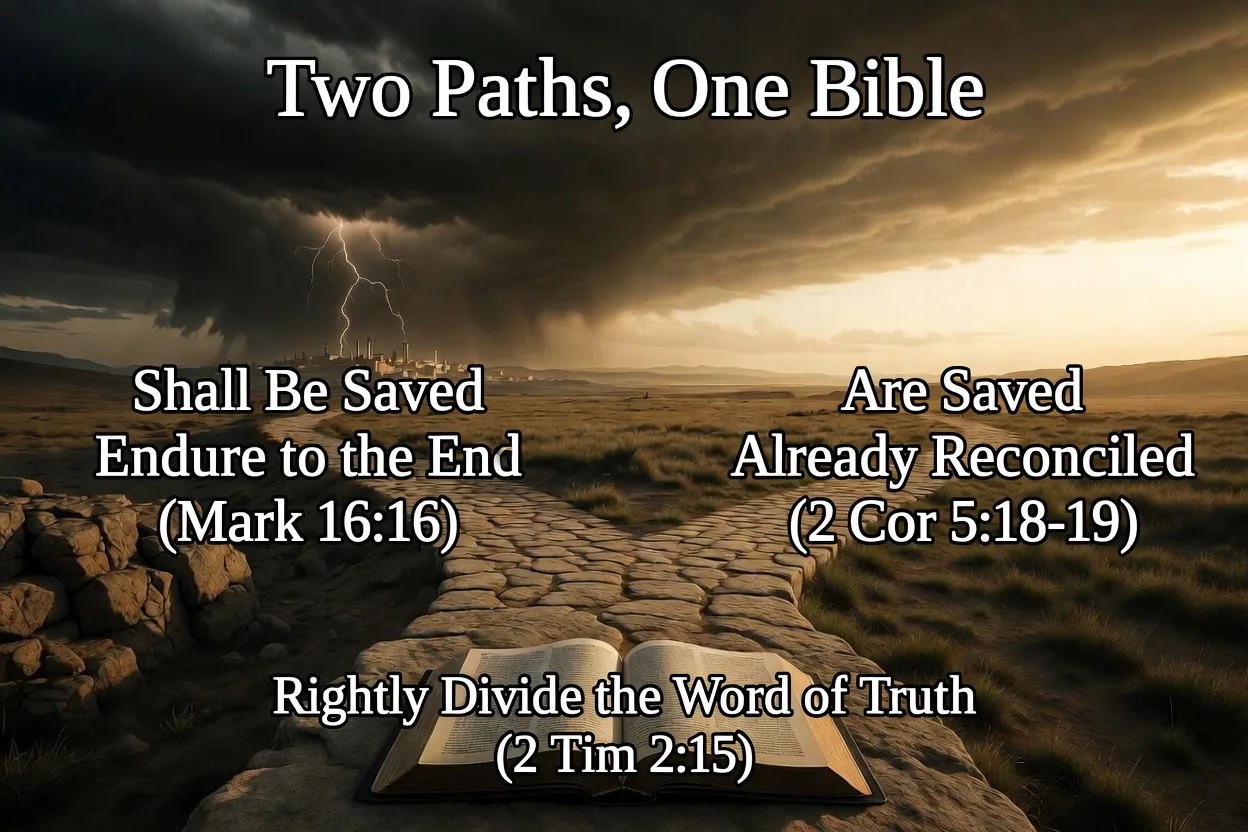

Comments
No comments yet. Be the first to share your thoughts.
Leave a comment