
A post recently circulated on Facebook arguing that Jack Hyles actually encouraged witnessing, and that the real problem with his ministry was not that he discouraged outreach, but that his outreach was the wrong kind — specifically, "soul winning" rather than witnessing. The author is right to criticize the soul-winning methodology. The problem is that he has reached for "witnessing" as the correction without asking whether the word means what he thinks it means.
When you rightly divide the word of truth, neither term holds up as the marching orders for the Body of Christ today.
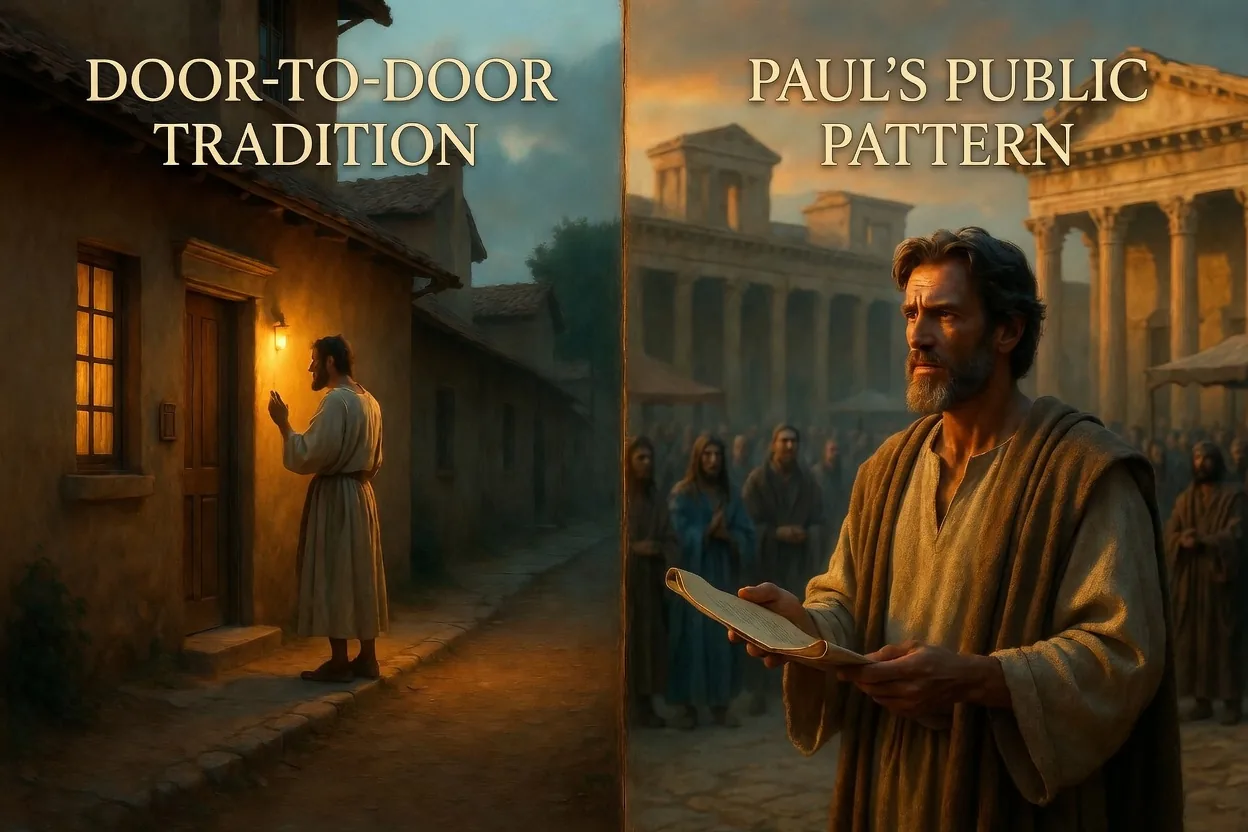
Soul Winning Is Not Paul's Language
Let us start where the criticism begins. The phrase "soul winning" comes from Proverbs 11:30: "he that winneth souls is wise." That is a proverb of Israel, written under the Law, addressed to a covenant people under a different program entirely. It is not a commission given to the Body of Christ. Nowhere in Paul's thirteen epistles will you find "soul winning" as the description of the believer's task. It is a borrowed term, and borrowing it from the wrong dispensation is where the methodology goes sideways.
Paul describes his own ministry with different language. "I am not ashamed of the gospel of Christ: for it is the power of God unto salvation to every one that believeth" (Romans 1:16). "We were allowed of God to be put in trust with the gospel" (1 Thessalonians 2:4). "I am appointed a preacher, and an apostle, and a teacher of the Gentiles" (2 Timothy 1:11). The task is to preach and declare the gospel — not to win souls, not to run numbers, not to manufacture professions.
The fruit problem that the Facebook author correctly identifies — fake professions, man-made methodology, pressure tactics, inflated church rolls — is not simply a bad method applied to a good commission. It is what you get when you take an Old Testament expression, build a program around it, and measure success by decisions rather than by the content of what was believed.
But Is "Witnessing" the Answer?
Here is where the conversation needs to go further than it did. The author wants to replace "soul winning" with "witnessing," reaching into the post-resurrection Scriptures to do it. But before adopting "witnessing" as Paul's language, the text deserves a fair look.
What Paul Actually Does With the Word "Witness"
Paul is not a stranger to the word. He uses it repeatedly — just not the way modern Christians do when they say "let's go witnessing."
In Romans 1:9, Paul writes: "God is my witness, whom I serve with my spirit in the gospel of his Son." That is not an evangelistic method. That is Paul calling God as his character witness — the same function the word carries in a courtroom. He does the same in 1 Thessalonians 2:5: "God is witness" — vouching for Paul's motives.
In Romans 2:15, the conscience of the Gentiles is said to bear "witness" to the law written in their hearts. In Romans 8:16, "the Spirit itself beareth witness with our spirit, that we are the children of God." In Romans 9:1, Paul says "my conscience also bearing me witness in the Holy Ghost" that he is telling the truth about his grief for Israel. These are all testimonial uses — one party attesting to the truth of something.
The legal sense carries into the epistles to Timothy. "Against an elder receive not an accusation, but before two or three witnesses" (1 Timothy 5:19). "Thou hast professed a good profession before many witnesses" (1 Timothy 6:12). "The things that thou hast heard of me among many witnesses" (2 Timothy 2:2). In every case the word describes people who are present, firsthand, to confirm something they personally observed.
The pattern is consistent: in Paul's writings, a witness is someone who can confirm something they saw or heard. It is never used as a term for sharing the gospel with others.
Now look at how the risen Christ applies the word to Paul himself. In Acts 26:16: "I have appeared unto thee for this purpose, to make thee a minister and a witness both of these things which thou hast seen, and of those things in the which I will appear unto thee." Paul is called a witness — but to what he himself saw. His was a personal encounter with the glorified Lord, and his witness role was grounded in that. It was not a commission handed to all believers.
The Acts 1:8 Problem
So when people say "let's go witnessing" and reach for Acts 1:8 as their commission, what they are actually grabbing is this: "Ye shall be witnesses unto me both in Jerusalem, and in all Judaea, and in Samaria, and unto the uttermost part of the earth." To whom was that spoken? The eleven apostles. When they chose a replacement for Judas, the qualification was explicit: the man must have "companied with us all the time that the Lord Jesus went in and out among us... beginning from the baptism of John, unto that same day that he was taken up from us... a witness with us of his resurrection" (Acts 1:21-22).
This is eyewitness testimony — the same pattern Paul's usage confirms. "We are witnesses of these things" (Acts 5:32). "We are witnesses of all things which he did both in the land of the Jews, and in Jerusalem; whom they slew and hanged on a tree" (Acts 10:39). The Twelve were witnesses in the literal sense — they were there. That commission belongs to them and to that program.
You and I were not there. We did not walk with Christ from the baptism of John. The problem is not the word "witness" itself — it is the Acts 1:8 commission being lifted from the people and program it was given to and applied wholesale to every believer in every age. That is not rightly dividing. That is trading one misapplication for another.
Paul's Commission — and Ours
Paul was not one of the Twelve. He did not walk with Christ during His earthly ministry. His encounter with the risen Lord on the road to Damascus was of a completely different character — "as of one born out of due time" (1 Corinthians 15:8). His commission came directly from the glorified Christ and contained something the Twelve had not been given: the mystery — truth "hid in God" (Ephesians 3:9), "kept secret since the world began" (Romans 16:25), not made known in other ages as it has now been revealed (Ephesians 3:5).
Paul describes his work not as soul winning or witnessing but as something else entirely: "Now then we are ambassadors for Christ, as though God did beseech you by us: we pray you in Christ's stead, be ye reconciled to God" (2 Corinthians 5:20). An ambassador represents the interests of another party. He does not pressure. He does not manipulate. He declares, plainly and faithfully, the message he has been given.
What is that message? Paul defines it with precision: "Moreover, brethren, I declare unto you the gospel which I preached unto you, which also ye have received, and wherein ye stand; by which also ye are saved... that Christ died for our sins according to the scriptures; and that he was buried, and that he rose again the third day according to the scriptures" (1 Corinthians 15:1-4). That is the content. Christ's death for sins, His burial, and His bodily resurrection. Believe it, and you are saved — not because you walked an aisle, not because you raised your hand, not because someone "won" you, but because "it is the power of God unto salvation to every one that believeth" (Romans 1:16).
What are we to do with that gospel? Paul tells Timothy plainly: "do the work of an evangelist" (2 Timothy 4:5). An evangelist — one who declares the good news. Not a soul winner running a program. Not a witness giving personal testimony about what he saw. A man or woman who takes the gospel of grace and sets it plainly before the people God brings across their path.
The Debate Nobody Is Having
The Facebook discussion about Hyles is really a debate between two traditions — Independent Fundamental Baptist soul winning culture on one side, and a more moderate evangelical "witnessing" approach on the other. Both sides are arguing about method, and both are reaching into the wrong parts of Scripture for their vocabulary.
The debate nobody is having is this: what dispensation are we in, and what did Paul actually say?
Paul did not build programs. He preached the gospel. He declared the mystery of Christ (Colossians 4:3). He reasoned from the Scriptures (Acts 17:2-3). His letters define the content, the manner, and the motive for spreading the gospel of grace: "speaking the truth in love" (Ephesians 4:15), "in meekness instructing those that oppose themselves" (2 Timothy 2:25), "with all longsuffering and doctrine" (2 Timothy 4:2).
Neither soul winning nor witnessing captures that. Preaching the gospel of the grace of God — that is Paul's language (Acts 20:24). That is our commission.
© 2026 Edward R. Cross








Comments
No comments yet. Be the first to share your thoughts.
Leave a comment